April in London – Part 1


One of the best parts about having your daughter do a semester abroad is that you have an excuse to cross the pond. Put that child in RADA’s Shakespeare program, then realize your visit coincides with Shakespeare’s birthday, and you begin to feel that the Bard himself has conspired to make that visit one of the most memorable, if not short, vacations you’ve ever taken.

It was just my mother-in-law Irene and I on this trip, and while we had a marvelous time together, we missed Mr TBTAM and my other daughter, who would have loved every minute of this vacation.

Where we stayed

The Academy, 21 Gower Street in Bloomsbury

If you want to hang with the locals, but still be close enough to walk to Covent Garden, Trafalgar Square and the British Museum, with easy access to buses or the tube to take you anywhere else you want to go, then Bloomsbury is where you want to stay. It’s the home of the University of London, the London School of Hygiene and Tropical Medicine and The Royal Academy of Dramatic Arts, so the streets are teeming with students and academic types. Needless to say, I felt right at home.

Our hotel was absolutely wonderful – a linked series of five townhouses, with small but lovely rooms, a conservatory and garden for relaxing or taking your morning coffee, and a restaurant.

Not to mention free wireless internet, great towels and fresh bottled water left at your door each evening by the small, personable staff.

However, in typical British fashion, the place had its quirks, with smallish rooms, a tiny-tiny bathroom, a shower that never really got hot-hot, and perpetually cold hallways due to ill-fitted front doors in the townhouses that let the air in all day and night. (I really think the Brits just don’t feel the cold the way we Yanks do…) None of which took away from the charm of the place, and I’d stay there again in a heartbeat.

The Weather

It rained every single day, but only intermittently, rarely heavily and apparently not enough to halt drought warnings.  The rapid changes in weather, while unpredictable, brought some amazing skies and light –

Spitalfields streets before the rain fell

St Paul’s Cathedral and Millenium Bridge between the rains

Store Street after the rain

And in Stratford-Upon-Avon

we even saw a rainbow.

The Little Things that Make London Different

As always, when traveling I love the little things that remind me I’m not in Kansas anymore . Like the bathroom stalls

the rented opera glasses,

the different words they use

and of course, the people.

The Big Thing That Makes London Different

You really know you’re not in America when it comes to transportation. Taxis are quite expensive and cars pay a fee to enter the center of London. As a result, public transportation is central to the busy life of this international city and puts every American city, including New York, to shame. I’ve never seen more buses in my life, one very few seconds it seemed on the busier routes.

And the train stations! Gloriously bright and beautiful  – Liverpool Street,

Marylebone

and Charing Cross Road.

And although London is not yet Amsterdam, it’s getting there. We saw hundreds of bikes parked overnight at the train station,

ready for retrieval by commuters in the morning rush.

And of course, there’s Barclays’ Bicycle Hire  – launched in 2010 and still expanding. (Pic from Wikipedia)

The Best Thing About London

But the best thing about London? It’s where I got to spend time with two of my favorite people in the world – Emily and Irene.

A fine pair of traveling companions indeed.

Up Next – Part 2: Where We Ate in London

Faure’ Cantique de Jean Racine


I’m performing this with my chorus in a few weeks (along with the Faure’ Requiem). I’ve been so enjoying this wonderful recording by the Orchestre de Paris that I just had to share it with you. It is one of the most beautiful pieces of music I’ve ever heard. I hope we do it justice.

Now For the Good News – Depo-Provera Prevents Ovarian Cancer

We’ve known for years that birth control pills protect against ovarian cancer, with an up to 80% reduction in risk with long term use.  Now it appears that use of Depo-Provera may convey a similar benefit.

In a large multicenter case control study in Thailand, published ahead of print in the upcoming issue of the British Journal of Ob-Gyn, use of Depo Provera led to a 39% reduction in ovarian cancer risk. Long term use for three years or more reduced the risk of ovarian cancer by a whopping 83%.  Oh, and by the way, in case you didn’t know it, Depo-Provera also protects against uterine cancer, doing it so well that it is actually used as treatment for uterine cancer.

That’s important information for women using Depo Provera to know, particularly in light of recent media attention to the potential for breast cancer in long term Depo Provera users under age 35.

To put it all into perspective, the risk for breast cancer in women under age 35 is about a 0.2% (1 in 500). The lifetime risk for ovarian cancer is about 1.5% (1 in 66). The lifetime risk of endometrial cancer is about 2.5% (1 in 40). Unlike the possible breast cancer risks, which disappear when Depo-Provera is stopped, the protections against ovarian and endometrial cancer appear to be lifelong.

All of these cancer risks are low in comparison to the risk of unplanned pregnancy, which comprise close to half of the pregnancies conceived each year in the United States. For most women, concerns about raising or lowering cancer risk is not the driving force behind choice of contraceptive.  But on balance, the cancer risk/benefit ratio of Depo-Provera appears to be quite favorable and on par with that of combined oral contraceptives.

For women who need effective birth control, that’s good news.

Depo-Provera Use Does Not Raise Overall Breast Cancer Risk in Young Women

That’s the headline the media should have used when publicizing the results of a recent study comparing Depo-Provera use among women ages 20-44 with or without breast cancer. Because that’s exactly what the study’s authors found.

There was no difference in exposure to Depo-Provera among women with breast cancer compared to controls – about 11% of women in each group had ever used Depo-Provera.

Small Sub-group analysis raised a question

However, the researchers also did what is called sub-group analysis – looking at smaller and smaller groups within the breast cancer study population to see if they could find any women who might have a higher risk from Depo-Provera use, even if the overall group did not.

Before I get to those results, I need to point out that cases and controls, and Depo-Provera users and non-users had significant differences in body mass index, ethnicity, family history, age and pregnancy history – all factors related to breast cancer risk.  In addition, controls had had less mammograms than their counterparts who had breast cancer. There is also a large issue of recall bias at play in studies such as this, since we know that subjects with the disease or condition being studied tend to remember drug exposures better than controls do.

Despite these marked differences between the groups, no statistically significant difference was found between Depo-Provera use in breast cancer patients compared to controls.

BUT, when subgroup analysis was done, there was one group that showed a difference – women who had used Depo-Provera for a year or more within the past 5 years. Here’s the finding that led to the headlines –

However, recent users of DMPA (Depo-Provera) for 12 months or longer had a 2.2-fold increased risk of breast cancer (95% CI: 1.2-4.2).

That was all the media needed to hear, and they were off and running, with headlines such as “Depo-Provera shots tied to breast cancer ” and “Depo-Provera shots double breast cancer risk.” Such headlines fail to convey the overall results of the study in a way that is meaningful to anyone but the lawyers.

The Sub-Group analysis that raised concerns was conducted in less than 100 women

What the media did not tell you was that in this “large study”, the actual number of women in the sub-group that showed this statistically significant and concerning result was extremely small – only 34 controls and 36 cases had used Depo-Provera in the past 5 years. Among these, only 15 and 32 respectively had used Depo-Provera for a year or more in that time!

So there you have it – headlines based on a subgroup analysis of less than 100 women who were poorly matched to start with.

These kinds of studies raise far more questions than they answer

Subgroup analysis is a research tool to look for potential topics for further investigation or to inform questionable findings in the overall analysis. For researchers, this type of analysis can be valuable in defining areas for future larger study. But publicizing the results of a small subgroup analysis as if it were the findings of the larger group mis-represents the strength and reliability of the findings. And in this case, that publicity does nothing more that to frighten women away from using hormonal birth control.

I for one am not changing my prescribing practices around Depo-Provera based on this study. Depo-Provera remains an important contraceptive option for many women, although potential side effects (irregular bleeding, weight gain) limit its acceptability as a first line method for the majority of them.  Overall, about 3% of women who use contraception in the United States currently use Depo-Provera.

The discussion around breast cancer and current hormonal contraception is not new

The magnitude of the risk cited, and it’s relationship to current use of Depo-Provera in younger women, is similar to that which has been reported in the past in studies of oral contraceptives and breast cancer risk.  Specifically with Depo-Provera, the risk that appears in current users in some studies actually disappears with longer term use, suggesting that the mechanism may be acceleration of growth of pre-existing tumors, rather than induction of new cancers over time.

Overall, neither oral contraceptives nor Depo-Provera appear to increase lifetime risk of breast cancer. Both reduce the risk of endometrial cancers, and the pill reduces ovarian cancer risk.

Future research may elucidate better what the effect of medroxyprogesterone acetate, the drug in Depo-Provera and the one studied as hormone replacement in the Women’s Health Initiative, may be on breast cancer risk. For now, that risk has best been defined in post-menopausal women, and not in users of hormonal contraception.

_________________________________________________

Further reading on Breast Cancer Risks and Depo-Provera

  • Depot medroxyprogesterone acetate and breast cancer. A review of current knowledge. Drug Safety Review, 1996
  • WHO Study showed similar results in subgroup analysis for current use in women under age 35.
  • WHO Memorandum on Depo-Provera and Cancer risks.
  • New Zealand study showing risk with longer term use in younger women, with same limitation of small numbers
  • Pooled Analysis of WHO and New Zealand Studies . JAMA 1995

Conflict statement – In the late 90’s, I published two studies of Depo-Provera acceptance and continuation, one of which was partially funded by small investigator-initiated grant from Upjohn that paid part of my research assistant’s salary, along with an NIH training grant.  I have no current conflicts to report.

Making Charoset

Although I was not born Jewish, I did marry into a Jewish family. Now, over 20 years later, the culinary traditions of that religion feel as much like my own as those I share with my own family. One of my favorite of the Jewish traditions is making Charoset for Passover dinner, a task to which I have been assigned for some years now.

Charoset is a pasty mixture of fruit, nuts and wine that symbolizes both the mortar used by the Israelites to build the pyramids of the Egyptians and the sweetness of the freedom they would one day live to see. Charoset is eaten during the Passover ceremony, and later, spread between two motsah halves with a bit of horseradish, it makes Hillel’s sandwich. The Charoset we serve is a traditional Eastern European recipe. Sephardic versions may use dates or figs, mixed nuts and even fruit juice.

The Charoset recipe I use never varies, but every batch is unique. That’s because I’ve never actually written the recipe for Charoset down. It’s impossible really since the flavors evolve as you make it, and vary depending on the size and variety of apple you use in a given year. Thus, every year’s Charoset making is a bit of an adventure to see if I can get it as close to perfect as I can, or at least as good as it was last year.

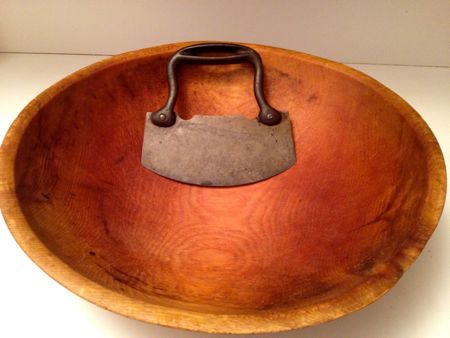
I begin each year by assembling the tools of the task – an old wooden bowl (did Irene give it to me? Did I get it at a house sale? I don’t remember) and the old rocker-bottom metal cleaver I bought at an antique market. Although the bowl is very occasionally used for salad during the year, the chopper is never used for anything else but this one task, and never unless it is used with this bowl.

I then gather the ingredients – Apples (Fuji or gala with a granny smith or two), pecans (How many? I have no idea – at least a cup but not more than two cups), a bottle of Manichevitz wine (I used about 3/4 of the bottle) and some ground cinnamon (2 tbsp? 3 tbsp?…). maybe some brown sugar or honey if your apples aren’t sweet enough…

There is always one, and sometimes more than one phone call to my mother-in-law. How many apples? (5-6 seems about right ) Which wine again – elderberry or blackberry? (Blackberry) Do I peel the apples? (Yes)

I peel the apples, cut them into eights and toss them into the bowl, working quickly because I don’t want them to brown. Next, I toss the pecans on top, sprinkle some cinnamon and pour some wine over the lot. And then the fun really begins.

There is nothing, I tell you, more satisfying than the Fwick! Clunk! sound the cleaver makes as it slides through the apples and pecans and then bounces against the wooden bottom of the bowl, only to repeat itself again, again and again, interrupted only long enough to sweep across the bottom to gather up more apples into the center so the symphony of chopping can begin anew. Here – just listen to it and see what I mean –


How long to chop? Until the mixture is evenly chopped, almost but not quite mushy, but not chunky either. As the wine is absorbed, you keep adding more. You stop to taste, and add more cinnamon. Then more wine. Maybe some brown sugar or honey, but not too much, just a teaspoon or so. Then more chopping. Until it is perfect. Or as perfect as you can make it until tomorrow, when you bring it to your mother-in-law’s kitchen for the final taste test. There, you won’t mind at all if she tells you that you added too little cinnamon. Or didn’t chop long enough. Or need a little more wine.  She will help you adjust it and she will always be right.

Each time you make Charoset, you remind yourself to stop and write down exactly what you are doing so that you get the quantities right once and for all. But then the Fwick! Clunck! begins, and you are lost in the sounds and a tradition that reminds you to savor this moment, and this task, and to just let what you are making be whatever it will be. And in that moment, you know that, perfect or not, it will be wonderful.
_______________________________________________________________
If you want a recipe for Charoset, here a few –

The War on Women Has Gone Too Far

First they want to take away insurance coverage of birth control. Then they call us sluts and try to force us to have vaginal sonograms.

Now they’re trying to convince us we’re even fatter than we already think we are.

US Women could be more obese than believed

MONDAY, April 2 (HealthDay News) — The way that obesity is currently measured greatly underestimates the actual number of women who are obese, a new study suggests.

Almost half of women currently labeled as not obese by virtue of their body mass index (BMI) turned out to be obese when measured by a newer method focusing on their percentage of body fat by weight, the research found.

A cheap and obvious attempt at psychological warfare.

What the reporter failed to mention that almost a quarter of men were also found to be fatter than their BMI suggested.

So there.

Birthwort and the Balkan Nephropathy – A Fascinating Medical & Environmental Detective Story

It’s one of the most fascinating pieces of medical detective work I’ve ever heard.   Using plain old-fashioned legwork combined with high tech laboratory investigation, a touch of international intrigue and even a bit of CIA intelligence data, Arthur Grollman and his collaborators across the globe have teased out the connection between Aristolochic acid –  found in Birthwort, a naturally growing herb – and the Balkan Nephropathy, a fatal kidney disease whose cause has eluded scientists for decades.

It’s a tale of caution for anyone who thinks herbal means safe, a tale of inspiration for scientists and epidemiologists of all ages, and a tale of intrigue for anyone who loves a good detective story. Do come hear it.

Lavendar Honey Vinaigrette

It’s the best dressing I’ve ever made, inspired by the signature salad at March de Sud – goat cheese fritter, figs, apple, candied walnut and romaine tossed with a lavender honey vinaigrette. Lucky for me, the restaurant also houses a small French Market, where I was able to buy this amazing honey, harvested from bees fed exclusively on lavender.  (This is not the same as lavender honey made by heating honey with lavender blossoms and then straining it).

Unlike other honey, lavender honey it is not sticky or runny, but rich and creamy – even spreadable. And yes, it really has a lavender taste.

The chef at Marche de Sud was not on the premises when I stopped in to buy the honey, so I was on my own in figuring out how to make a vinaigrette using this delicious honey. I’ve made my dressing several times now, and each time was asked for the recipe. So I figure it’s worth sharing here.

Lavender Honey Vinaigrette

I like to make my dressings right in a jar, making it easy to store and shake before using. If I were to make this using vinegar instead of lemon, I’d use Champagne vinegar. The amount of oil may vary depending on how much juice your lemon gives. Start with 1/3 cup oil and add more if the dressing is too tart for your taste. (I happen to like it tart.)

  • 2 tbsp lavender honey
  • Juice of 1 lemon
  • 1/3 -1/2 cup extra virgin olive oil
  • 1/4 tsp sea salt
  • 1/4 -1/2 tsp freshly ground black pepper
  • 1 large garlic clove, finely minced
  • 1/2 tsp coarse Dijon mustard

Combine all ingredients in a jar. Cap, tighten the lid and shake well. Serve at room temperature.

Central Park, Early Spring

It was one of those “It doesn’t get any better than this” afternoons. Fresh from a massage at Equinox (courtesy of a gift certificate from my daughters from last Mother’s Day – that’s how long it took me to find a free hour…), I strolled across Central Park to my voice lesson on the Upper West Side. The weather was balmy and even the slightly overcast sky could not dampen my mood. For although it is only mid-March, the forsythia were in full bloom,

as were the daffodils

and even the cherry trees.

The  American elms in Mall were starting to bud

while bubbles were being blown at the Band Shell

and Baldo, as always, was keeping watch over it all.

I snapped a group  shot for some tourists, listened to a pedicab rider speaking Swahili on his cell phone as he rode along looking for a passenger, and stopped to enjoy some casual New Orleans style jazz.

Early though it may be, it’s Spring in New York City.

Bring it on.

Doc-Bloggers Speak Out Against Laws that Threaten Women’s Rights & Ethical Medical Practice

In my last post, I spoke out against new laws that, in their zeal to limit the practice of abortion, actually threaten the practice of medicine, as well as the rights of physicians to free speech. Not to mention the fact that the laws mandate both the physical and emotional abuse of women who choose to have a completely legal medical procedure.

In this post, I want to highlight my fellow medical bloggers who have also spoken out on this issue.  If I’ve missed your post, email me and I will add it here. If you haven’t written your post yet, consider this a challenge to do so. Let’s make our voices heard.

  • Jen Guntner calls the new laws  legalized malpractice and wonders how the Supreme Court could refuse to hear the case  challenging Pennsylvania’s  law that protects doctors who deliberately hide genetic test results from their patients.
  • Eijean Wu, MD reminds us of the women who are affected by these laws.
  • Elaine Schattner, MD tells us that women’s rights are being threatened on three fronts – birth control, access to safe abortion and to care without intimidation or emotional abuse. She also wonders why more doctors are not speaking out.
  • Skeptical OB sees the backlash against birth control as un-American.
  • PalMD tells us we cannot afford to remain apart on this issue.
  • Labor and Deliverance does not really want to get political, but tells us that we should not sacrifice women or mothers for the sake of controlling their options.
  • Judy Stone, MD has a wonderful article in Scientific American about the use of so-called “Conscience” clauses that are anything but.
  • OB Cookie, an O-Gyn resident who also loves baking ( a girl after my own heart) writes eloquently on the collateral damage to women she cares for in Texas as Rick Perry’s wages war with Planned Parenthood.
  • One of the best posts (and apparently, one with an enormous amount of traffic) is unfortunately anonymous. It’s a recipe for organized civil disobedience, all in the doctor’s office and all in accordance with our duty to protect patient autonomy. Sharon Phillips, MD discusses the relative wisdom of such an approach.

Doctors Must Speak Out Against Anti-Abortion Legislation that Threatens the Legal & Ethical Practice of Medicine

Kudos to Alabama pediatrician Pippa Abston for publicly speaking out for all doctors and their patients against legislation that violates women and forces doctors to choose between violating professional ethics or breaking the law. (HT to Rh Reality Check for their fabulous reporting on this issue)

In addition to posting the above video on You Tube (Let’s make it viral, folks…) Dr Abston has co-authored legislation that will protect doctors from being used as pawns by the anti-abortion movement. The bill is called the  “Right to Professsional Medical Judgement Act” and is short and sweet, written unemotionally and unambiguously –

No physician or health care provider licensed to practice in the State of Alabama shall be forced by state or local regulatory authority to perform any medical service or component of medical service if the service or component of service is not medically necessary or would be harmful to the patient and the patient does not desire the medical service. The right to practice within the scope of a medical license supersedes any existing or future legislative act.

Where are our Medical Societies?

I wish the AMA and ACOG would speak out more publicly on this issue. I hope they are lobbying, but working the back room is very different from speaking out publicly for the rights of both women and their physicians who are providing a legal medical procedure.  The Daily Kos has a petition circulating to the AMA asking them to speak out publicly.  I encourage you to sign it.

When the Pennsylvania Medical Society spoke out against the ultrasound law in that state, the legislators promptly backed down.

The Pennsylvania House postponed a scheduled March 12 vote on the bill. House Majority leader Mike Turzai, a Republican, said the debate was cancelled due to “concerns raised by the medical community, among others,” Philly.com reported. The Pennsylvania Medical Society, which has no official position on abortion, opposes the bill because it would potentially interfere with the physician-patient relationship.

We all must speak out together against these bills that attempt to legislate medical care. As I’ve said before –

This is not just about abortion. Or women’s rights. 

It’s about the practice of medicine and the rights of our patients. It’s about physician-patient privacy and the authority of doctors to practice medicine without the fear of breaking the law.

It is also about free speech.

The way these laws are written, physicians who perform abortion are being forced to read scientifically false information to patients.  They are being forced to tell women that an abortion will increase their risk of breast cancer – which is simply not true.

“I’m so sorry that I have to do this,” the doctor told us, “but if I don’t, I can lose my license.” …When the description was finally over, the doctor held up a script and said he was legally obliged to read me information provided by the state. It was about the health dangers of having an abortion, the risks of infection or hemorrhage, the potential for infertility and my increased chance of getting breast cancer.

All physicians and patients, whether they are male or female, pro-choice or pro-life, Republican or Democrat, should be outraged. Our medical societies and our patient advocacy groups  – every single one of them, whether related to reproductive care or not – should be fighting these laws, and engaging physicians and patients everywhere to fight back. Publicly and vocally. Or, as blogger Palmd implores us –

When it comes to the latest abortion bills we cannot afford to remain apart.  We must all speak out against this violation of our ethics and our patients’ rights.

What Can You Do?

  • Contact your state medical society and ask them what they are doing to protect the practice of medicine and the rights of women in your state
  • Write, phone and E-mail your state and national representatives to let them know you oppose any proposed legislation that threatens women and their doctors.
  • Petition the AMA to speak out publicly on this issue.
  • Speak out! Pick a medium, any medium –  be it you blog, e-mail, Facebook, Twitter, You Tube, Pinterest, Tumblr, or the latest and greatest social media network I haven’t heard about yet. Make your voice be heard.

Tomorrow, I’ll be highlighting physician bloggers who are speaking out. Stay tuned -and if you know of a blog post I need to highlight, email me.  I’ve got a list of about 10 so far.

Thank you, Rush Limbaugh

I mean it.

What Rush and his women-hating, slut-calling, reproductive rights bashing cronies have done is the best thing that could have happened for women in this election year.

I know you think things are horrible, what with us now having to fight the battle for reproductive rights all over again, and on 50 different fronts.

But don’t you see? That battle has been going on for years – you just weren’t really aware.

Rush and his pals who oppose reproductive rights were all here last year, when you thought your reproductive rights were safe. They were here in 2010, when Arizona became the first state to limit insurance coverage of abortions. They were here when the Hyde Amendment was cemented into law and when George Bush, Jr reinstated (and Obama reversed) the Global Gag Rule limiting family planning funding across the globe. They were here when 20 our 50 states passed laws regulating ultrasound use prior to abortion, while others mandate counseling (often including erroneous health information) prior to abortion or limit insurance coverage of this legal medical procedure.

During all this time, if you did know they were there, you thought they were just against abortion – you did not realize that they were also against birth control. You thought their agenda was pro-life, not anti-woman. You thought you and they shared common ground, but now you know that ground is filled with landmines targeting women’s rights and your ability to plan your own family.

Thanks to Rush, we’ve finally started the conversation about reproductive rights in America that we should have been having for the past decade.

Like a family with a secret that is finally coming out, that conversation is exceedingly uncomfortable. Fine – let’s have at it. But don’t talk amongst yourselves – make sure your local, state and federal representatives know what you think.

Because what Rush and his buddies don’t realize is that what they’ve actually done is wake up a sleeping giant. That giant is the 98% of Catholic women who have used birth control, the one in five American women who has used Planned Parenthood’s services at some point in their lives and the 40% of women who has had an abortion. That giant is the majority of Americans who support the provision of contraception as part of preventive healthcare – every woman and man who recognizes the value of a society where every child is wanted, loved and born to parents with the resources to care for them. And that understands that spending on contraception makes sense financially for us as a nation, because cutting back on contraceptive prescription coverage ultimately results in women and their partners using less effective over the counter contraceptives, resulting in higher rates of unplanned pregnancy and abortion.

So thank you, Rush, for waking us up.

Now if you’ll excuse us, we’ve got a lot or work to do.

__________________________________________________________

In 2011, states passed 92 restrictions on abortion, and many are also targeting family planning services. Where does your state stand? Do you know who represents you and how they stand? How about the Presidential candidates?  

Penne w/ Caramelized Cabbage, Anchovies & Bread Cumbs

When your husband gets doored by a cab while riding his bike home from work, and breaks his elbow, requiring a two hour operation complete with plates and screws and an arm swollen to twice its size, the best thing that can happen as a result is that your mother-in-law, the greatest home cook in the world, will come up to visit. Although her company would have been gift enough, she will spend the entire time cooking, and counting the pan of eggplant pastistio she brought with her, leave practically a week’s worth of dinners in your fridge.

The best part of the visit will be getting to cook in the kitchen with her on Saturday, where we made this delicious pasta adapted from a recipe in this week’s NY Times.

Mr TBTAM, we’ll get through this. Thanks in no small part to your wonderful Mom.

Pasta with Caramelized Cabbage, Anchovies & Bread Crumbs

We modified the NY Times recipe to suit both the size of the cabbage Irene had bought, as well as our own personal preferences for onion, more anchovies and bread crumbs. We loved it. It reheated well tonight for leftovers. Check out the original recipe if you want something with a little less cabbage. (I may try the original recipe myself one of these days soon…)

5 garlic cloves, peeled and put through a garlic press
3 tablespoons unsalted butter
1 (2 oz) can of anchovy fillets, drained
1 cup coarse bread crumbs (We used Panko)
2 tablespoon finely chopped fresh sage
1/2 teaspoon black pepper, plus more, to taste
Kosher salt, to taste
1 pound dry penne
1/3 cup extra virgin olive oil
1/4-1/2 teaspoon red chile flakes
1 medium head cabbage, shredded (About 10-12 cups)
1 large onion, peeled and sliced very thin
2/3 cup grated Parmesan (plus more for serving)
Chopped parsley for topping

1. Melt the butter in a small skillet over medium heat. Saute one clove of the pressed garlic till fragrant but not browned. Add the anchovies and cook, mashing with a fork, until they dissolve into the butter. Stir in the bread crumbs and sage and cook until crumbs are golden brown, about 2 minutes. Season well with black pepper. Set aside.

2. Heat the oil in a large skillet over medium-high heat. Add the remaining garlic and cook until golden brown. Add the chile and cook until fragrant. Stir in the onion and cabbage and cook, stirring occasionally, until it begins to caramelize, about 15 minutes. Meanwhile, cook the pasta according to package directions. Drain and toss with the cabbage/onion and bread crumb mixture. Quickly toss in the cheese and remove from heat. Scatter chopped parsley atop and serve.

Serves 8.

New Hampshire Abortion Legislation Mandates Health Misinformation and Threatens Doctors’ Safety

The latest salvo against abortion comes from the New Hampshire House of Representatives, who have passed a bill requiring, among other things, that women be told that there is “a direct link between abortion and breast cancer”. Using the worst of pseudo scientific logic, the writers of the bill start with an accepted fact – that pregnancy lowers breast cancer risk – and then proceed to weave a theory linking abortion to breast cancer that, to the lay reader, might sound quite scientific,  but in fact makes no sense given what we actually know about hormones and pregnancy.  There is no link between abortion and breast cancer – this has been shown in multiple well-done scientific studies.

An even more concerning aspect of the bill that has not received much press coverage is that doctors must certify that they gave women the educational materials and that the number of certifications a doctor has submitted is to be made available to the public. The fanatic and violent anti-abortion crowd would love to get their hands on a comprehensive list of every doctor out there performing abortions, and with this law, they would get it in New Hampshire.  This bill is a direct threat to the safety of doctors who provide abortions in new Hampshire, and is clearly designed to intimidate them.

The woman who introduced the bill also claimed that birth control pills cause prostate cancer via environmental contamination by hormones. There is no proof of such a claim.

This bill has passed the New Hampshire House, but not the  Senate. The good news is that New Hampshire’s governor is expected to veto the bill if the Senate passes it. But if I lived in New Hampshire, I wouldn’t count on my governor’s veto. I’d be calling and emailing and writing both my state senator and my governor, and telling everyone I know in New Hampshire to do the same.