Seven Things To Know About Hormones – My Take

The Wall Street Journal gives a nice response to Oprah’s recent HRT hype with an article entitled “Seven Things You Should Know about Hormones. This, of course, is not to be confused with George Carlin’s Seven Words You Can’t Say on TV, which is really funny but won’t help you decide whether or not to take estrogen…

Here’s my take on the seven things –

1. ‘Bio-identical’ hormones are available in FDA-approved forms
I agree. The stuff Suzanne Somers and Oprah are getting compounded is exactly the same chemical ( probably purchased from the same supplier) as Big Pharma uses to make their estradiol patches and creams and progesterone pills.

2. Hormones from compounding pharmacies aren’t safer than conventional HRT.
I completely agree. Any compounding pharmacist or doctor who sells HRT without warning patients about the risks should be put out of business. We don’t stand for this behavior from Big Pharma, and we shouldn’t accept it from these folks. They are couching their sales pitch around women’s wellness and selling women a purported fountain of youth, while trashing Wyeth for doing the same thing with Prempro. FDA – Get on it. And if you don’t have the authority, Congress needs to give it to you. Women’s Rights Groups should be all over this one, but they are unfortunately being duped by these shysters into thinking they are all on the same side.

3. Don’t trust saliva tests.
Ditto. Most of the folks doing saliva testing make money on the testing. Be wary of any doc who has a financial interest in what test he/she orders. Or what vitamins you take.

4. There’s a critical window of time for starting HRT.
Not so fast. It’s a hopeful hypothesis, but it’s just not proven yet. A lot of the docs pushing the hypothesis are also consultants and speakers for pharmaceutical companies who sell HRT. In my heart of hearts I think and hope that they are right, but I’m not willing to tell a patient to count on it. We need studies to prove it.

5. The increased risk of breast cancer appears related to progesterone rather than estrogen.
The key words here are “appears to be”. It’s not written in stone yet, so don’t count on it. And don’t go taking estrogen without progesterone if you still have your uterus – that’s a recipe for uterine cancer. I’m not about to trade one risk for another with my patients.

6. Estrogen applied to the skin, in patch, cream or gel form, may have a lower risk of blood clots and strokes than in pill form.
Agree. This is the one piece of new data that makes the most sense to me and that I am willing to put out there. I prescribe transdermal estrogen preferentially over oral whenever I can. We know clot risk is related to dose and there are well-done studies showing the lesser impact of transdermals on serum clotting factors. There’s no reason to think this won’t translate this to lower incidence of blood clots. Stroke incidence is a little more tricky, since strokes are multifactoral, but if clotting times are closer to normal, that’s one less factor to worry about.

7. Stay tuned.
This, of course, is the hardest part about HRT. It’s not like your menopause is going to wait for the next big randomized, placebo controlled trial. You have to make a decision with imperfect information and uncertainty. And that’s difficult for some women to understand and accept.

Easier to do what Oprah and Suzanne have done and latch onto the compounding pharmacy crowd, who sell certainty and security along with their drugs. But it’s a false security and very dangerous. I find it so sad that these two intelligent women are letting themselves be taken in this way. And even sadder that they are bringing other women along with them into their fantasy of hormonal certainty.

If you’re interested
Here are TBTAM’s Ten Rules for Prescribing HRT.

Now if you’ll excuse me, I have to get back to You Tube

Happy Groundhog Day

Not the Day. The movie.

Groundhog Day, released in 1993 and starring Bill Murray and Andie Macdowell, is one of the best movies of all time. It appears to be a comedy, but it’s much, much more than that. It’s really a mythical tale of transcendance, a lesson in how to live a life making every day count. Even if that day looks supiciously like the day before. And the day before that. And the day before that…

What do you do to given meaning to your days? That string of little events that repeat themselves day after day? What keeps you going when you’ve gotten there and nothing looks new to you anymore? (If you’re reading this BS, you know what I’m talking about.) How do you live a day and “get it right”?

Watch this movie and learn.

I require myself to watch it at least once a year, and should make myself do it even more often.

Think I’ll watch it tonight.

A Visit to Salzburg – Part 2. A Revisit Tour

This was my third trip to Salzburg, a wonderful place to visit any time of year, though early January would not have been my first choice.  I had some work and sleep to catch up on, and they kept us busy with concerts and dinners, so this won’t be the grand tour. We won’t be taking the Sound of Music Bus Tour, visiting the museums or Fortress, or taking any day trips to visit the salt mines or Hitler’s Eagles Nest, as I did on prior trips.We’re just going to take a few hours to visit my fave spots in this wonderful little city.

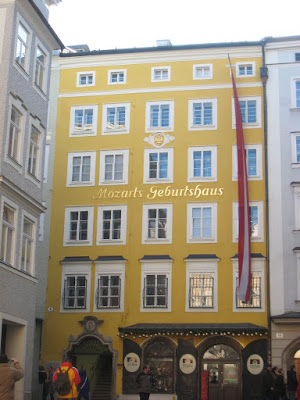
Mozartplatz and Mozart Geburtshaus

Mozart was born in Salzburg, and was court musician to the Archbishop here in his early career. The city celebrates him with festivals twice a year, one in late January and a bigger one in the summer. A visit to his birth house is a must.

If you miss the festivals, catch his music at the Mozart Dinner theater- it sounds hoaky, but it really is a nice experience – they serve a menu from Mozart’s era and serenade you with his music. ( Definitely beats the Sound of Music Dinner Theater, which is to be avoided at all costs.)

Chess at Kapitel Platz


Where Maria and the Von Trapp family hid from the Nazis in The Sound of Music.

Michaelskirche


The oldest church in Salzburg. I was treated to an organ solo last time I visited. It was quiet this time, and I was sorry to miss yet again the wonderful concert series held here.

Salzburg Markets

The weekday Green Market is located near Collegiate Church. It was small in this weather, but there were still beautiful breads and meats.  Even better is the Thursday Schrannen Market at Mirabellplatz, and the Christmas markets in December. Maybe next time.

Shopping in Salzburg

Shopping in Salzburg is a cultural experience, as you wander through the old streets and narrow alleyways. There are literally hundreds of shops, and prices are not always so cheap. I mostly window shoppe, but always stop at Furst Condiserie for chocolate and visit the tiny Kaslochl Kaserei near the river just down from the Mozart Geburtzhaus.

I recall my first visit to this tiny family-owned cheese shop 9 years ago. The owner’s two -year old daughter was sitting beside her on the counter. Of course, she’s a big girl now and was in school the morning of my visit, but I had a nice talk with Mom about the cheese business, and bought some local goat cheese for lunch.

My favorite place to shop in Salzburg is Interio. It’s sort of like a slightly upscale IKEA. I got some gorgeous placemats.

Near Interio is Ma Lai a wonderful woman’s clothing shop that mixes new and used clothing.

The Supermarket

One of my favorite things to do in a foreign country is to go food shopping. It makes me feel like a local, and I love exploring the local foods. Here in Austria, it’s the meats that are unusual – many varieties of smokes bacon and pork, with Speck being the local favorite. (My colleague Amos tells me that Speck is amazing, so I buy some to bring home – I’ll tell you how it is once I use it.)

I pick up some teeny sausages for my lunch and head down the aisles. I note that every kind of sugar imaginable is available, including beet sugar.

Entire aisles of chocolate, and I notice mostly locals buying it.

I pick up some tiny noodles for soup and mayonnaise. Why the mayo? It was in a tube!

Biking in Salzburg

On my last trip, I enjoyed biking the path along the river, which runs for miles from Salzburg into neighboring towns. Although I decided to forgo the pedals this trip, winter’s cold and snow doesn’t stop the natives.

My Lunch

Having spent a good 5 hours wandering the city, I headed back to my rooms at the Schloss to enjoy a late afternoon lunch with the provisions I had purchased. I fell in love with the tiny sausages – so delicious!

TBTAM PSA : Is Double Click Slowing you Down?

My internet has been increasingly slow lately. As I was waiting for pages to load, I kept seeing “Waiting for http://www.doubleclick.net.”.

Double Click belongs to Google. It’s major product is the DART cookie – a device that lets advertisers track how many users saw their ad, how many clicked through, and which ads users went to. The cookie stays with your browser and gets updated every time you visit a webpage that uses the cookies (like Google).

Can Ad-Double Click be disabled?

The answer is yes!

Simply go to the Adclick website and download a privacy cookie. That’s it!

Really? It’s that easy?

Yep. But there are a few things to know to keep things in place once you’ve opted out of double click –

1. Opting out is a cookie, not a program. So if you remove or diable cookies, doubleclick will come right back as soon as you visit Google and you’ll need to go and opt out again.

2. If you have both IE and Firefox, you’ll need to upload the privacy opt-out cookie to both browsers.

3. It’s not as if you won’t keep getting ads. They’ll just be generic and not targeted to you. (Sorry.)

4. Doubleclick will still be able to track you by your IP address (just like I know the IP addresses of everyone who visits this blog), unless you use an IP blocker or route your visits through another site like AOL.

So, does it really work?

I am ZOOMING!!! (Mouse, don’t fail me now…)

Stem Cell Research – A Beautiful Thing

Mouse Embryonic Stem Cell
Photo credit: Bruce Conklin at the J. David Gladstone Institutes

The California Institute for Regenerative Medicine, that state’s funding agency for stem cell research, held a stem cell photo contest in 2008 among its funded scientists.

From hundreds of entries depicting stem cell research, these 12 were chosen as the most beautiful. The diverse images represent the wide range of stem cell research taking place in California.

To learn more about stem cell research, check out CIRMTV on YouTube.

Thanks to Don Gibbons at CIRM for sharing these beautiful images.

Oprah’s Talking Hormones

I should have expected it. Today, while counseling a patient about hormone replacement, I heard those three little words that I predict will haunt me from this day forward – “But Oprah says..”

Yes folks, Oprah’s in menopause.

“You feel flat and you feel tired, you haven’t had a good night’s sleep in two years [and you’re] just going through the motions, trying to get through the day,” Oprah says. “You feel like your life force is being sucked out of you.”

Now Oprah’s taking hormone replacement, which of course means that America’s women are heading back on the HRT roller-coaster, wondering if they should be forgetting everything they heard in 2002 and doing the same thing as Oprah.To get the conversation going, Oprah’s doing a two-part series on her TV show and running special issue on the topic in her magazine next month. (Thanks, Linda, for the heads up.) I figured I’d better head over to Oprah’s web site and see what ‘s going on.

So what exactly is Oprah saying?

To her credit, Oprah seems to be trying to frame the HRT issue as a debate – “Should you replace your hormones?” she asks. A reasonable question, I’d say.

Her magazine features a well-written article that frames the issues nicely and is medically up to date and fairly well-balanced. Everything you need to know is in there, albeit with a little too much paragraph space given to the theories that support HRT use and not enough to the facts that recommend against it. Still, it’s a good start.

But Oprah’s blowing it with her show.

She gets points for working with Christiane Northrup, the author of the book The Wisdom of Menopause, and the leading medical guru to the public on HRT. While Northrup’s book is a bit too long and a bit woo-woo for most of my patients, it is medically correct, and I really liked her Public TV Special last year.

Oprah also featured a short segment with Dr Wolf Utian from the North American Menopause Society, who faced off against Suzanne Somers on Larry King last year. Utian warned about the risks of HRT – and both he and Northrup recommended that women work in close partnership with their doctor in managing their menopause.
Unfortunately, Northrup’s measured wisdom and Utian’s warnings were no match in grabbing the audience’s attention compared to the anectodal testimonies of Robin McGraw and others about bioidentical hormones.It’s the “HRT changed my life and you should take it too” school of menopause management by girlfriend.
HRT is touted as the cure for everything from weight gain to depression, and as long as its bioidentical, there are no risks. These folks have free rein to spout whatever theories and beliefs they have, unchallenged by Oprah, Northrup or Oprah’s own medical guru, Dr Oz.

Dr Oz dropped the ball

To my disappointment, Dr Oz failed to question the unsubstantiated statements made by Dr Prudence Hall, a practitioner he interviews who prescribes ridiculously high doses of estrogen and progesterone to her patient without once mentioning their potential risks.

This is not informed choice – it’s pure salesmanship, and both the patient and Oz fall for it hook, line and sinker. Oz even puts Hall’s crazy regimen up on the screen as if it were gospel – 2 mg of estradiol and 150 mg of progesterone twice a day – 8 times the starting doses I use in my practice, and much more than most women need even at the start of treatment.

DR OZ – Who should take hormone replacement?
DR HALL – Anyone who has a low hormone should have that hormone replaced.

Huh????? I though we got away from this craziness with the WHI.

Oprah, I’m disappointed.

You had such good intentions, but you’re giving way to the hype, and taking your viewers along with you. Like poor Michelle, who you promise to take to Dr Hall for her “Oprah Hormone Makover”-

OPRAH:…It’s ultimately up to you to make the choice for what’s right for your body. We just want women to start to feel better and to be in charge of your own health. Because you don’t have to feel this bad. Look at Michelle. Michelle, there is hope for you.

MICHELLE: I’m going to get myself some of these hormones.

OPRAH: Yeah. Yeah.

MICHELLE: Sign me up!

This is not letting Michelle make her own decisions, Oprah. This is pulling her into your club. HRT is not a makover that you offer your viewers for free. It’s a medical treatment, with risks and benefits about which every woman deserves to be properly informed. Your show, unfortunately, is not informing. It’s hyping.

Things are no doubt going to get even worse when Oprah gives the stage over to Suzanne Sommers later this week for part 2 of her HRT series. (Northrup will be airing a Webcast Thursday evening that will be worth listening to, but I don’t think is going to be on the show again.).

Disclaimer

I take HRT, and I prescribe it to my patients who want to use it for treatment of menopausal symptoms. Every one of my patients who takes HRT is informed of the potential risks, and their decision to use it or not is made in light of their own risk factors, symptoms and concerns.

In the end, most of my menopausal patients don’t need HRT or don’t want the risks, and we either find them non-hormonal alternatives or they find other ways to handle their symptoms. It’s called informed choice.

I prescribe FDA-approved regimens, mostly bioidentical but not always, and sometimes custom-made formulations for women who can’t find the right regimen among the approved products. I recommend the lowest dose for the shortest time, and prefer transdermal estrogen over oral forms if possible.

I also offer alternatives to HRT, including SSRI’s and neurontin for hot flashes, low dose vaginal estrogen for dryness (along with over the counter non-hormonal remedies for the same), and encourage all my patients to eat well, exercise, avoid dietary and stress triggers for hot flashes and take care of themselves.

If you want to learn about HRT

Check out the readings listed at the bottom of this post. Or my series on HRT. Or talk to your doctor.

And remember, just because Oprah’s doing it, does not mean it’s right for you. Use her show to start the conversation, but take the responsibility to inform yourself and do what’s best for your menopause.
Not Oprah’s.
_______________________________________________
Menopause Reading list
-The Menopause Guidebook by North American Menopause Society – The Cliff Notes of menopause management. Everything you need to know without the hype.
Is It Hot in Here, or Is It Me? by Barbara Kantrowitz and Pat Wigert Kelly – The What to Expect while you’re in Menopause book. Q&A format, easy to read in short segments.
The Wisdom of Menopause by Christiane Northrup. The Torah of Menopause – Everything’s there, along with the book of Job. Read it and believe.
Our Bodies, Ourselves for the New Century. If you liked the original, you’ll love this version.
Medicine Net answers FAQ’s about bio-identical HRT and Oprah.
TBTAM on HRT – my four part series. Everything I needed to say.

The Maldistribution of Healthcare in America

Two posts from my Google Reader today illustrate the problem we have in distribution of healthcare here in America –

Paul Levy writes how partners Healthcare is building an ambulatory center within 8 miles of the much smaller Norwood Hospital, duplicating services almost exactly and presenting unnecessary competition for patient business.

…the new center is 75,000 square feet and will offer the following specialties: Primary Care, General Surgery, Plastic Surgery, Orthopaedic Surgery, Cardiology, Cardiac Diagnostics, Dermatology, Diagnostic Imaging, Women’s Health, Rheumatology, Rehabilitation Services including Cardiac Rehab, Physiatry and Pain Management.

I now understood why my colleagues at little Norwood Hospital were nervous. Their website says they offer the following services, among others: Surgery, Obstetrics, Cardiology, Dermatology, Radiology, Neurology, Orthopaedics, Gastroenterology, Cancer Care, and Pediatrics. Not a complete overlap, but quite a bit.

Edwin Leap, MD writes about the limitations of practicing emergency medicine in the rural south without the services and expertise he had when he worked in a big city hospital –

…we were seeing some 25,000 patients per year in a 10 bed ED, in a 120 bed hospital. We had one cardiologist, but no cath lab. We had no neurologist, pulmonologist, neurosurgeon, toxicologist, trauma team or pediatric subspecialties….We don’t have residents to help with the volume and we don’t have a trauma team. There is, now, a helicopter service taking our patients to the regional trauma referral center, but when they can’t come, it’s 40 minutes away by ground.

Looks like the Big City has more hospitals than they need. And rural America doesn’t have enough.

Ironically, we have similar maldistribution of retail services in America.

I have dozens of stores within a few miles of my home here in NYC, where Bloomies, Nordstrums, Target, Gap, Old Navy, Sears, Saks and Macy’s all compete for my busness. But I have to drive 40 minutes to the mall from my country house in the Endless Mountains of Pennsylvania, where my choices are limited to Walmart and Sears.

The difference, of course, is that retail emergencies are rare, and never life-threatening. Wish I could say the same for healthcare emergencies.

Kudos to Dr Leap for all he does, and good luck there at Norwood Hospital.

A Visit to Salzburg – Part 1

I know, I know. You’re wondering, what would be worth a second trip across the Atlantic just one week after returning from London? I’ll tell you. The Salzburg Seminars, that’s what.

This was my third time serving as a volunteer faculty member at the Open Medical Institute’s Salzburg Seminars – a week long intensive training for physicians from Central and Eastern Europe, Central Asia, the former Soviet Union, and this year for the first time, Qatar. Funded by the American Austrian Foundation and held at the beautiful Schloss Arenberg (photo above), the Seminars are a great chance to update the old slide set and meet some amazing individuals who practice medicine without the resources we take for granted here in the United States.

This year, I gave lectures on Family Planning, Vaginal and Vulvar Diseases and Menopause. My colleagues from Weill Cornell Medical College and the University of Vienna tackled Uterine Fibroids, Gynecologic Cancers, Obstetrical Ultrasound, Ob and Gyn Hemorrhage and Emergencies, Ethics, Patient Safety and the Internet in Medicine. The international fellows gave some amazing case presentations for discussion.

We had lots of conversations about healthcare in our respective countries. And all I can say is, despite all the issues we have in the United States, I wouldn’t want to be practicing medicine anywhere else but here. Not when I hear tale of docs whose only way of surviving financially is to take tips from patients who pay to squeeze into the surgical schedule ahead of the cue. Or of abdominal emergencies handled in hospitals that don’t have a CT scanner. And not a single fellow has a microscope in their office, forcing them to rely on gram stain only for management of vaginitis. (A poor substitute for an in office wet prep in my opinion.)

Most of these docs would give their eye teeth to spend some time learning medicine in the United Sates, be it something as simple as an observership or as complex as a second residency. Unfortunately, visa regulations in their countries and ours make this extremely difficult. But all of them will be offered observerships in Vienna and in Germany at the Institute’s expense.

I’ve been part of the Salzburg Seminars for nine years now, and each time I return anticipating that there can’t be much for me to teach these doctors now that the Internet has reached Eastern Europe. But up to date information, while freely flowing, is not free. I forget that my own unlimited access via Cornell’s Online Medical Library is a luxury most physicians do not have. Just having the latest English-language textbook in their field is considered a major coup for these hard working docs, who grilled me on which textbooks I recommended. I admitted that I left textbooks long ago for online access, and advised them that a better use of their limited funds might be an annual subscription to Up To Date. (At least the exchange rate will be in their favor…).

One thing we can all afford to do is to stay in touch, and I look forward to keeping in contact with all the wonderful doctors I met last week. (Already I’ve gotten two new friend requests from them on Facebook). I gave them the address of my blog, and told them all about the medical blogosphere and Grand Rounds. Who knows? There could be an aspiring medical blogger among them…

Next up – A Little Tour of Salzburg, and of course some food photos.

Ovarian Cancer and Obesity – Weighing the Risks

A recent research study reports an increased risk of ovarian cancer among obese women.

Since every woman I know thinks she is fat, this report is sure to raise anxiety levels across the board. So let’s see if I can calm things down a bit by placing the data in perspective.

First off, you need to know your BMI. Go here and calculate it , then come back. For those of you who are too lazy to click the link, you can think of it this way – your BMI is 30 if you are 5’2″ and 150 lbs, 5’5″ and 180 lbs or 5’8″ and 200 lbs.

Got your BMI? Okay. Here’s the data –

Women with a BMI of 30 or more had a relative risk of 1.6 for ovarian cancer compared to women whose BMI is < 25. That means for every 1 case of ovarian cancer in the thin women, there were 1.6 cases among the obese women. Almost double the rate. Sounds pretty bad, right?

Well, that depends on how risky ovarian cancer is to start with. Turns out ovarian cancer is not that common, whether you are thin or fat. The risk in this study was less than 1% over the 7 years of the study.

Here’s how it looks visually – There are 1000 dots in each group, representing 1000 women. The red dots represent the women who got ovarian cancer in the 7 years of the study.

What about the risk among HRT users? Well, in that group, obese women’s risk for ovarian cancer was no higher than thinner women’s risk, because thinner women on HRT have a higher risk of ovarian cancer than their thin counterparts who don’t use HRT. How high?  For every 1000 women on HRT there were 3-4 cases of ovarian cancer. Same as with obese women.

Bottom Line

Obesity increases your risk for ovarian cancer. Fortunately, that risk is still quite low – certainly not high enough to warrant anything other than routine screening.

But add it to the increased risks of diabetes, hypertension, hyperlipidemia, heart disease and breast cancer associated with obesity, and maybe it’s enough to get you thinking more seriously about losing  weight. Not to mention the improvement in your quality of like when you can sleep without snoring or apnea, exercise comfortably, wear the clothes you love and just plain feel better.

London 6 – An (Almost) Perfect Day in London

If you are in London on a cold, sunny Saturday in early January, then this is where you must go and what you must do (and in this order) –

1. Visit the Portobello Road Antique Market

Get there early, say by 9 or 10 am, to beat the crowds. Take the tube to Notting Hill Gate and follow the flow of people – you’ll find it, it’s not far.

Today, we’re only doing the antique part of the market. (If you want to give it a whole day, you can do the whole thing. It’s fun. ) This means you will need a plan. The plan is to do the right side of the road first, then when you hit the green market stalls, you’ll know you are at the end of the antique section of the market. Turn ’round and head back up the other side – it is the better side, with gallery after gallery filled with stall after stall of antiques.

Make sure that you walk through each and every market or gallery (and there will be many…)

Enjoy looking at all the wonderful antiques and talking with the dealers, who have time to talk since it is very cold today and the market is not as busy as usual. There is so much to see. Do your best to see it all.

Do not buy a pith helmet. But do take a picture of it, even though they don’t seem to want you to.

When you start to get tired, have a coffee and a sit at the downstairs cafe with the dealers at the Admiral Vernon Antique Market .

Make sure to find one or two things that you love, and buy them. (I happen to love old African and Asian antiques, so I got a wooden statue from Tonga and an old ceremonial cloth from Bali, but you should get what you like).  Sadly, you will not be able to buy everything you want, including that nifty ceremonial headdress, because some things are just too big to take home on the plane.

Keep walking, and looking, and sometimes buying.

By now, you are getting a bit peckish. Have a sausage or a crepe at one of the many stalls lining the market. Even so, you will still have to stop at the Hummingbird Bakery.

There, you can get two cupcakes for later, because you know you will want them at some point. (We got Nutella and Carrot cake cupcakes, but you should get whatever strikes your fancy.)

You are almost done. Just another block or two of wonderful things to see. The crowds have gotten much thicker, just in time for you to head on. If you like, you can stop and get some shoes or second hand clothes on the road back to the tube stop.

No time to stop at Arancina , but what a cute little cafe! (Hmm, next time maybe you should have lunch there instead of a sausage…)

Take the tube to Charing Cross Station and walk to Trafalger Square.

2. Trafalger Square and the National Gallery

The steps of St Martin in the Fields provide a great place to watch the crowds. Stop downstairs below the Church and get tickets for tonight’s concert. (Don’t worry – the rest of the tourists will be at Jersey Boys or Spamalot – You will be able to get tickets at the last minute.)

Now head into the National Gallery . Check your bags and coat – you’re tired! (Don’t worry – there are plenty of places to sit while looking at the paintings.) Wander through the galleries, using the museum’s map to find your faves. It’s almost like a treasure hunt! Make sure you see the Camara Obscura in the same room with Vermeer’s paining of the Girl at the Piano.  And Van Gogh’s Sunflowers. And the Gaughans. And the Renoirs. And the Cezannes….

Oh yeah, and the gift shop….

3. Dinner and bronze rubbings at St Martin’s Crypt

Now you are really tired. But that’s okay – we’re done walking for today. Head back over to St Martin’s Crypt. Do a brass rubbing. Visit the gift shop. And have dinner in the Cafe in the Crypt . A little odd, perhaps, supping over gravesites, but hey, this is London and the food is fine. (By the way, they also have lunchtime concerts in the crypt if you decide to come at a different time.)

When you’re done, head upstairs for your concert.

3. Concert at St Martin in the Fields

If you are lucky, it will be a chamber concert of violin music by Mozart, Vivaldi and Bach. Or something equally as wonderful. The kids read their books and sketch while you listen to the music.  It gets very cold at intermission when they throw open the doors to the outside so you may want to head downstairs for a cup of herbal tea and those cupcakes you bought earlier. Or perhaps you already ate them. Oh well…

Do you like that wacky stained glass window? It’s been called  “a gynecological” rendering. I guess they’re referring to the vaginal-type light filled opening in the middle. I like it. Very futuristic for such an otherwise simple old church.  Here’s a better photo .

4. The way home

You’ve had a wonderful day and an even more lovely evening.

Do NOT ruin it by refusing to speak to your husband because you are cold and want to take a cab home and he wants you to take the tube. And definitely do NOT refuse to help him find the tube stop on the map because you are still mad and since he’s Mr Subway Guy he should know where the tube stop is, right? If you do do these things, then you must offer a make-up kiss on the subway home. Don’t worry – It will work.

However, if I were you, I would instead do what we did the night before and take a long double decker bus ride home.

Then it will have been a perfect day.

Portobello Road

London 5 – New Year’s Eve Dinner

We celebrated with a dinner and terrace firework watching at our apartment in London (Thanks again, Val – Don’t forget to come to our place soon!). We picked up provisions earlier that day at the Borough Market. The fact that we were going straight from the market to the theater limited our purchases to non-perishables, so we chose to make a mushroom risotto the main course, with assorted cheeses and dried meats for appetizers. I think we did pretty well under the circumstances.

Appetizers from Borough Market

The cheeses are Spenwood, a goats mild cheese made by Anne and Andy Wigmore in Eisely, and  a Gorwydd Caerphilly made by the Trethowan Family in Wales, both purchased at Neal’s Yard Dairy. (Click the cheese names for more info about the cheese makers.) The wonderful Balsamic Fig Sauce comes from Apulia Blend. I don’t know the name of the stall where I bought the salamis, but they were delicious.

And how about those cheesticks? They’re called “Red Leicester Cheese Straws” and they’re from the Flour Power City Bakery stall at the Borough Market. Like air they are. Look how light – What I’d give for that recipe…


Mushroom Risotto with Thyme

For this entree, I used mushrooms and herbs bought at the Wild Mushroom Company in Borough Market. The recipe is a basic risotto, with a few additions such as thyme and mushroom stock.

4 tbsp butter
2 tbsp olive oil
1 lb assorted mushrooms, sliced thin (I used chantarelles, cepes from South Africa and button mushrooms from France)
1 medium onion, diced small
2 cloves garlic, chopped fine
2 tbsp chopped fresh tyhme
1/2 cup white wine
2 cups risotto rice
4 cups chicken broth
1 cup mushroom broth (I used a dried mushroom stock cube, but you can make your own from dried porcinis, straining the stock before using and chopping the porcinis to add to the mushrooms)
1/4 cup grated parmesan cheese
1/4 cup chopped fresh flat-leaved parsley
Salt and pepper to taste

Combine the broths and heat to boiling, then turn down to a low heat to keep warm.

In a large heavy pot (I use a le Cruset French Oven), melt 1 tbsp butter with the olive oil over medium high heat. Add the chopped onion and saute till soft and translucent. Add the mushrooms, garlic and thyme and saute, stirring frequently, till the mushrooms give off their water and just start to brown. (About 10 minutes).Add the rice and stir, cooking for 2-3 minutes till it is opaque. Add the wine and stir till evaporated (about a minute).

Now turn down the heat a tad and begin adding the hot stock to the rice, a laedful or two, and stir. Continue stirring and adding the stock a ladleful at a time, waiting until the liquid is absorbed each time before adding more, until the rice is tender and creamy yet still a little al dente.

Remove from heat. Stir in the remaining butter, then the parsley and parmesan cheese. Season with lots of fresh ground pepper and a little salt. Serve with a side green salad and sauteed root veggies (recipe follows).

Sauteed Root Vegetables with Salsify

I discovered Black Salsify at the Wild Mushroom Company at Borough Market. The propietor suggested I treat it like a root vegetable, so that’s what I did, combining it with a few gorgeous carrots, leeks and fennel I found at the same place.

Salsify is sometimes called “Goat’s Beard”, which I suppose describes what the small roots look like coming off the end of the stalk. (This is black salsify – there are other types as well.) Salsify is also called  Oyster Plant because of it’s flavor when cooked. In this dish, that flavor did not come through, probably because of the stronger flavors of the carrots and fennel that accompany it. I’ve seen recipes for sauteed salsify with apple, and if I ever find salsify again,  that’s the recipe I will try.

You need to peel salsify before cooking it, after which you keep it in water with a little lemon juice to prevent it from turning color before cooking it.

1/2 lemon
Large bowl of cold water
3 salsify roots, peeled and julieened
2 large carrots, peeled and julienned
1 large leek, halved lengthwise, rinsed, sliced again lenghtwise and the into 2-3 inch strips
1 medium fennel bulb, sliced into thin strips 2-3 inches long

Squeeze the lemon into the cold water. Peel the salsify, then julienne. Keep in cold water till ready to cook, then drain and blot dry before cooking .

Slice the leek lengthwise and rinse well in cold water. Drain. Cut across the length, and then again lengthwise. so you have strips about 2-3 inches long.

Melt butter in heavy skillet. Add carrots, fennel and salsify, and saute over medium high heat till just softened. Add leeks and continue to saute till soft and veggies start to brown. Season with salt and pepper and serve.

London Diary 4- Borough Market

If you are lucky enough to have a kitchen while visiting London, you must visit the Borough Market for provisions for a great meal. On second thought, even if you don’t have a kitchen, you still have to visit. You’ll have to be content with just eating the fabulous food from the stalls or surrounding cafes.

Think Union Square Greenmarket mixed with Reading Terminal Market, add in the ever-chiming bells of the Southwark Cathedral and the hum of the trains heading over London Bridge overhead and you’ll get an idea of what a marvelous experience a visit to London’s Borough Market can be.

Our first stop, Neal’s Yard Dairy.

Neal’s Yard sells cheeses from farms all over the UK. Because many of the farms are too small for a cheese-making operation, Neals has their own aging rooms at their central warehouse. Every cheese is labelled with the name of the farm and its owners from whence it came. I purchased the Spenwood and Caerphilly.

On to the Wild Mushroom Company, where our main course is inspired.

and where I found these babies:

and saw some beautiful fruits and veggies.

This is salsify, which the stall keeper tells me is a tasty root. I’ll try it!

Let’s wander some more, shall we?

Boar Pie, anyone? No? How about pheasant?

Okay, then how about some Ostrich Salami? Try it! It’s French!

No? Okay, we’ll just get some more mundane pork salamis. And balsamic-fig syrup to serve with the cheeses. (Can you visualize tonight’s appetizer plate yet? Wait till you see the cheese sticks I got!)

Hungry yet? Let’s have some freshly made fish curry. (It tasted great!)

We’ll try to be good and pass up the truffles.

But maybe just some dried fruit and chocolate covered nuts for the Theater later…

We need to make a matinee, so there’s not enough time for bread and jam at the Monmouth Coffee Shop. (Put it on the list for next trip).

Unfortunately, the Market had only limited hours and not all the stalls were open on New Year’s Eve, plus the Raclette Guy was off. But you can see more photos and get more info about the market by browsing the links below.

Tomorrow’s post – What we made with what we bought…
_________________________________________________________

Borough Market Links

The best of Borough Market  (according to Enrica Rocca)
Borough Market Website
Borough Market Vendor Map
London Eater has has a Two Part post on Borough Market.
Great pics from Not Another Big Menu
A nice Flicker Set of Borough Market photos
Liz does the Borough Market

Using the FRAX in Clinical Practice

This post is in response to Jane Brody’s recent NY Times article on the FRAX fracture risk calculator. FRAX is a clinical decision tool devised by the World Health Organization that allows physicians to account for the myriad of risk factors, including bone density, to determine a patient’s risk for osteoporotic fracture.

Now about 20 years into the practice of medicine, I have evolved from what they call an “early adopter” of new drugs, through a time of cautious use of new drugs, to what I am now – highly skeptical of most new medications and suspicious of Big Pharma, medical thought leaders and anyone else trying to “educate” me about a disease. I am also disappointed in my medical societies for failing to cut the ties between themselves and industry, but hopeful that we are slowly but finally starting to emerge from of an era of industry-dominated health care and into a time of patient-centered medicine.

Case in point – Treatment of Bone Loss.

I used to prescribe a fair amount of medication for treatment of bone loss, having fallen victim, I am ashamed to say, to the Big Pharma’s commandeering of medical education on Osteoporosis, with all the so-called experts telling us all that Osteopenia was a treatable medical condition rather than an arbitrary research category. (The story is one that should go into the Hall of Shame for medicine, and I encourage you to follow the link to NPR’s fabulous article about it.)

These days, I prescribe meds much less often for bone loss. With the help of the FRAX fracture risk calculator, I’m able to determine which of my patients with osteopenia are at significant fracture risk and require treatment (very few, it turns out) and which ones can be adequately managed with lifestyle, calcium and vitamin D (most).

I’ve been using FRAX for almost two years now, and find it to be an extremely helpful and objective tool. With it, I can calculate a person’s risk for fracture in the next 10 years. Then, using the WHO or National Osteoporosis Foundation guidelines for treatment, I treat only those with risks high enough to warrant medication. (I’ve also been screening for and treating vitamin D deficiency in a large number of women, giving me a non-pharmacologic treatment option for bone loss that is welcome by my patients.)

FRAX is not an entirely perfect tool. For instance, FRAX does not account for high risk medication other than steroids. For women taking drugs such as aromatase inhibitors, therefore, I fudge the FRAX by checking off the “steroid use” box. It’s not a perfect fix, but it’s not a bad one, either. Another fracture risk assessment tool called QFracture is under investigation as an alternative that may address some of FRAX’s limitations.

Despite its limitations, FRAX is a more than adequate tool in my clinical practice. I find sitting down with my patients and doing the FRAX together serves as great education for them and brings us together into the realm of joint decision making. I do the FRAX with them when they come in to have a vitamin D level checked – that’s a test I do routinely in women with low bone mass before deciding on any course of management. The FRAX only takes a few minutes to do, and my patients can take a print out of the results home along with their bone density results.

My major issue with the FRAX is that it seems to be a proprietary site. The FRAX tool is not integrated with any medical record system that I know of, which means I have to head to the FRAX site every time and enter information that already resides in my chart. This, I believe, limits use of the FRAX use and I would encourage the WHO to find ways to integrate FRAX into online EMR systems. Integrating FRAX results into bone density reports would also go a long way to increasing the use of this important clinical decision making tool. (I believe the NOF has made recommendations to radiology practices on how this should be done.)

By the way, in the NY Times article, Jane Brody describes FRAX as a “controversial” tool. I have not seen any controversy over its use. The National Osteoporosis Foundation appears to have embraced FRAX (actually, it was from them that I first learned about FRAX). The controversy lies in deciding if and when to treat bone loss. Like the mammogram controversy, the question is one of balancing potential harm (in this case, side effects of medication) with benefit ( lowering of fracture risk).

London Diary 3 – The Food so Far

As much as I wanted this visit to be a gourmand’s tour of London, my kids refuse to have their eating itinerary dictated by Mom’s must-visit restaurant list. They value spontaneity and self-discovery above all else in their dining experiences. As long as they are in on the choice, they will love the meal, whether we eat at a local hole-in-the-wall with a family-run kitchen or a tourist trap Italian eatery in Covent Garden.

Fortunately, we’ve eaten well for the most part. While I wouldn’t make a special trip just to eat at any of the following places, if you find yourself in the neighborhood, you won’t go wrong to stop in. (I’m leaving out the Covent Garden eatery – you’re on your own in that neighborhood. Good luck.)

Our local spots here in Putney Bridge include –

The River Cafe
. A throw-back restaurant with a family-run kitchen, original tile walls, formica table tops and home-cooked food. Has a Barney Greengrass kind of feel, without the lines and with immigrant Brits behind the counter (The cook, an older gent, seemed to have some sort of French accent). If you go in for retro dining, as we do, this place may well be worth a special visit.

Cafe NuNu. An adorably funky little place with a casual hippie feel and excellent croissants (not so easy to find in London). Think East Village 10 years ago. Dinners look interesting, in an early Moosewood kind of way – though it is not vegetarian, you get my drift.

Gourmet Burger Kitchen – a fabulous slightly upscale burger joint chain, where one can have a cappucino or glass of wine along with one very delicious burger. They’re all around town.

Other places we’ve eaten –

Preem & Prithi. We had a very good and reasonably-priced meal at this well-known Bangli curry house on Brick Lane. I finally tasted (and loved) Masala Dosa and discovered coconut chutney, a condiment I shall have to have again. Unfortunately, Brick Lane has gotten very touristy since we last visited it over 15 years ago, and I don’t think I’ll go back. Next time, we’ll head to Southall for a more authentic London-Indian experience.

Westminster Arms. The kids, starving after our tour of Westminster Abbey (Jeremy Irons’ narration of the self-guided audio tour is itself worth the visit), insisted we eat at the first place we passed on our way to the Churchill War Rooms (a must-see). Which was how we found ourselves eating lunch at the tourist-packed Westminster Arms, where I am amazed to report that I had the best sausage and onion sandwich I have tasted. Really. And I want to go back and have another. Right now.

Borough Market.One thing I did insist upon was a visit to the Borough Market to shop for ingredients for dinner on New Year’s Eve, a holiday we always celebrate at home rather than by going out to a restaurant. Despite my disappointment that a fair number of stalls were closed and the Cheese Guy was off for the holiday, the Market was well worth the visit. And it’s own blog post.

So stay tuned for photos of dead pheasants, a recipe for mushroom risotto and everything you ever wanted to know about salsify.

London Diary- Day 2 – Music Underground

Want to perform for tips in the underground? Want to avoid a fine? Apply for a licence, audition before a panel of judges, and get on the schedule. Now you’re an offical underground “Busker”. (That’s the word for street performers here. It derives from a Spanish word meaning “to seek”.)

Nice stuff.