Is Medtronics in Trouble?

I, TBTAM the Marvelous, lowly disciple of Carnac the Magnificent, did not predict this…

In the last 72 hours, my previous post outlining My Predictions for the Medtronic Implantable Defibrillator suddenly began getting a lot of visitors, most coming from a google search on the term “sue Medtronics.”

Could this be the result of Medtronics recent recall on their defibrillator leads? Is it coincidental that Medtronics also appears to have pulled its DTC campaign for cardiac defibrillators?

I wonder how bad it really is? What happens, for instance, when I google the term “Medtronics”?

Uh, Oh. Not good. Three lawyer ads right at the top. And it looks as though like the first lawsuit has already been filed.

That’s too bad for Medtronics. Hopefully their DTC campaign netted enough profit to pay their lawyers.

But TBTAM the Magnificent is disturbed that she did not predict this unforseen product recall and its consequences. It could be that the radio signals emanating from my implantable cardiac defibrillator are intercepting the flow of predictive powers which comes from the Universe through my turban.

I think it’s time to call my lawyer…
________________________________________________________________

For a much more intelligent discussion of the Medtronic product recall, and advice on what to do if you have one of the recalled leads, see Dr Wes’s Blog.

TBTAM Visits the Colbert Report

It’s a surprisingly small studio (think off-off broadway theater) and a surprisingly small, very nice staff.

If you’ve ever been to a TV show taping, you know the routine – line up, take you seat, listen to the warm up comedian (Pete Dominick, very funny guy), practice your whoops and cheers for the stage manager, and then the star comes in and takes questions.

That’s where Colbert showed his real persona – the one he showed in his interview on Larry King the other night. Nice guy. He signed a copy of his book for a woman to send to her husband inIraq, then shot her one of his wrist strong bracelets. Like I said, nice guy.

Then the show starts, and he’s brilliant of course. First he ragged on Hillary, then announced his candidacy for president. (He’s really doing it, though only in South Carolina, and registering as both a Republican and a Democrat.) Balloons fall on the stage to the strains of “Hail to the Chief”. Jeff Greenfield pops in to give some political advice. Then a brief interview with the author of “Curveball”.

Then, before you know it, it’s over.

And you think “That’s it?”

Maybe it was 16 minutes of material, including the commentary from the guests. Pretty much all of Colbert’s material delivered straight to the camera, with us, the audience, serving as the soundtrack. He acknowledged us enought to let us know that he knew we were there and appreciated us. And we felt appreciated.

But in the end, it wasn’t really a show for us. It was for you, and the over one million others who watch this show.

This little show produced by this little group of people in this little studio. Seen by over a million people every night.

Television.

It’s bizarre.

And brilliant.

Abortion – Changing the Conversation

In a landmark paper published this week in Lancet, researchers at the Alan Guttmacher Institute reported that abortion rates are down worldwide, due in large part to increasing use of effective contraception. The decline in developed countries was most marked in Eastern Europe, an area that until recently did not have widely available contraception.

I think the data are very real. I have seen many patients over the years who emigrated here from the former Soviet Union and who had upwards of 5 abortions, because, they told me, this had been their only available form of birth control. Here in the US, these women are using effective contraception, and not having abortions.

Another important finding from the study was that abortion rates were the same regardless of abortion laws. Again, I am not surprised. Abortion is not like drinking or gambling, a viceful pleasure that needs to be regulated by the state. It is a woman’s desperate response to an unplanned pregnancy, and desperate women do desperate things, regardless of the laws. But give these same women easy acccess to effective contraception, and the need for abortion disappears.

Unfortunately, the proportion of abortions that are unsafe increased from 44 to 48% in the same time period. According to an interview in the NY times with one of the study’s authors;

Generally, where abortion is legal it will be provided in a safe manner..And the opposite is also true: where it is illegal, it is likely to be unsafe, performed under unsafe conditions by poorly trained providers.

I am greatly encouraged by the media play on this study, and hope that it will help drive the battle over abortion into the common ground between the two sides – contraception.

In this regard, I read a very encouraging post in a The Mirror of Justice, a blog on Catholic legal theory that seems to be getting a lot of play on the internet (it’s number 4 when I googled “abortion rates” and “Lancet”…)

Here’s my question. If this study were true, and if it were the case that making abortion illegal would most likely only drive it underground, without having much effect on its actual incidence but making it far more dangerous for women to have an abortion, would that be a reason to rethink the Church’s teachings, not on the morality of abortion, but on the tight connection between abortion’s (im)morality and its legality? I’ve tried to get this conversation off the ground a few times at MOJ, but I feel like we often get side-tracked onto the question of abortion’s morality or into the empirical question whether studies like this one are actually correct.

If this is how the Catholics are starting to think, then there may be hope that one day abortion will become, as many of us hope, legal but rare.

Update – the conversation’s starting

The World’s Best Non-Fat Yogurt

It’s Fage (promounces fah-yeh), a strained yogurt imported from Greece. Once you’ve eaten this stuff, you’ll never go back to Dannon or Stonyfield Farms, or even YoPlait. This is yogurt the way yogurt should be – creamy, thick, fresh and flavorful. No preservatives, no Nutri-Sweet, no artificial flavors. It’s so good you don’t need anything in it but maybe a touch of honey (it comes packaged that way if you want it), or just fresh fruit with a sprinkle of granola.

Fage yougurt is packaged with a little film of wax paper on the top of the yogurt, which makes opening every container feel very special to me.

Here in New York, Fage is everywhere. If you’re not in New York, Trader Joes carries it, as does Whole Foods and Wegmann’s. If you can’t find Fage where you live, contact the distributor in Queens (where the Greeks live here in NYC) to find out where you can get it.

Tzatziki


Fage Total Yogurt is great for making Tzatziki because it’s already strained. If you use any other brand of yogurt, you will need to strain it. Put it into a cheescloth-lined strainer over a bowl, cover and placed in the fridge overnight.

2 large cucumbers
1 tsp Kosher salt
1 tbsp finely minced garlic
Juice of half a lemon
1 tbsp of olive oil
1 pint Fage Total 0% Yogurt
Salt and pepper to taste
2 tbsp finely chopped parsley or dill (Optional)

If the cucumbers are waxed, you’ll need to peel them. Otherwise, leave the skins on. Cut in half, lengthwise, and remove the seeds using a teaspoon. Shred using the shredding disc of your food processor, or grate by hand. Toss with 1 tsp kosher salt and place in a cheese cloth-lined strainer over a bowl. After about an hour, lift the cheescloth bag out, and holding it over the bowl, wring it to remove as much water as possible without crushing the cucumbers.

Place cucumbers in a medium size bowl. Add garlic, lemon juice and olive oil. (plus parsley or dill if using) Add yogurt and blend. Salt and pepper to taste. Garnish with a sprig of parsley or dill if using.

Serve with pita toasts for an appetizer or as a side dish with dinner.

Menopause News Round-Up

The length of time between accessing and disseminating new medical information is inversely proportional to the immediate import of that information.

Which is another way of saying that I heard nothing at last week’s meeting of the North American Menopause Society that is going to impact my medical practice anytime soon, which may be why it’s taken me so long to blog about it.

Which is not to say it wasn’t an interesting meeting.

More Theorizing About Estrogen and the Heart

There was lots of talk about the recent publication of the WHI Coronary Artery Calcium Study. You know, the one the media hasn’t talked much about. The one that showed that women age 50-59 who took estrogen alone had 30-49% less calcifications in their coronary arteries than women who took placebo. This, combined with a non-significant trend toward lower rates of cardiac events in this age group, continues to fuel hope that hormone replacement begun in the early menopause may actually be a good thing for the heart. As opposed to HRT started 10 or more years later, which, as we all know, is not.

This data dovetails nicely with some very interesting recent research into estrogen’s actions on blood vessels. Let’s see if I can make this simple …

We’ve known for years that estrogen increase nitrous oxide levels in the endothelium (the lining of blood vessels), which leads to vessel relaxation, endothelial cell migration and blood vessel wall repair (all good things). We also know that estrogen raises the good cholesterol (HDL) and lowers the bad cholesterol (LDL). Another good thing. So how do we explain that women who took estrogen in the WHI had more heart attacks?

One reason might be the action of 27-hydroxy cholesterol (27 HC), a cholesterol metabolite found in the blood and in the plaque of atherosclerotic blood vessels. It turns out that 27HC acts like a natural SERM (selective estrogen receptor modulator) that blocks estrogen receptors in blood vessels. This interferes with estrogen’s favorable action on nitrous oxide synthetase and blood vessel repair.

So, in cardiac vessels free of blockage, perhaps those of a newly menopausal woman age 50-59, estrogen is free to do it’s good stuff. But in vessels that already have build-up of plaque, and that harbor 27HC, perhaps like those in women age 62 (the average age in the WHI), estrogen does no good. In fact, given estrogen’s additional action in increasing blood clotting, giving estrogen at this late date might even be harmful.

It all sounds very nice, but the problem is that the research on 27HC and estrogen has so far only been done on mice, not women. The other problem is that the Coronary Artery Calcium Study did not include women over 60, so we have no idea what really happened to the coronary vessels of older women on estrogen.

So all of this is just a hypothesis. A hypothesis that does not change the decision-making process around using HRT in real women today.

Low-Dose Transdermal HRT

It’s the new mantra – go low dose, and think transdermal.

Why low dose? Because for many women using HRT, lower doses work just as well as standard doses for menopausal symptom control and for treatment of bone loss, but are less likely to increase breast density and cause side effects such as breast tenderness and bleeding.

Low doses of estrogen given transdermally do not appear to alter clotting parameters, leading to the assumption that they may be safer and carry less risks of strokes and blood clots.

Actually, I’ve been prescribing low dose HRT for some time now, and use mostly transdermal preparations. Although we do not as yet have the large clinical trials to support its relative safety compared with the formulations used in the WHI, it just makes sense, and truth be told, I see no compelling reason not to use these preparations.

But be careful – Estrogen is still estrogen, and until we have further data, women using low dose transdermal preparations need to assume they are accepting the risks of HRT as defined in the WHI.

One exception could be the risk of clotting , which may be lower with low dose transdermal HRT. The data are compelling enough that a few practitioners will now prescribe low dose transdermal estrogen to women at increased risk for thrombosis. That’s a tough call given the FDA labeling, but if this is a choice you are facing, talk to your hematologist.

Measuring Bone Quality

There was talk of fancy new ways of assessing bone quality – things like MRIs that can be manipulated to show the reaction of a vertebra to stress, and lots of computer modeling that will allow for drug manufactures to compare their products using technology more exacting than a simple bone density.

This was all very nice, but in the end, not clinically applicable just yet.

Preventing Breast Cancer

As usual these days, there is lots of talk about breast cancer chemo-prevention, a conversation begun primarily by the folks at Lilly, who have been trying for sometime now to turn the results of the STAR Trial into some meaningful profit for their drug Evista. ( I blogged about this trial back in February) Evista has been FDA-approved for treatment of osteoporosis, and is now approved for prevention of breast cancer in high-risk women with osteoporosis.

IN the STAR Trial, Evista prevented breast cancers as well as Tamoxifen, with less adverse effects on the endometrium and less blood clots. However, both drugs increase blood clots and stroke risks relative to placebo, and Evista is not as good as Tamoxifen in preventing DCIS. Oh, and Tamoxifen increases cataracts but Evista does not. Not so simple, is it?

But the big question is this – what breast cancer risk if high enough to warrant taking a drug that is not risk-free for five years? The STAR trial used a five-risk of 1.66% as criteria for enrollment in that trial, a risk which is essentially that of any 60-64 year old woman. As one women commented at the meeting, are we to ask every woman over 60 to consider taking a drug to lower their breast cancer risk that will also increase their risk of stroke? Most of us seem to think not. But for certain very high risk women, it’s a consideration, especially if they are already looking to treat osteoporosis.

The Eli Lilly folks have been working overtime to sell breast cancer risk assessment as the lead-in to use of their drug. But selling chemo-prevention is a different story. It’s a hard sell, essentially convincing women to trade in one risk for another, and the nuances of the choice are complex.

I really hope Lilly does not try the DTC approach on this one…

The Media and Health Reporting

The highlight of the meeting for me was a talk by Tara Parker-Pope, health journalist and author of “The Hormone Decision”. Pope took on the medical establishment, asking us to accept our role in the media mess surrounding the WHI, and challenging us to begin to better communicate research findings.

Pope made two simple but profoundly important suggestions – Write your abstract with the public in mind, and stop reporting relative risk. Relative risk, while useful statistically, is meaningless to individuals who really just want to know their individual risk associated with a treatment or lack therof.

I thought Tara was right on, and look forward to reading her new column and blog in the NY Times.

Greetings from Texas!

That’s right, I’m in Dubya’s territory, not too far from his ranch in Crawford, but far enough, thank you.

I’m attending the annual meeting of the North American Menopause Society. Smart planning, to put a meeting about hot flashes in the middle of Texas in late summer – the temperature today was 92. That way, we physician meeting attendees can truly identify with our patients…

The meeting is being held at the Gaylord Texan, a resort somewhere in the middle of nowhere, but fortunately very close to the airport. And there’s lots to do, although the highlight seems to be the trolley to the outlet mall…

But I’m really just being a persnickedy New Yorker, because the truth is, this hotel is fabulous. Just look how nice my room is!

The hotel has everything a person could want, save perhaps, any resemblence to the real world. But I’m not complaining.

I just got back from a nice long swim in the lap pool at the spa here, took a hot shower and ordered in room service (crab cakes, mostly all crab with very little filler, and a wonderfully light mango salad). Add some San Pellegrino, excellent Internet access, and a remarkable grand rounds by Dr Rob, and I am one happy camper.

Tomorrow I plan to rent a bike and ride around the trails lakeside, study for and take the menopause practitioner exam (have to keep up my certification), and get a haircut at the spa. Then the meetings start tomorrow evening.

I don’t know that there is really much new in menopause these days – lots and lots of talk and theories, but not a lot of hard clinical data to support them yet. We’ll see.

NAMS has not a few ties to Big Pharma, and there are a number of symposia funded by them. Not to mention every lunch, which will make it very hard for me to keep to my No-Pharma-Lunch policy.

I’ll let y’all know what I learn. Meanwhile, Dubya and I got some brush to clear…

Ambivarianism

One of the commenters on my last post nicely pointed out my error in calling my daughter a vegetarian when she will sometimes eat fish (making her a pescetarian).

I was also wrong in calling myself a carnivore, when really I am an omnivore, namely, a person who eats everything – and, I might add, can’t stop …

But the real problem with defining my daughter’s eating habits is that they still vary. One week she is off all meat and fish, then another week it’s okay as long as the animal is raised humanely (ie., farm-rised or free range).

I completely respect her choices, and understand them. I, too, am sometimes uncomfortable with my omnivorism, or more correctly, with the way our society currently grows and raises the foods we omnivores eat.

And so I give my daughter full permission to eat whatever she is comfortable eating, and change her mind as often as she likes. I only ask that she keep us in the loop. After all, food choices are very personal, often political, and can be difficult to maintain given busy lives and tempting dishes on the table.

But I’ve decided we need a new word for folks like her who are not fixed in their food choices, or are trying out out different ways of eating. So here it is:

Am∙bi∙va∙ri∙an [am-bi-vair-ee-uhn]
noun
1. a person who is not sure if they are a vegetarian or a pescetarian or a even a vegan, but knows that they do not want to be an omnivore.
2. a person who vacillates between various forms of vegetarianism
3. Variant or short form of ambi-vegetarian
-adj
1. of, or pertaining to, ambivarianism, ambivarians or ambi-vegetarians
[Origin: 2007; (AMBIV)ALENT +VEGET(ARIAN)]

How long, do you think, before it gets an entry in Wikipedia?

A Vegetarian Dinner Party

It’s always a challenge serving dinner to mixed company – by which I mean Vegetarians and Carnivores. Given that we frequently have dinner with our Riverdale friends, and each of us has a Veggie daughter, I’ve gotten pretty good at mixed menus. Usually it’s a meatless standard such as mushroom risotto or some sort of fish (which they’ll eat) or pasta.

But I have to admit, I often plan my meal forgetting about the Vegetarians, only to realize halfway through that I need to make something they can eat. So I whip up a pasta side or adjust the recipe, somehow feeling a tad bit of resentment as I do so. And, truth be told, I don’t worry too much whether or not the Vegetarians are happy at meal’s end (though they generally are). My heart lies with the Carnivores, and it is them (and myself) that I seek first to please.

I realized today that what I’ve been doing is accommodating the vegetarians, not celebrating them. And that’s not fair. After all, vegetarian cuisine is as much a food style as Italian or Mexican. My menus often revolve around a country’s cuisine. Why not a vegetarian menu?

So last night we celebrated our Vegetarian daughters with a menu designed with them in mind. And, just as I’ve accommodated the Vegetarians in my other dinners, I’m adding a little side of meat just for the Carnivores. Was that so wrong?
_____________________________________________________________

A Vegetarian Dinner Party with a Carnivore Side

Appetizers (all store-bought)
Vegetable Terrine
Rice crackers
Mixed olives
Manchego Cheese
Wheat toasts
Baby Carrots
Hummus

Dinner
Scheherazade Casserole with Tomato Coulis (Recipe follows)
Mixed green leaf lettuce and mesclun greens with lemon vinaigrette (Recipe follows)
Tsatziki with Mint (Recipe coming in another post.)

Carnivore side dish
Grilled organic chicken sausages with basil and sun dried tomato (from Gourmet Garage)

Dessert
Fruit tartlets made with fig paste, nectarines and plums , served with vanilla ice cream (Modified from this recipe) _____________________________________________________________

Scheherazade Casserole

For the main course, I went to the source – The Moosewood Cookbook, from the restaurant in Ithaca, NY that was a cornerstone of the natural foods movement in the 70’s. It’s still there today, and retains its cooperative, local feel. (We had a nice meal there a few years ago.)

This recipe is from the out-of-print 1992 edition of the Moosewood, and it was my first time making it. I added some mushrooms and a tomato coulis for interest, but I think it still needs tweaking – perhaps carrots and maybe red instead of green bell pepper. I’d like to try it with some lemon and mint flavors rather than the cumin and basil, and scallions rather than onions. It’s a hearty dish, and that would lighten up it’s impact. I also recommend using a good vegetable broth instead of water.

As I was writing this, I checked and saw that this recipe is not in the 2000 edition of the Moosewood. Perhaps Molly had similar feelings to mine, and didn’t want to spend the time updating the recipe. That said, our group all but finished the pan, and my daughter wants me to make it again. Since I have plenty of soybeans and bulgur left, I guess I will…

1 cup raw bulgur
1 cup boiling water
1 tablespoon olive oil
2 cups minced onions
3 garlic cloves, minced
1/2 teaspoon salt
2 teaspoons cumin
1 1/2 teaspoons dried basil
black pepper and cayenne to taste
1 large bell pepper, diced
4 oz mushrooms, sliced
3/4 cup dried soybeans
1 (14 ounce) can tomatoes
3 tablespoons tomato paste (1/2 of a small can)
1/2 cup packed finely minced fresh parsley
1 1/2-2 cups crumbled feta cheese
Tomato coulis (recipe follows)

Soak the soybeans overnight, or do as I did and make a fast soak by covering them with cold water + 1 inch, bring to a boil, then take off heat, cover and soak for 1 hour.

Preheat oven to 375 F. Lightly oil a 9×13 inch baking pan.

Place the bulgur in a small bowl. Add boiling water (or better yet, veggie broth), cover with a plate, and let stand at least 15 minutes.

Meanwhile, heat the olive oil in a large skillet. Add onion, garlic, salt and seasonings. Stir occasionally as you saute over medium heat for 5 to 8 minutes. Add mushrooms and green pepper and saute till the mushrooms give off their water but nothing browns.

Drain the soybeans and place them in a blender or food processor with 1 cup fresh water (or better yet,veggie broth). Grind until the soybeans resemble a coarse batter. Transfer to a large bowl. Add the soaked bulgur and sauteed vegetables to the soybeans.

Pour the tomatoes into a bowl, and using your hands, break the tomatoes up into bit size pieces. Drain. Stir into the large bowl of beans and veggies. Add tomato paste, parsley and 1 cup of the feta. Mix well.

Spread into the baking pan and sprinkle the remaining feta on top. Cover and bake for 30 minutes at 375 F., then uncover and bake 15 minutes more with the oven turned down to 350 F. Serve hot with warm tomato coulis on top or on the side.

Tomato Coulis

A coulis is slightly thicker than a sauce, is often pureed, and can be served cold as a side dish or warm as a sauce. I would think this would taste even better made with fresh tomatoes – I used canned because that was all I had. This recipe is from Food Network.

2 tbsp olive oil
1 onion, chopped fine
3 cloves garlic, finely minced
1 large can tomatoes
salt and pepper to taste

Heat the olive oil in a medium saute pan. Add onion and saute onion until softened, about 2 to 3 minutes. Add garlic and cook for 1 minute longer before adding the tomatoes. Stir well to combine, season with salt and pepper, and continue to cook until tomatoes have softened and most of the released liquid has evaporated. Serve warm.

Lemon Vinaigrette

Juice of 1 lemon
1 clove garlic, finely minced
1 tsp dried mustard
3/4 tsp kosher salt
1/4 cup olive oil

Combine all but the olive oil in a small bowl. whisk. Continue whisking while adding the olive oil in a steady stream. Serve over fresh greens.

Walmart offering $9 Birth Control Pills

 (Update – Target and Kroger now sell the same pills Walmart sells for the same $9. In some states, Target’s price is $4 for a month supply.)

The Good News
It’s true. Walmart is selling birth control pills for $9 a pack for a month supply and $8 a pack for a 90 day supply.

That’s the good news, and for women without insurance, its great news. For women who have insurance and a $10 co-pay, it’s not a big savings, and if you can mail away for 3 packs with that co-pay, I’d say “No thanks” to Walmart. But Walmart’s birth control pills are a great deal for women without insurance.

And a huge turn-around from the early days when Walmart refused to carry the morning-after pill, a policy they changed last year. Ah, the power of the almighty profit-dollar. Occasionally, it can be used for good…

The Not Necessarily Bad News

Here’s the not so good, but then again, not necessarily bad news. It’s only 2 pills – Sprintec and Tri-Sprintec, generic versions of Ortho Cyclen and Ortho Tricyclen. Not necessarily my first choice of pills, but not necessarily bad ones, either. For most women, these are fine – in fact, more than fine – pills.

Anecdotally, I seem to get a few more complaints of moodiness on these pills, but it’s not a common side effect. In clinical trials, moodiness was more common among users of Ortho Tri Cyclen than in placebo users, but overall occurred in less than 10% of users. If I had no insurance, and had no problems with mood on pills before, generic Ortho-tricyclen or Ortho Cyclen would be my first choice pill, for sure.

If you have acne, Wal-Mart’s offering a great pill. Ortho-Cyclen was the first pill to receive FDA-approval for acne treatment, primarily because Ortho was the first company to do the clinical trials that proved what we all knew for years – namely, most birth control pills are good for acne. Now, other pill manufacturers have gotten wise. Both Estrastep and Yaz are also FDA-approved for acne treatment.

The Ugly News

The ugly news about Walmart’s birth control pills are the higher generic price tag. Walmart offers all it’s other generics for $4. Why the difference for birth control pills? Wal-Mart claims that the reason for the higher price is that they needed it to be profitable.

I’m not buying it.

Birth control pills are no more expensive than other drugs. In fact, some of the drugs being offered in Wal-Mart’s $4 generic plan are traditionally very expensive – Lamictal and Diflucan to name just two.

No, I figure that Walmart is banking that young women are more likely than Seniors to swallow the $5 difference in price, and also more likely to spend a pretty penny in their stores. And since there is no lobbying group with the power of the AARP behind young women, why not charge them more?

It’s just another example of price discrimination against women. If the dry cleaners and clothing manufacturers can get away with charging women twice the price as they charge men for the same products and services, why shouldn’t Walmart do the same thing?

If I seem particularly sensitive about this subject, it’s because this week, my husband accidentally took one of my “blouses” in for dry cleaning along with his “shirts”, and lo and behold they cleaned the thing for only $1.99 instead of my usual price of $5.99! Lesson learned – send hubby in with your dry cleaning.

Now if it were only that easy for birth control…
_______________________________________________________

You may also want to read –

Kailyn Chooses Mirena - Was it Product Placement?
Save $ on Birth Control (and not just pills). Tips from a gyno in the know.
Clots & Birth Control - What's Real Risk? Let me help you visualize it...

Verizon and Free Speech

From today’s NY Times

Saying it had the right to block “controversial or unsavory” text messages, Verizon Wireless last week rejected a request from Naral Pro-Choice America, the abortion rights group, to make Verizon’s mobile network available for a text-message program. But the company reversed course this morning, saying it had made a mistake.

Darn right, it was a mistake. And the reversal came just in time. I was about to cancel my phone service…

Darn! I missed it again!

Once again, I let my dream of literary fame slide, and forgot to submit something to the annual Bulwer-Lytton Fiction Contest, which asks its entrants to compose a bad opening sentence to an imaginary work of fiction. And once again, some other writer has claimed the coveted Grand Prize – a pittance.

This year’s contest winner is Jim Gleeson of Madison, Wisconsin, who bowled over the judges with this marvelous opening sentence:

Gerald began–but was interrupted by a piercing whistle which cost him ten percent of his hearing permanently, as it did everyone else in a ten-mile radius of the eruption, not that it mattered much because for them “permanently” meant the next ten minutes or so until buried by searing lava or suffocated by choking ash–to pee.

The Bulwer-Lytton Fiction Contest honors the memory of the author who penned, along with memorable lines like “The pen is mightier than the sword”, that famous opening line made infamous by Snoopy, which begins – “It was a dark and stormy night.”

It was a dark and stormy night; the rain fell in torrents–except at occasional intervals, when it was checked by a violent gust of wind which swept up the streets (for it is in London that our scene lies), rattling along the housetops, and fiercely agitating the scanty flame of the lamps that struggled against the darkness.”
– Edward George Bulwer-Lytton, Paul Clifford (1830)

There were multiple category winners and honorable mentions in this year’s contest, but my personal favorite, in the category of Romance, was submitted by Tracy Stapp of Santa Ana, California –

There was a pregnant pause– as pregnant as Judith had just told Darren she was (about seven and a half weeks along), which was why there was a pause in the first place.

Would someone please remind me next year in time for me to submit something?

HPV Vaccine – The Canadian Response

A well-considered position against universal HPV vaccination in Canada has been published in the Canadian Journal of Medicine. The authors, who are part of the Canadian Women’s Health Network, argue the following:

  • Cervical cancer is far from epidemic in their country, with only 400 deaths yearly, a rate that has been steadily declining;
  • Most HPV infections resolve spontaneously;
  • The vaccine was not trialed sufficiently in adolescents, the group being targeted for univeral vaccination;
  • The long-term efficacy of the vaccine against cervical cancer in the population has yet to be proven, in light of the fact that it protects against only two of the subtypes that cause cervical cancer and its duration of effect is not known;
  • The vaccine is too new and the clinical trials were all industry-sponsored;
  • The true costs are not determined.

The Canadian Government apparently had a different opinion on the matter – they recently allocated $300 million for HPV vacination. The Canadian health service is rolling out a mass HPV innoculation campaign with the beginning of this year’s school year, the first such innoculation campaign since the polio vaccine in the 1950’s. (CBC.Canada has a very well-done segment on the vaccine initiative.)

Opponents of universal HPV vaccination in both Canada and the United States are focusing on reports of Guillain Barre syndrome occuring after Gardasil administration, expecially when administered along with the meningococcal vacine Menactra. This is typical of anti-vaccine strategies – to focus on rare adverse events that are unlikely to be caused by a vaccine. Similar publicity around a since-debunked theory that the MMR vaccine causes autism has been blamed for recent outbreaks of measles in Britian.

Here in America, the lawyers are already jumping into the Gardasil fray.

Basically, here is the situation – Merck is frightening women about cervical cancer, then using slick marketing campaigns to sell them their vaccine. The anti-vaccine folks are frightening the public that this vaccine has severe side effects, an approach they basically take with all vaccines.

But well-reasoned and informed views such as those expressed by the Canadian Women’s Health Network deserve attention and discussion. Unfortunately, such views do not lend themselves to catchy slogans or soundbites, and don’t frighten anyone. Which makes it unlikely that anyone will hear them.

My position? (Like I haven’t beat this drum enough already…) I pretty much agree with the position of the Canadian Women’s Health Network. I believe that the HPV vaccine is safe, but not yet appropriate for universal vaccination. Like all new pharmaceuticals, only time will tell if there are rare effects not found in clinical trials. I do offer the vaccine to patients who express interest in it and who understand its limitations, mostly adult women who are having multiple partners over time. I am opposed to universal or mandatory vaccination in young adolescents, and abhor the marketing and lobbying tactics being used to promote this vaccine.

Fig and Plum Tartlets for an Almost Perfect Day

The three couples were first drawn together by our daughters, a treo of 11 year olds who walk together to school every morning. But it’s more than the kids now – it’s a shared love of good food and wine, of different cultures (Greek, Jewish, Christian), of politics and a dream of one day all living in a European city, probably Paris. We are two doctors, a teacher, a psychologist, and a Greek scholar and an actress turned pet store owners. And, oh yes, seven children.

We get our families together for dinner every few months or so. Tonight, I’ve promised to bring dessert.

I sleep late because I have a migraine (I said it was an almost perfect day…), and Mr TBTAM beings me a cup of coffee while I am in the shower waiting for the Imitrex to kick in. It does, and I spend the rest of the morning looking at recipes and cookbooks, deciding what to make for dessert.

Mr TBTAM has brought home a big box of gorgeous plums from Costco, and there are some mission figs on the verge of becoming too dry to eat alone. Although I am certain the flavors will go well together, I can find no recipe for a fig-prune tart. So I decide to create my own.

Natalie helps me in the kitchen, and we spend the early afternoon baking. This is followed by a late afternoon bike ride in Central Park with Mr. TBTAM and then a wonderful dinner with our friends.

Yep, it’s been pretty much an almost perfect day.

Fig and Plum Tartlets
Makes 6 -4 inch tartlets

Fig Base
12 dried figs
3 tbsp sugar
1 tsp lemon juice
2 tbsp Calvados brandy

Pate Brisee
1 2/3 cups unbleached, all-purpose flour
1 tbsp. sugar
1/8 tsp. salt
12 tbsps. unsalted butter
4 ½ tbsps. ice water

Tart filling
(This is what I used for these tarts, next time I would increase to 3 plums per tart)
12 plums, halved, pitted and sliced
1/4 cup sugar

Topping
Sliced almonds

Vanilla Ice Cream for serving
____________________________________________

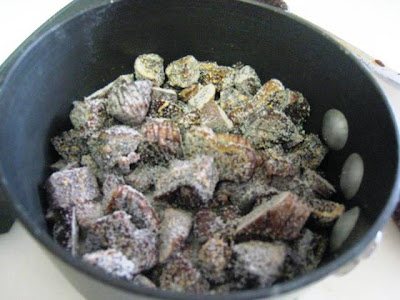
Remove the stems and chop the figs.

Toss the figs with 3 tbsp sugar in a small saucepan.
Add 1/4 cup water and a squeeze of lemon to the figs and cook over very low heat for 15 minutes.
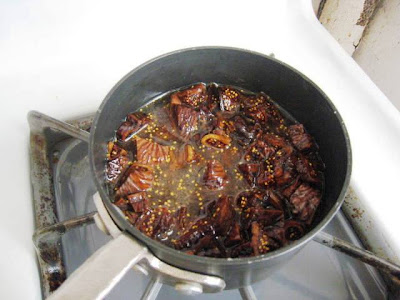
Add 2 tbsp calvados (and a bit more water if necessary to keep from drying out), and cook till figs are soft, about 15 munutes more.

Remove from heat and let sit a few minutes to cool. Process in food processor a few seconds until smooth.
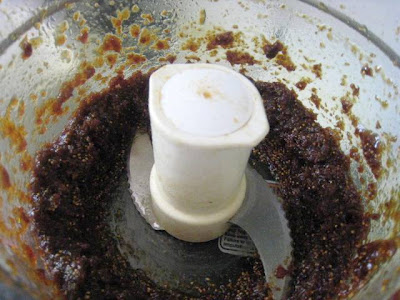
Set aside (and try not to eat any…)

Make pate brisee.

Process the flour, sugar and salt in a food processor to mix. Cut butter into pieces and add to the processor.
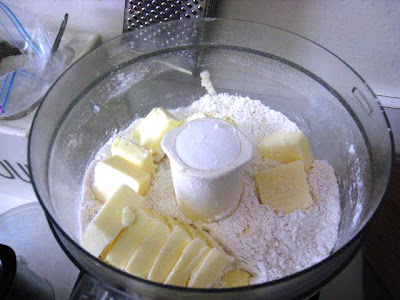
Pulse to the consistency of coarse meal, about 10 seconds.
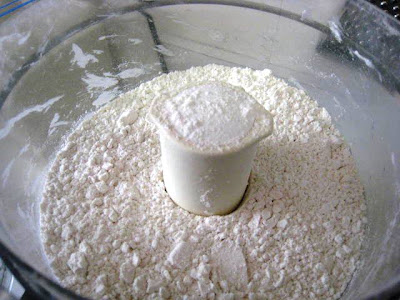
Pour ice water through feed tube while processing. Stop motor as soon as dough begins to form a ball.

Turn out onto a lightly floured surface and shape into a disc about 1 inch thick. (Can be made ahead and refrigerated.) Cut into 6 equal pieces. Flatten each piece into a disc about 4 inches round, then place into tart pan and, using your fingers, press the dough up the sides of the pan and across the bottom evenly.
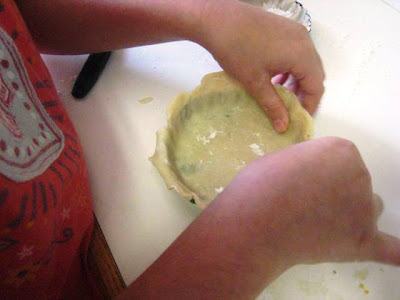
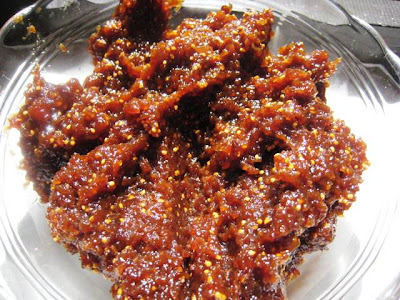
Using a small rubber spatula, spread about 2 tbsp fig paste across the base of each tartlet.
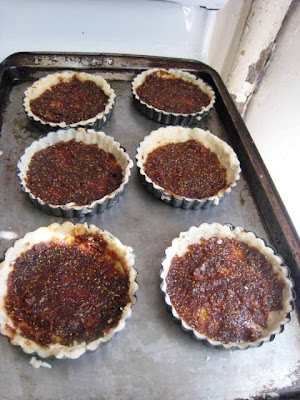

Toss the plum slices with 1/4 cup sugar
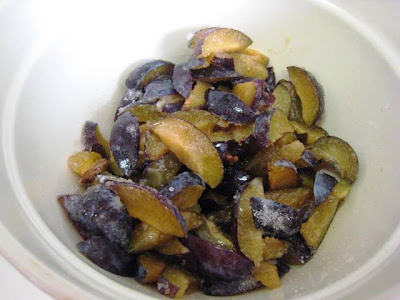
and arrange them, overlapping slightly, in the tartlet pans. Place an almond slice in the middle.
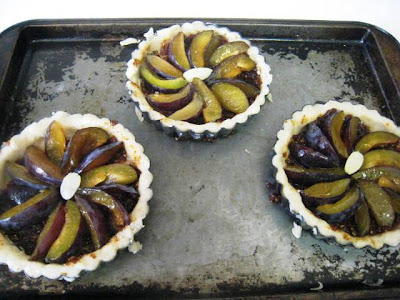
You could do an eggwash on the crusts at this time – I forgot to do it.
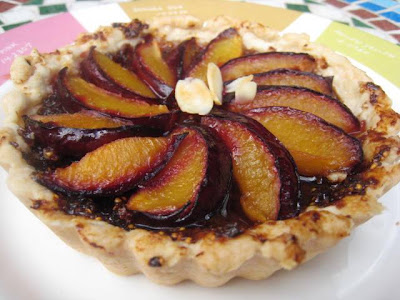
Bake at 400 degees for 10 minutes. Lower heat to 350 and bake an additional 40 minutes, till the fruit is soft and bubbly and the crust is golden brown.

Serve warm or at room temperature with vanilla ice cream on the side.

Strep Throat and Medical Ethics

So here’s the dilemma – I was diagnosed with a strep throat at about 6 pm tonight. I have patients scheduled for tomorrow am, and a lunch at the home of the head of the volunteer board I sit on.

I’ve taken one dose of antibiotics so far (at 7 pm tonight). I feel pretty crappy right now, but not so bad that I can’t work tomorrow.

Is my obligation to see my patients or to protect them from infection and cancel their appointments?

God knows if I infected anyone today – I saw about 20 patients, but the truth is that I am extremely obsessive about washing my hands before and after examining every patient.

UPDATE
I stayed home. But only after calling my patients myself to cancel them last night. (One of the advantages of the EMR is that I can access it at home). None were urgent visits, most were patients I’ve known for years, and everyone was happy not to be seen and wished me well. I actually feel worse this morning than last night, so I think it was the right decision.

Thanks, everyone, for your input.