To see Italy through the eyes of those who live there is to truly experience that country.
It is the difference between standing in a café stranded by the lack of language and knowing that you order one way when sitting at a table and another when standing at the bar, and never cappuccino after noon. The difference between getting lost on the Autostrade and knowing that the road you are driving on took years to build because each kilometer had to be contracted separately with the Mafia family assigned to it. The difference between wandering around the Palatine Hill with a tourbook in the sweltering heat and having a picnic there. Between feeling like an outsider and belonging.
And so first, I want to thank our dear friends Wanja and Fabrizio for hosting us during this trip and our new friends Martina and Federico for making us feel as if we belonged in their wonderful country.
Now on to your visual trip through Italy, complete with a recipe or two. First stop…
ROMA
 Our friends live in Trastevere, which means “Across the Tiber”. Trastevere is Rome’s Left Bank, and is a vibrant neighborhood that has been gentrified from its seedier predecessor. Graffiti still abounds, but the area is safe and like New York, there are people out till the late hours. Visitors tend to stick to the same main streets, which can be very crowded at night. But just stray off the beaten path by a single block, and it is peaceful. Needless to say, we felt right at home.
For this one night stay we split up between Wanja’s apartment and that of their friends in Monte Verde, which is on one of Rome’s seven hills. The apartment came complete with terrace garden, great views of the city and a four flight walk up. There was an air conditioner, but we did not discover it until the next morning. Oh well, what’s another bath or two when the tubs are deep enough that the water covers your shoulders while you read.
 Now that we’re settled, how about a walking tour through the cobblestone streets of Trastevere? (Since I am contemplating painting my living room orange, you will see a lot of orange buildings in these photos…)

 The Piazza Santa Maria Trastevere is the heart of the neighborhood, and until recently, it was where all the school kids hung out at night, till the cops had them move on to another Piazza.
 Check out the floors in the Church of Santa Maria Trastevere…
 Even though I no longer am a practicing Catholic, I light a candle for my Mom whenever I visit a church. Here, we also wrote a request to St Anthony to take away Mom’s post-herpetic neuralgia. We tucked our paper in near the top, hoping this would get her priority attention.
 Piazza Navona. They used to fill it with water and reenaact naval battles there.

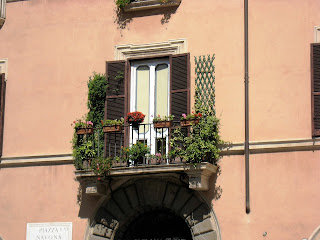 Speaking of water, there are freely flowing fountains everywhere. The Romans are very proud of their water, which rivals New York’s in terms of taste. You can cup your hands under to get a drink,
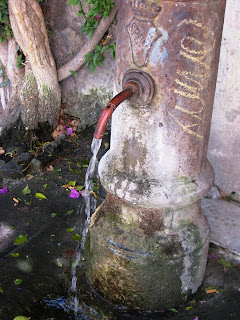 or do as the Romans do, plug the bottom and and lean in for a sip from the top.
 We all share a few bites of a pizza Blanca (pizza dough without sauce), sandwiching a few slices of meat.
 The gelato looks delicious,
 as does the apricot torte…
 But it’s too hot to eat anything else but fruit.
 The Pantheon was not really as crowded as this photo makes it appear. We strolled right in.
 The top of the Pantheon is open, but the floors are slanted so the water runs away from the center when it rains.
 Wanja’s daughter’s school is across the street from the Pantheon. Can you imagine looking out your window during class and getting an eyeful of ancient Roman History every single day?
Speaking of school, Italian kids get real food at lunch. There is no institutional food. Only fresh pasta, meat, salad or veggies and fruit, home made by the school cooks. Apparently the best school food in Italy is in Modena.
Back for a nap and a bath (loving that tub…), then out for dinner to Corallo, a restaurant in Centro (the center) near Piazza Navona.
 Tables from the restaurants flow out into the narrow cobblestone streets on these hot nights, and we eat bathed by street lamps and serenaded by passing vespas. We had pastas and a delicious fennel-orange-peach salad with shrimp.
 Italians care very much where their food comes from, and eat it in season. They are suspicious if they are offered food that they know is out of season or not grown in the region. So, when we were offered artichokes, which are in season near Rome in June and August, our friends knew they were not local. Indeed the waiter admitted that they were from Brittany.
 After dinner, we wandered back to Trastevere, stopping at Tre Scalini for gelato (supposedly one of the best places for gelato in Rome), and strolling along the banks of the Tiber for the Estate Romana (Roman Summer) Festival.
 This is one of the many summer evening activities around the city for visitors and those poor Romans who haven’t yet gone to the seaside to escape the heat.
 What we did not do, and should have, was go to Isola Tiberina, where you can have a drink or eat while reclining Roman style on pillows or rugs on the inclines.
Tomorrow, it’s off to Fierenze (Florence)
Fennel, Orange and Peach Salad
Here’s a recipe we came up with and made the following night.
Fresh fennel
1 Blood orange
1 peach
Fresh basil leaves
Olive oil
Salt and pepper to taste
Pesto
Shave the fennel thinly (It should look like a thinly sliced onion). Place into a large bowl. Peel and section the orange; core and section the peach. Add both to bowl. Make sure you get any extruded juice, it serves as the “vinegar” for your salad. Scatter fresh basil on top. Add a small amount olive oil, and salt and pepper to taste. Serve with a dollop of pesto on the side.

 The Mercato Centrale (Central Market) in Florence is filled with a seemingly endless array of vinegars, cheeses, meats, fruits, vegetables, all stunningly gorgeous, fresh and wonderful, in surroundings a bit prettier and a little more self-conscious that I’d expected.


 Vinegar tasting bar


 Ricotta, arugula and sundried tomato sandwiches
 Cooked Scamorza Cheese
 When do you eat scamorza? Well, it could be a second course at dinner. Or, according to Wanja, you keep it around at all times, “And when you get home late on Sunday night and you’re hungry and too tired to cook anything, then you make yourself a scamorza.”
 Tucked away behind the tall stone walls are apartments, gardens, schools, hotels, you name it. It all seems so very secret. So it should come as no surprise to you that behind the unassuming door of our building was this entryway…
 Go through that gate and down the hallway…
 And you are in the main garden!
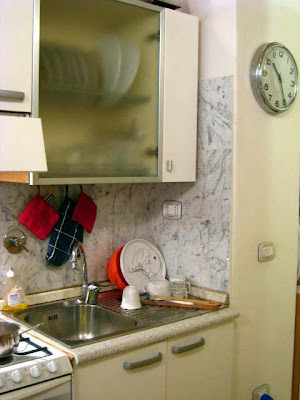
 Our apartment is a modern renovation on the ground floor…
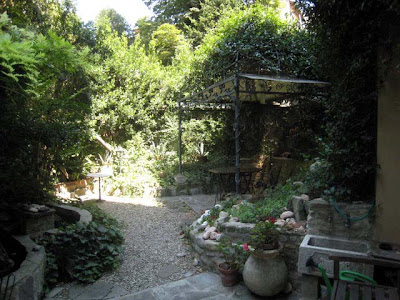
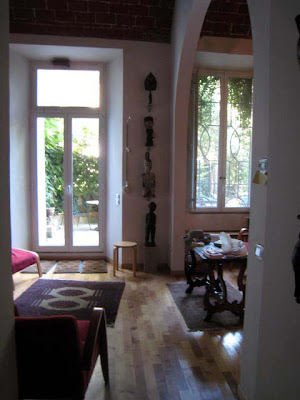 and has a small private garden.
 We rented the partment through a European site called
  Now you don’t!
 But enough domesticity – on to Florence.
 This is the Duomo. It was closed by the time we arrived, but open for Mass, so we decided to attend the Mass in order to see the place. We were a rather motley crew – one ex-Catholic, one Jew, 2 Quakers, and 2 kids raised without a formal religion. No one seemed to mind.
 We strolled the streets, stopping to buy sandals, watercolors and other small things.
 Dinner was at a rather touristy place near the Ponte Vecchio, a meal during which the waitress ran out of the kitchen screaming when a large bird flew in. The food itself was non-descript, save for a single dish – Pecorino cheese served with honey and pears. We decided then and there to make it ourselves the next day. (recipe below)
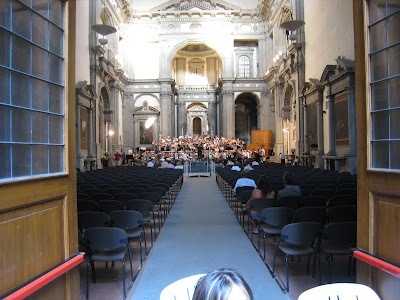 The entire first half of the concert was accompanied by a solo bird singing along somewhere in the eaves of the church! The highlight of the concert was
  But don’t be frightened. Madonna is there on almost every corner watching out for you…
 The restaurants are still open…
 And there is plenty going on behind those walls. One evening, we walked past an open door, and looking in, saw that the whole neighborhood was in a large coutyard watching an old movie being projected on the walls!


 The woman moved quickly through the crowd, weaving expertly between the carts and stalls of the marketplace, the sleeping child held close beneath her robes. She hoped to go unrecognized for just a few more precious hours before giving her child to the fate into which she had been born.


 The basil is the green stuff growing on the rocks. If you zoom in you can see it there on the big rock on the left.