Lighten Up!

Thanks to Grunt Doc for pointing folks to my post series on “How to Get Pregnant“. Despite his telling readers that the series is a poke at our medicalization of normal life, it appears that some readers still don’t get me. Because once again, I’ve gotten a chiding comment from an offended reader accusing me of being insensitive to the needs of women. Here’s what Christian wrote today:

If I asked my physician for advice on how to conceive a healthy child, then I’d expect something a little more helpful than “have sex.” …After years of trying to avoid pregnancy is it so surprising that a woman might have a question or two? Conception isn’t a trivial choice for many women. It’s not unreasonable to expect that your doctor might be able to provides some good advice.

It’s hard to be funny when you are a doctor, particularly when you are writing about subjects as sensitive as reproduction. Therefore, I have designed that humor warning sign up there, and attached it to the post so readers will know right up front not to take me too seriously. We’ll see if it works…

Feel free to use it on your own blogs to warn readers to lighten up.

Category: Second Opinions

HRT Deja Vu

It’s deja vu all over again
-Yogi Bera

If my practice is at all representative of the whole, then expect to read sometime soon that prescriptions for hormone replacement have dropped further in the wake of the recent news that breast cancers rates have declined since the publication of the Women’s Health Initiative in 2002.

In the past 2 weeks, I have had at least 5 patients come in for annuals either telling me that they stopped their HRT or wondering if they should stop as a result of the recent news. All of these women had been using HRT since the WHI results were published in 2002. All had been counseled extensively counseled about the risks of HRT as defined by that landmark study, had received written material outlining the risks, and had been offered non-hormonal alternatives for their symptoms. And all had wanted to continue to use HRT.

Until this new news came out.

The fact that these women are responding this way to these new findings may mean that they really did not believe the WHI findings in the first place, despite my counseling them in a way that I thought was factual and unbiased.

Or perhaps they believed the data, but also believed that it somehow did not apply to them.

Or perhaps it is simply because, as one patient told me – “You get scared when you see the risk you are taking splashed on the front page of the New York Times.”

So we sit and talk, review the numbers and the risks again, and they come again to a decision to use or not use HRT. One patient today decided to stay with HRT, figuring that since she had a major project due at work, this was not the time to upset the apple cart. Two decided to stay off and see how they do. One went onto an SSRI to help her wean off. Yet another finally went to the lower dose that I had been urging her to try.

I’ve asked them all if there was anything I could have said to them before now that would have dissuaded them from their decision to use HRT. Nothing. Did I portray the risks accurately for them? Yes. Should I have been more directive? No. Pushed them harder to avoid HRT? No.

All felt comfortable with the decision they had made previously, and all feel comfortable with the one they are making now. At least until the next news comes out.

It’s an ongoing process…
________________________________________________________________
Graph adapted from J Clin Oncology, 2006, 24 (30): 49E-50.

Category: Second Opinions

How Boys Lose Weight

Warning – Gross generalizations about the differences between the sexes follows. If they don’t apply to you, don’t get mad at me. That’s why they are called gross generalizations… When I was 13, I went on the Dr Stillman’s Water Diet and lost 25 pounds. That same summer, my brother Al decided he needed to shape up, so he did what boys do when they want to lose a few pounds. He gave up Cheetos and started running and lifting weights.

Guess who still has the weight problem?

When girls want to lose weight, we starve ourselves. When boys want to lose weight, they cut back on the junk and head to the gym. And they always lose weight faster than we do. And, in my family’s case at least, they keep it off.

Diets don’t work. I am living proof of that. But until recently, I couldn’t wrap my brain around that in a way that was meaningful enough to move me to anything other than frustration.

Lately, though I have been doing a lot of reading, inspired by my friend Sam’s 30 pound weight loss following the program called “Burn the fat, Feed the muscle“. I started reading the program book (it’s over 300 pages, so it’s taking some time), and what I’ve read so far is this – When you diet alone, you lose fat, but also a fair amount of water and muscle. At a certain point, if your calorie intake is too low, you go into starvation mode and your metabolism slows down. So the weight loss slows, and when you go off the diet, you gain wieght back faster than you can say “Cheetos”. Okay, I’m starting to get it…

Then, a few weeks ago, a study is published showing that dieters who don’t exercise don’t just lose muscle – they lose bone! Researchers compared those who went on a diet for a year with those who ramped up their exercise for a year. The former lost an average of 18 lbs, the latter 15 lbs. But most shocking was that the dieters also lost 2% of their bone mass!

So, you go on a diet. You drop 20 pounds. If you do it the way I usually do, which is rapidly, the first 5 pounds of that is probably water, part of it is muscle, a fair amount is fat, and some of it is bone! Then you regain, and you’ve replaced that muscle and bone with fat.

I can hear Henry Higgens now… “I think she’s got it!”

You know what? I just remembered. I was thin for a number of years. I lost 25 pounds during my first 3 months living in New York City. I did absolutely nothing consciously to lose the weight, and in fact, that first year in New York was one filled with culinary awakenings. All I had done was live like a New Yorker, which basically meant that I walked everywhere I went. I exercised. I didn’t diet. I started running shortly thereafter, and even did a few10K’s. And I kept the weight off for almost 10 years.

Then I got pregnant.

Since then it has been nothing but gain, gain and gain. I’ve lost up to 30lbs at a stint using either Weight Watchers or Atkins or South Beach. But it comes right back on, because who can keep that up forever?

Call me an idiot, but I swear that I just realized that at no point since having my kids have I ever gotten back to a regular exercise program. I don’t think I’ve gone to the gym or done my treadmill for more than a week or two at a time. And, since my office is now a scant one block from my apartment, I don’t even walk anymore. No wonder I can’t keep the weight off!

As my friend Sam, who is also a doc, says – “All those years of medical training, and I never really learned about nutrition till I read this book.'”

Well, this year, I’m giving myself a break from dieting. Or, more truthfully, a break from trying to start a diet. This week, I’ve been to the gym 3 times, did cardio and even picked up a few weights. And I’m going to try to do that for most days of this upcoming year of my life. And I’m not going on a diet.

Oh, alright, I’ll give up the Cheetos…

Category: Second opinions, considerations

For Your Consideration…

Voting has opened up for the Medical Weblog Awards over at Medgadget Blog. There are over 100 nominees in 7 different categories. If you aren’t a reader of medical blogs, and want to start with the best, these blogs are the ones to read.

It’s going to be hard to choose the best, but I’ll be casting my votes. I urge you to head on over and do the same.

Congratulations to all the nominees!

Category: Second Opinions

TBTAM Subscriber Update

Bloglet’s Subsciption Service is no longer working or supported, so I’ve changed to Feedblitz.

If you are currently subscribed to my blog, then you should get a message from Feedblitz inviting you to re-subscribe through them. If you did not get that message, and wish to continue getting my blog posts via email, please complete the Feedblitz form over there on the right sidebar.

I apologize for the inconvenience, and thanks for reading!

The Perfect Scone

It’s moist and crumbly, it’s delicious, it’s delighful! It’s a recipe so special that it inspired a new musical sensation, and it’s my New Year’s gift to you, Dear Readers…

And so, without further ado, ladies and gentlemen, allow me to present – The Perfect Scone!

This recipe is the culmination of a year long search for that elusive pastry, and was well worth the journey. I want to thank those who commented on my previous scone posts, especially Waynetta, Chairwoman, Katy, and Laura, all of whom shared their recipes and suggestions. I consider this recipe to be a group effort. In the end, the recipe I created was closest to that of my sister, the OBS Housekeeper, without whose nagging I would never have finally finished this culinary journey. OBS, we tried your recipe and even taste-tested it with Irene, who gave it the thumbs up. In the end, though, I went for an ever so-slightly different recipe containing butter instead of Crisco.

Here is what I learned about scones along the way:

1.The British scone is more akin to an American biscuit, and the American scone is more like the Irish scone. I have been looking for the perfect British scone.

2. Most scone recipes do not have enough liquid, and are too dry for my taste. Perhaps this is where the clotted cream comes in…

3. Technique is paramount. Work quickly once the liquid is added. A soft shaggy mass is what you are aiming for. Just fold it once or twice, pat it down and cut out your scones. Don’t mess too much.

4. Use only double-acting, aluminum-free baking powder. Here in the US, that is Rumford Baking Powder. (Thanks OBS for this tip.) Or, do as Cooks Illustrated does, and make your own baking powder (1/4 baking soda, 1/4 tsp salt and 1/2 tsp cream of tarter make 1 tsp baking powder.)

5. I really love scones!

The Perfect Scone

2 C flour
1 tsp. salt
1/4 cup sugar
2 1/2 tsp. baking powder (Aluminum-free)
6 tbsp butter, cold, cut into pieces
1 C heavy cream, half & half or a combination
½ C chocolate chips, raisins or other small dried fruit bits

A bit of milk in a small bowl
Sugar

Preheat oven to 400 degrees Fahrneheit.

Mix together flour, salt, sugar and baking powder. Cut in butter using pastry cutter till it is the consistency of coarse corn meal. Add chocolate chips and mix until they are coated.

Make a well in the center, and pour in cream. Mix with a wooden spoon just enough to get all the dry ingredients incorporated. Dump the dough onto a table. (It should be a shaggy soft mass.) Fold the dough once or twice, then pat the dough into a circle ½ inch high. Cut with a biscuit cutter. (Size of cutter depends on if you like little or bigger scones. Standard size is 2 inches)

Place scones on an ungreased baking sheet. Brush the tops with a bit of milk and sprinkle with sugar. Bake for 12 to 15 minutes.

Makes 8-10 scones.

Category: Food

Fosamax – Can You Stop After 5 Years?

Stopping aledronate (Fosamax) after 5 years of use may be a reasonable option for many women using this osteoporosis-fighting drug, according to a research study published this week in the Journal of the American Medical Association.

In this multicenter study, which was funded by Fosamax manufacturer, Merck, and designed jointly by both Merck and non-Merck investigators, women who had been using Fosamax for 5 years were randomly assigned to continue aledronate for another 5 years, to continue for 5 years at a lower dose, or to take a placebo for 5 years.

Not surprisingly, stopping aledronate after 5 years led to a decline in bone mineral density at both the hip and the spine, and bone turnover increased. The loss of bone, though significant, was small, so that bone densities five years later were still higher than they were when aledronate was first started.

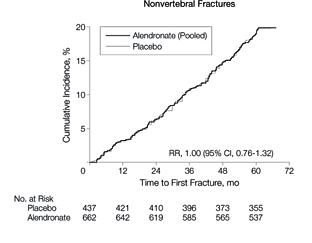
Women who stopped aledronate after 5 years did not have an increase in the rate of new non-vertebral fractures.

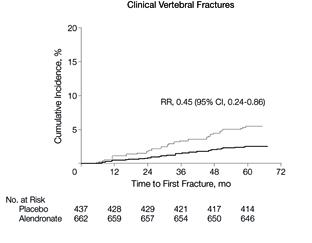
However, there was a significantly higher risk of vertebral fractures in women who stopped aledronate.

The protection provided by continuing aledronate beyond 5 years was evident among women whose T scores (measured at the hip) were below -2.0 at baseline and in women who had a prior risk of fracture. For women whose baseline bone density was above -2.0, the risk for fracture was the same whether or not they stopped or continued aledronate.

It should be reassuring to Fosamax users to know that no excess in adverse events occurred in the 10 year Fosamax use group, and no cases of osteonecrosis of the jaw were reported in the over 1000 Fosamax users in this study. There were also few differences in outcomes when the 5mg and 10 mg Fosamax doses were compared.

Understanding the results

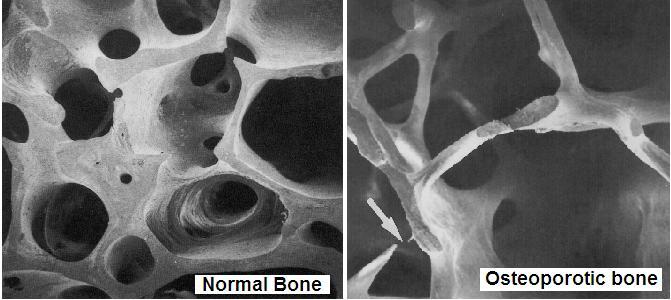
Bone is a living tissue, undergoing constant reformation via a delicate balance between the breakdown of old bone by osteoclasts and the formation of new bone by osteoblasts. If bone breakdown exceeds bone formation, bone loss results.

Fosamax is one of a class of drugs called bisphosphonates. These drugs bind to the bone to cause the aptosis (cell death) of osteoclasts. This shifts the balance of bone turnover in favor of new bone formation.

Bisphosphonates bind very tightly to bone and can remain there for up to ten years. During this time, they continue to increase bone density and prevent fractures. Although no adverse effect of prolonged use has been reported, concerns remain, particularly in light of recent reports about osteopnecrosis of the jaw in bisphosphonate users. Interest has been growing to find ways to limit bisphosphonate use to shorter periods of time. This study was done in order to determine if Fosamax use could be limited to 5 years and still be effective.

Bottom Line

If you have been taking aledronate for 5 years, and your hip T score is above -2.0, it appears that you can stop your aledronate for 5 years without increasing your fracture risk. Women with certain medical conditions or at increased risk for fracture may do best to stay with with their medciation, so talk to your doctor to see if this applies to you.

If your hip T score is less than -2.0, then stopping aledronate will not increase you chance of a hip fracture over the next 5 years, but your risk of spinal fracture will increase. This increased risk is small and should be weighed against the risks of continuing the drug. Talk to your doctor about your options. If you are at high risk for fracture, it is probably advisable to continue taking you medication. A a one to two year drug holiday might be a good compromise between stopping your medication altogether and staying on it continuously. You could also consider lowering the dose.

If you do stay on bisphonsphonates for 10 years or more, be reassured that to date, long term use has not been found to increase the risk for adverse events.

Do these results with aledronate apply to other bisphosphonates, in particular, risedronate or Actonel? We have no data, but Actonel has a similar mechanism of action and duration of action to Fosamax, so it may not be unreasonable to expect similar results. Again, talk to your doctor.

____________________________________________________

Patient information about osteoporosis from the National Osteoporosis Foundation and from The Hospital for Special Surgery.

Physician’s Guide to the Prevention and Treatment of Osteoporosis. This great resource from the NOF is downloadable and free with registration.

Category: Second Opinions

Got PMS? Have a Kookie!

Here’s a great gift idea for that special someone who suffers from PMS – a little box of sweets from the PMS Kookie Company. I got these decadently rich chocolate cupcakes last night for a Secret Santa gift. The chocolate chip cookies were also delicious.

Of course, these are best eaten with either a tall glass of milk or cup of warm tea while relaxing in your PMS Bath.

Category: Food and Second Opinions

I Lost It on the Streets

I left my wallet in a cab on Wednesday. I was a few minutes late for a lunch date with my daughter, and it must have slid from my lap to the floor as I rushed out the door of the cab. I realized it as soon as I closed the door, but by the time I turned around, the cab was zooming off.

Luckily, I had a few bucks in my pocket, so I was able to pay for lunch, a meal during which I debated calling the credit card companies right away, or waiting to see if someone had found my wallet. We decided that I would wait a few hours.

Sure enough, my secretary called me about 3 hours later. The next fare, a sweetheart of a guy named Alex, had found the wallet, and tracked me down through my hospital ID. He would be at Grand Central for the next hour. Did I want to come there, or should he come to my office tomorrow? This guy was saving my life, and now he was offering to schlep to my office!

Problem was I had no money and no metro card, so Mr TBTAM headed over to Grand Central for me and retrieved the wallet. Unfortunately, he did not get Alex’s address, so I can’t send him the wine I had planned to get him.

So, Alex, wherever you are, thanks. It’s people like you who make me love this city. Have a wonderful holiday.

Category: Considerations

Big Pharma and Women in Government – Partnering for HPV Legislation

Much of the push to mandate coverage of the HPV testing and the HPV vaccine is coming from the Women in Government’s Challenge to Eliminate Cervical Cancer, a campaign that appears to be funded in part by the makers of the HPV test and HPV vaccine.

The Challenge, begun in 2004, has an ambitious agenda to eliminate cervical cancer in the United States, and seeks to “mobilizes state legislators to address cervical cancer prevention in their states.” According to a recent NEJM article entitled “Ethics and the HPV Vaccination“:

Women In Government, a Washington-based, bipartisan organization of female legislators, is leading a push to make HPV vaccination compulsory in every state. The group has issued recommendations for ensuring that the vaccine is accessible and affordable, including a recommendation that states add it to their Medicaid programs and encourage private health plans to cover it. The group follows in the tradition of breast-cancer activists, who have mobilized through many political channels to combat an illness that disproportionately burdens women.

Membership of the WIG, a 501 (c)(3) non-profit entity, includes female state legislators from all over the US. The group has a large list of policy issues they consider important – quite extensive and quite impressive. They appear to be taking on chronic kidney disease and higher education funding with a similar energy to their cervical cancer campaign. It’s an ambitious agenda that most certainly requires funding.

Who funds the WIG?

Like every non-profit, the WIG has lots and lots of corporate partners, and most of Big Pharma is there. But what the WIG also has is something called the Business Council, a tiny group of sponsors who seem to be much more intimately involved in the organization than most corporate sponsors of non-profits. From the WIG website –

The Women In Government Business Council is comprised of a small, select group of industry leaders. Business Council members support the overall mission of Women in Government and provide a private sector perspective to our programs. Members also play an integral role in planning for future growth, have the ability to attend our regional conferences, and support the financial stability of the organization.

Here’s the corporate membership roster of the Council – Digene (makes the HPV test), Merck (HPV vaccine maker), GlaxoSmithKline (HPV Vaccine maker), Wellpoint (heads the council), Exxon Mobile and Verizon. A full 50% of the membership stands to benefit from the legislative efforts of the Challenge to Eliminate Cervical Cancer. And one of the Council’s members, Digene, has a bit of a sordid past when it comes to partnering with women’s groups to forward favorable legislation.

Digene and the European Women for HPV

In 2004, a group called The European Women for HPV Testing began to campaign for legislation in England for national HPV screening. High profile female celebrities were recruited to the group to be spokespersons for the group and to lobby for legislation to approve the HPV test as primary cervical cancer screening. The European women for HPV Testing group even got mentioned in the British Medical Journal, in a manner similar to the NEJM mention of the WIG.

The problem was, the European Women for HPV Testing did not actually exist. As revealed by the Guardian Observer, the “group” was actually a front organization created on paper by the advertising company Burson-Marsteller and entirely funded by, you guessed it – Digene.

Partners with Aligned Interests?

Digene makes no bones about its strategy, which, according to their 2006 annual report, is to “expand beyond published data and medical guidelines to change the way healthcare is practiced“.

The WIG makes no bones that its strategy for tackling the issue of cervical cancer is “a collaborative approach… enlisting the support of stakeholders from across the globe” in its efforts. In their most recent report, the Challenge to Eliminate Cervical Cancer clearly stated that the publication was made possible by funding from Digene. But on none of its press releases about HPV does the WIG reveal its relationships with Digene, Merck or GlaxoSmithKline.

One could argue that without such funding relationships, the agenda of the WIG could not be forwarded. One could argue that in the case of cervical cancer, the interests of women and those of Big Pharma are aligned. One could argue that without Big Pharma to fund it, the Challenge to Eliminate Cervical Cancer would be nothing more than a nice name for a good cause.

But one could also ask whether the Challenge to Eliminate Cervical Cancer would even exist without Big Pharma. Both Merck and Glaxo have used PR firms to create advocacy groups whose mission is to increase awareness of HPV, and who “partner” with existing health and women’s advocacy groups. One is called The Partnership to End Cervical Cancer, and the other (which now appears defunct) is called Make the Connection.

And one could also argue that the financial ties between the WIG and Big Pharma puts the WIG in the position of being a lobbyist for Big Pharma rather than being political advocates for women.

Update on this issue here.
_____________________________________________
Disclaimer: I use the HPV test in my clinical practice, although only for ASCUS triage and not for routine screening. I have not yet given the HPV vaccine to any patient, although we are discussing it, and given the recent recommmendations of the immune practices committee of the CDC, I expect I will be giving it. I still have a lot of concerns about the high cost of the vaccine, how long immunity will last, what will happen when the next generation of vaccines hits the market, and if it will really make a difference in the health of my patients, who for the most part, recieve regular pap smear screening.

Both the speed and sense of urgency accompanying the recent movement of the HPV test and vaccine into the healthcare arena has been startling to me, and I believe heralds a new age of unprecendented pharmaceutical marketing and influence. Physicians, patients and yes, even lawmakers need to be aware of these new strategies that are being used to influence us.

Category: Second Opinions

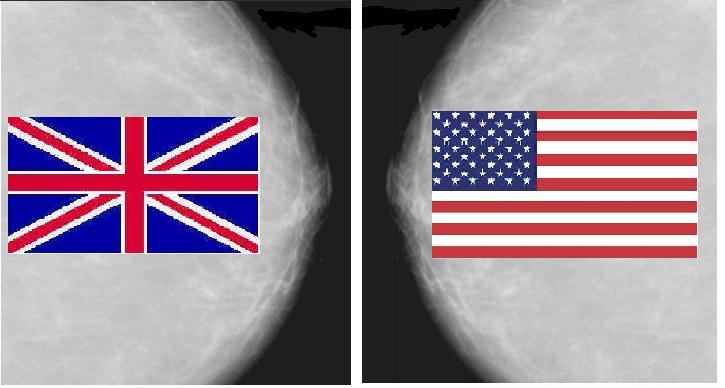
Mammograms – The Brits vs the Yanks

It appears that my recent post about the Lancet study has stirred things up a bit over at Dr Crippin’s blog. The trans-Atlantic discussion in the comments section is quite an interesting read, and I encourage you to head one over there for it. From what I read, we Americans have slightly different recommendations for mammogram screening than do our counterparts in the UK.

Mammograms in America

We recommend routine mammograms every 1-2 years in women age 40 and over. (Read the NCI justifications for this recommendation here) Although this screening is not universally free, it is covered by all insurances (some annually, some every 2 years). For women without insurance, there is a free national screening program, and many local screening programs exist as well. Women can self–refer, but must identify a physician to receive the mammogram report.

Mammograms in Britian

In the UK, breast cancer screening appears to be free to all for women through the NHS Screening Programme, but is not routinely offered until after age 50, and then every 3 years:

The NHS Breast Screening Programme provides free breast screening every three years for all women in the UK aged 50 and over. Around one-and-a-half million women are screened in the UK each year. Women aged between 50 and 70 are now routinely invited.

Because the programme is a rolling one which invites women from GP practices in turn, not every woman will receive an invitation as soon as she is 50. But she will receive her first invitation before her 53rd birthday. Once women reach the upper age limit for routine invitations for breast screening, they are encouraged to make their own appointment.

Higher risk women can be identified by their physicians and referred to more intensive screening programs in the UK. The women in these programs either have BRCA mutations or a 20% or higher chance of being a BRCA carrier. The intensive screening programs offer individualized risk assessment and screening, including mammography, sonograms and MRI.

It appears from the NICE guidelines (see below) that only women who raise concerns about their family history to their GP get referrals to high risk centers:

1.3.1.2 Healthcare professionals should respond to women who present with concerns but should not, in most instances, actively seek to identify women with a family history of breast cancer.

Some thoughts

Both the UK and American program recommendations are evidence-based, but appear to be relying on either different evidence, or making different conclusions based on the same evidence. Perhaps concerns about liability and very strong breast cancer awareness and concerns among American women are driving our guidelines a bit more than those in the UK.

The increase in mammogram use in the US and the UK has been associated with a decline in mortality from breast cancer in both countries. Advances in treatment, however, may be as much responsible for the decline in mortality, since in the US, the rate of new advance breast cancers has not changed, despite a marked increase in diagnosis of early stage and in-situ cancers.

One could argue that the increase in mammograms has done nothing more than diagnose early indolent cancers that would never have killed anyone. It’s a salient argument, but until we have some way of distinguishing who is going to get the aggressive vs indolent tumors, it doesn’t change screening. However, advances in proteomics and DNA testing are rapidly being made, and currently are driving treatment decisions so that women with more agressive tumors get more agressive treatments.

Someday, we’ll have a better screening than mammogram. It may be MRI, it may be a serum test. It may even be a genetic test to identify the women at risk, so that those at no risk can avoid mammograms altogether. Wouldn’t that be great?

Category: Second Opinions

Mammograms in Women Under 50 – The Lancet Study Reviewed

That graph up there shows the main outcomes of the AGE Trial, a large study of mammography screening in England that asked the question “Does offering mammograms to women in their 40’s save lives?” The dotted red line represents the mortality from breast cancer in women offered mammograms annually between ages 40 and 48 through the National Health Service (or NHS). The solid line represents the control group of women who were not offered mammogram screening by the NHS until after age 50.

The investigators are interpreting that graph to mean that mammograms in women under age 50 are not worth doing.

Let’s talk, shall we?

The study, which was published Dec 9 in the Lancet, randomized 160,921 women on a 1:2 basis to either annual mamograms from age 40-48 or to a control group of “usual care”, which in the NHS is an invitation to a first mammogram between ages 50-52. Deaths were identified through the NHS central registry for a mean follow up of 10.7 years.

There was a 17% reduction in breast cancer mortality in the early screen group. (That’s the graph up there)

As it turns out, only 69% of the women invited to screen actually came for the initial screening, and overall, only 81% of them ever got a mammogram during the study. The women who never showed up for the mammograms had a higher rate of breast cancer deaths than those who got the screening. When adjusting for these two factors, the investigators found that women who actually showed up for the early mammograms had a 24% reduction in mortality from breast cancer compared with the control group.

Sounds pretty clear, doesn’t it?

Well, unfortunately, it’s not. You see, neither the numbers I quoted nor the difference up there in the graph between the red and black lines is statistically significant.

Why not? Very possibly because the study wasn’t big enough to detect the difference in breast cancer mortality with enough certainty to call it real . You see, the NHS ran out of money and personnel partway throught the study, so the sample size was smaller than initially planned. Secondly, mortality in the control group was much lower than initially estimated, making it even harder to find a statistically significant difference with the smaller sample size. Here’s what the investigators said about this:

The power of the trial to show a reduction was diminished both by the smaller than planned sample size and by the lower than anticipated mortality from breast cancer in the control group (2·35 per 1000 vs 3·3 per 1000), resulting in a revised power of 60% to detect a 20% mortality reduction, and the CI does not exclude a reduction of 34% or an increase of 4%.

Most studies are powered at 80%, meaning that, going into the study, there is an 80% possibility that the study has enough subjects to be able to detect a difference with 95% certainty between the groups. (or something like that – statisticians, feel free to correct me.). If the study is too small, then the odds are stacked from the get-go against finding anything to hang your hat on in terms of results. And that’s what happened here.

Finally, the mammograms performed in this study were below standard. Although the first screens were standard two view mammos, subsequent screens in the under 50 group were single view only. This was done in an attempt to diminish radiation dose, but likely resulted in lower detection rates in the screened group, since single view mammograms are less sensitive and specific than two view mammos. (Current standards in both UK and US are two view mammograms.)

The end result is that the Lancet study failed to show a benefit to mammograms before age 50. What a shame – to do all that work, and have your final study size to small to detect a difference between your two groups with any confidence.

Perhaps to ease our disappointment with their study, the investigators did make a very nice graph of the clinical trials of mammograms in women under 40 to date:

For the lay crowd, what this graph means is that the risk of dying from breast cancer in women getting mammograms before 50 is smaller relative to those who wait till after 50. (The black boxes up there) But the 95% confidence intervals (the thin lines) of almost all of these studies crosses one, meaning that the protective effect of mamograms is still not statistically significant overall. However, I would say there is a clear trend to protection against dying in the early mammogram group, wouldn’t you? (All the black boxes except one fall below 1)

What about other outcomes?

Dying or living are not the only two possible outcomes that might be affected by earlier diagnosis of breast cancer. We all know that cancers picked up earlier are more likely to be amenable to breast-conserving surgery and less likely to require chemotherapy. I don’t know about you, but if I am going to get breast cancer, I would rather have it diagnosed at a stage where I can keep my breast and avoid chemo. Also, chemo can be associated with secondary cancers years later, something a 10 year study would not pick up.

Bottom line – this study adds little to our understanding of the role of today’s mammograms in women under age 50 as practiced in the United States. For my patients, I will continue to recommend mammograms every 1-2 years beginning at age 40, and annually at age 50 and above. I advise women with dense breasts to have digital mamograms and ultrasound in addition to mammography, especially if there is a family history of breast cancer.

Hopefully, the data from this latest Lancet study will not be used by the NHS to continue to deny this same screening to women in the UK. ________________________________________________

United States Preventive Services Taskforce recommendations for mammograms

NCI statement on mammograms in women under age 50

Info on Digital Mammography from the NCI

University Of Pennsylvania’s Med Page Today critique of the Lancet Study (excellent read)

Thanks to Rachel for pointing the Lancet article out to me.

Category: Second Opinions

Joe’s Calamari Marinara

You think I’m a foodie? Nah. I’m chump change compared with my brother Joe, who is the genuine foodie of the family.

Joe has actually worked in real restaurant kitchens, has close friends who own restaurants, and knows wine because he used to sell it in Northern California. And while Joe may love to read cookbooks, he doesn’t need to cook from them like I do. He cooks like the real chefs do, with instinct, flare and a sense of what’s right and what goes with what. His wife Rachel is the same kind of cook, and together, they can make a mean meal. Dinner at their house is an event that goes on for hours, with one course after another woven together with the thread of fine wine…

Joe also loves to wax prolific about food and wine. Get him going, and the phrases”hit it with a little olive oil” and “crank up the heat” and “floral lilt” and begin to creep into his otherwise colloquial speech. By the time he’s done, you’ve either got to start cooking right away or run out to the nearest fine restaurant to satisfy your cravings.

Joe made a delicious Calamari Marinara appetizer on Friday night. I think I’ll let him tell you himself how to make it. He’s our own Jamie Oliver, and we love him. Enjoy!

Calamari Marinara ala’ Joe (Click on the arrow to view video. Requires Flash Player)

Category: Food

Joe Waxes Calamaric

You think I’m a foodie? Nah. I’m chump change compared with my brother Joe, who is the genuine foodie of the family.

Joe has actually worked in real restaurant kitchens, has close friends who own restaurants, and knows wine because he used to sell it in Northern California. And while Joe may love to read cookbooks, he doesn’t need to cook from them like I do. He cooks like the real chefs do, with instinct, flare and a sense of what’s right and what goes with what. His wife Rachel is the same kind of cook, and together, they can make a mean meal. Dinner at their house is an event that goes on for hours, with one course after another woven together with the thread of fine wine…

Joe also loves to wax prolific about food and wine. Get him going, and the phrases”hit it with a little olive oil” and “crank up the heat” and “floral lilt” and begin to creep into his otherwise colloquial speech. By the time he’s done, you’ve either got to start cooking right away or run out to the nearest fine restaurant to satisfy your cravings.

Joe made a delicious Calamari Marinara appetizer on Friday night. I think I’ll let him tell you himself how to make it. He’s our own Jamie Oliver, and we love him. Enjoy!

Calamari Marinara ala’ Joe (Click on the arrow to view video. Requires Flash Player)

Category: Food

Grand Rounds: Vol 3, No 11

Le venin de serpent, antidote au poison
Pseudo-Galien, Kitâb al-diryâq (Livre de la thériaque). Jazirah ?, 1199.

Grand Rounds is up over at The Antidote, a website that is subtitled “Counterspin for Health and Haalthcare news”. Grand Rounds is a weekly compilation of the best of the medical blogosphere. The target audeince for grand rounds is the educated but nonmedical reader. If that’s you, then head on over to The Antidote and see what the offerings are this week.

The Antidote is written by Emily DeVoto, Ph.D., and is an example of a well-written blog that makes a real contribution. Many thanks to Evelyn for tackling Grand Rounds this week, and for accepting my contribution at the last hour – or was it 2 am?

Image from the website of the Bibleoteque Nationale de France
Category: Second Opinions