Hormone Replacement – Part 4

In Part 1, Part 2 and Part 3 of this series, I’ve said just about everything I know, or you would care to know, I expect, about HRT. But before we leave this topic, I need to say…

A Few Words About Bioidentical Hormones

One concerning impact of the Women’s Health Initiative has been the wholesale marketing of so-called “natural” hormone products to women as the safer alternative to Prempro. These “bioidentical hormones” are manufactured replicas of the same molecules our bodies use. They can be found in the FDA-approved HRT products such as Climara, Vivelle and Prometrium, to name a few.

Many women have the misguided belief that when these same compounds are made in a smaller local compounding pharmacy, they are somehow safer and better than Prempro or the FDA-approved products. There is absolutely no data to support this claim. So, until someone does a placebo-controlled, randomized clinical trial to prove otherwise, estrogen is estrogen, whether it comes from plants, mares urine or the moon.

Don’t get me wrong – I am more than happy to prescribe “natural” hormone replacement. Estrogen is estrogen, after all.

But I will not act as if somehow this stuff is risk-free and safer than it’s synthetic counterpart, or hand it out like candy to every woman who comes into my practice looking for the fountain of youth. I treat it the same way I treat Prempro. That means you can have it if you need it, and as long as you understand the potential risks as we know them today, and the benefits as they have been proven to date. The rest is all hype as far as I am concerned.

And speaking of hype…

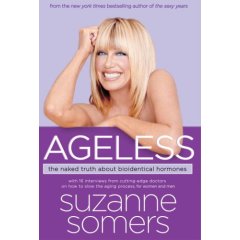
The bio-identical hormone crowd have found a new guru in Suzanne Somers, whose books tout the age-defying wonders of bio-identical hormones. Suzanne takes these hormones herself, and sells them as the risk-free answer to the problems of aging, from hot flashes to wrinkles to weight gain to Alzheimers.

Look, I love Suzanne, but she is out of control with this hormone thing and someone has got to rein her in. Here’s a quote from the cover of her latest book “Ageless”:

“The second half of life can be wonderful. I know it because I am living it. This new approach to health gives you back your lean body, shining hair, and thick skin, provided you are eating correctly and exercising in moderation. This new medicine allows your brain to work perfectly and offers the greatest defense against cancer, heart attack, and Alzheimer’s disease. Don’t you want that?”

Somers’ books are the new Feminine Forever, except that they tout bio-identical hormones instead of Premarin. And, just as Femine Forever was a marketing tool of Wyeth, Suzanne is being used as the marketing tool of the anti-aging industry. Her own use of the hormones, as well as her sincerity (and I do believe she is sincere) only make her message that much more appealing.

But we can’t hold Wyeth’s feet to the fire, and then turn around and give Suzanne and her friends a free ride. Unfortunately, this group appears to be operating under the radar of both the FDA and the media, both of whom appear to be ignoring the problem. The media, in fact, is part of the problem, letting Suzy hype her message on every talk show known to man, with nary an opposing viewpoint.

Fortunately, Somer’s book has not influenced mainstream medical practice. But it has convinced a fair number of women to go to their doctors and ask for natural hormones to fulfill some vague notion they have of health, youth and beauty. Perhaps they want look and feel like Suzanne. (This reminds me of the movie Shampoo where the little old lady sits in Warren Beatty’s chair holding up a photo of Princess Diana, saying “I want to look like her.”)

More than a few patients have arrived to their appointment toting Suzie’s book. It can take a lot to get them to be specific about what it is they feel they need hormones to treat, and to understand that natural estrogen is indeed estrogen, with all its risks and benefits. And that we are all going to get old (and look old) someday, estrogen or no estrogen.

But then again, I don’t look like Suzanne, so why should they believe me?
____________________________________

Addendum: Good news – the media seem to be getting the message. Head over to Kevin, MD for the links.

Patient information on bioidentical hormone here.

An excellent review article on bioidentical hormones. (Abstract only – full text for a fee for non-members)

Read the National Women’s Health Network Fact Sheet on Natural Hormones.

Category: Second Opinions

Hormone Replacement: Part 3

In part one and part two of this four part series, I reviewed the history and findings of the WHI, the impact of those findings on the medical establishment, and the newer data that have gotten us all muddled up again in our thinking about estrogen.

In the face of all that uncertainty, I have to practice medicine. To that end, I have created my own set of guidelines for prescribing HRT that I would like to share with you now. Feel free to comment, question, criticize or amend these guidelines, or god forbid, to use them yourself.

Please do not ask me if I am “pro-HRT” or “believe in HRT”. Health care is neither politics nor religion, despite that picture up there. It is, however, an uncertain science. Therefore, one must be wary of anyone expressing extremes of opinion about HRT, either for or against its use, and of anyone claiming to have the final word on HRT.

  1. I am willing to prescribe HRT for any of its approved indications (vasomotor symptoms, vaginal dryness, osteoporosis), provided you understand the risks as well as the benefits and know about alternative treatments for these conditions.
  2. I will give you the best data I can find that defines your personal risks and benefits from using HRT. Unfortunately, that data is imperfect, and may change in your lifetime. This will be frustrating for both of us.
  3. I am willing to prescribe HRT for reasons of well-being, mental or physical, provided you are willing to accept the risks and can describe the benefit for me as best as you can.
  4. If you are at increased risk for or have had breast cancer, I am willing to prescribe HRT provided you accept the risks and we have exhausted the non-HRT solutions to your problem, assuming, of course, that it is a problem that HRT can address. (I can count on less than one half of one hand the number of my patients with breast cancer who would fit this rule, but for them, I have it. )
  5. I will not prescribe estrogen without progesterone if you have an intact uterus. If you use anything less than standard progesterone regimens, you must undergo frequent monitoring of the endometrium.
  6. I am unwilling to prescribe estrogen if you are at increased risk for blood clot or stroke. I will do everything I can to find you an alternative that will address your symptoms or condition.
  7. I am not willing to prescribe HRT for cosmetic reasons alone.
  8. I am happy to prescribe bioidentical hormones, but you must assume they have the same risks as Prempro until there is data to prove otherwise.
  9. I consider vaginal estrogen to be safe in almost every woman. (I’ll let you know if I think you are the exception to this rule, and why.) If you feel otherwise, I completely understand.
  10. I will support your decision to use or not use HRT, and will work with you to find the optimal way to manage your menopause, whether it be through lifestyle changes, diet, exercise, hormones and/or medications. It is, after all, your body and your menopause.

Up next: A few words about bioidentical hormones.

Image: I mutilated The Ten Commandments Pressbook Cover. (I just ordered it from Ebay, and can’t wait to get it and see what other images are inside. It is one of my favorite movies of all time.)

Category: Second Opinions

Hormone Replacement – Part 2

See Part 1 here.

When we last left the WHI, the results of the estrogen-progesterone arm of the study had just been released. Unexpected results which showed the drug to increase the risks of heart disease, stroke and breast cancer…

The Immediate Reaction

Well, we all know what happened next.

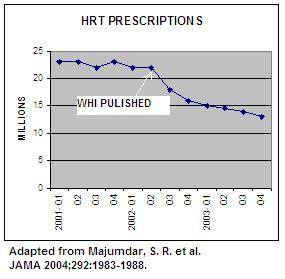
Widespread confusion and not a little panic erupted, helped in no small part by the manner in which the WHI’s findings were released (via press release prior to publication of the paper). The investigators did little in their contact with the media to place their results in perspective or to address how they might relate to women using HRT for treatment of menopausal symptoms. Instead, they fanned the flames of hysteria by making statements to the press like “This is a dangerous drug.” (NY times) That was just irresponsible, in my opinion.

Critical analysis of the paper was lost in the melee. The fact that the WHI was never designed to study the use of HRT for treatment of menopausal symptoms was a fact that received cursory mention at most. Questions of statistical significance and relative risk were rarely mentioned. The WHI was accepted as gospel from day one. I don’t fault the media – most of the reporting I read was intelligent and well meaning. But critical analysis of the data itself was notoriously absent, because no one had time to do it before having to talk to the media.

Overall, about two thirds of women who were taking HRT at the time the WHI results were released stopped their therapy; those who stayed on the drugs tended to be those women who had the worst menopausal symptoms.

Physician reactions were just as strong. Some docs stopped prescribing HRT altogether. One doc I know told her patients, “You can kill yourself if you want to, but I am not going to prescribe the gun'”. One patient of mine was told by her former physician, “I won’t let my wife use it, and I’m not going to prescribe it for you.”

Perhaps they are worried about being sued. Given that there are more lawsuits out there against Wyeth than you can count, I can’t say as I blame them.

Still, it seems to me as if that approach merely exchanges the “one size fits all” approach to estrogen with the “no size fits anyone” approach, and is just more of the medical simple-mindedness that pre-dated the WHI. And when has the practice of medicine ever been simple?

The More Measured Response

In a relatively short time, the medical establishment recovered from the acute shock of the WHI. New guidelines for HRT were formulated by the US Preventive Services Task Force, recommending against the use of hormone replacement for the prevention of chronic conditions in women.

But what to do with all those women on HRT for treatment of menopausal symtoms? The WHI did not address these women, and yet they were the ones using most of the HRT. We were essentially left on own to figure this one out. Professional organizations like the American College of Obstetrics and Gynecology and the North American Menopause Society eventually came out with guidelines that were more detailed and helpful than the “just say no” guidelines of the USPSTF. In 2005, the FDA published HRT guidelines for women considering hormonal therapy.

The new guidelines can be summarized simply as: Talk to your doctor, take the lowest dose needed shortest shortest period of time, make sure you know the risks as well as the benefits, and consider alternative treatment when available.

Lower Doses, Shorter Use
The use of HRT for treatment of menopausal symptoms continues to be supported, but at the lowest effective dose for the shortest period of time necessary. Women are now encouraged to try to wean off of estrogen once it is no longer needed for the symptoms of the menopause transition, which last on average about 18 months. For women who continue to need estrogen past that time, the goal is to find the lowest effective dose.

Are lower doses of estrogen safer in terms of heart disease, blood clots, stroke and cancer? No one knows. We do know, however, that they are likely to be just as effective for prevention of osteoporosis, and are often enough to control symptoms. So why take more if less will do?

Vaginal Estrogen
Vaginal estrogen remains a viable option for the many women whose only real symptom is vaginal dryness. To date, I know of no adverse data associated with vaginal estrogen use, except that if the cream is used, one may occasionally get endometrial stimulation. Some experts still recommend some progesterone to balance that out. Newer vaginal estrogen formulations such as the ring or vaginal tablet appear to be quite safe for the endometrium. For women who are concerned, drawing blood levels can confirm that the absence of significant systemic absorption. Additionally, the endometrium can be sonogramed periodically.

Transdermal Estrogen
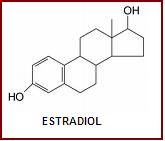
Since the WHI, some doctors have begun to preferentially prescribe transdermal estrogen, there being some data that it may impact clotting factors less than oral estrogen. Transdermal patches are a good option for women who want to stay with the so-called “bio-identical” estrogen, 17-beta estradiol. Taken orally, this molecule can have a shorter half life, and I have had more than a few patients need to take either higher doses of more frequent dosing to alleviate their hot flashes. For some women, however, patches can irritate the skin, so they are better off with oral.

Progesterone
Natural progesterone has become de rigeuer, although there are no really good data that it is any safer than Provera was. I do prescribe natural progesterone preferentially, because I find it is generally better tolerated than Provera. But I have no major objections to the so-called synthetic progestins, because natural progesterone can make some women very sleepy, even at low doses. (For most this is an advantage, insomnia being a symptom of menopause.)

Transdermal progesterone, while a very popular health food store item, is very variably absorbed through the skin, and not yet available in any reliable product for endometrial protection. As a result, it is not recommended to “balance” the estrogen part of HRT.

Some women cannot tolerate any progestin, oral, transdermal, natural or synthetic. The Mirena IUD might be an option for these women.

Non-Hormonal Options
For symptomatic women unwilling or unable to take HRT, newer non-hormonal options are being studied and offered off-label for treatment of hot flashes. The SSRI’s fluoxetine, paroxetine, venlafaxine and the anti-seizure medication gabapentin have been shown in small controlled trials to reduce hot flashes by about 65%. Not as good as estrogen, but for some women, enough. No large long term trials of these drugs have as yet been done.

Do you see what is happening? We are beginning to custom tailor the therapy to the patient – her needs, her symptoms, her concerns, her side effects. And her risks. Because, most importantly, doctors have began to weigh the risks and benefits of estrogen a little more carefully, patient by patient.

No more one size fits all. And that’s just better medicine, if you ask me.

The Plot Thickens…

Since 2002, the plot has taken a few twists. The first was the publication of data from the estrogen-only arm of the WHI. In that group, breast cancers were actually fewer in women who took Premarin alone, though not statistically so. (Of course, this data got much less attentionia atention than the combined hormone arm of the study.)

This difference between the data on estrogen-alone and combination HRT has led many to believe the the evil hormone is not estrogen, but progesterone. Or more specifically, medroxyprogesterone acetate, the progestin compound in Prempro. But is the so-called “natural” progesterone safer than Provera? Your guess is as good as mine. Again, no long term data.

The second twist has been an analysis of the younger women in the estogen-only arm of the WHI, those who began the drug in their 50’s, in a manner more typical to the way we gynecologists tend to prescribe it. In this group, there was not an increase in heart disease, but a suggestion of a decrease. This would support the hypothesis of a so-called “window of opportunity”, a period of as yet undefined time after menopause during which HRT, if started, might actually do all the heart-friendly things we all had thought it would do.

Recent findings from the Nurse’s Health Study also support this hypothesis, and suggest that for women who use HRT beginning at menopause, the risks of heart disease are reduced almost a third. A randomized, placebo-controlled trial to investigate this possibility is in the works, but don’t expect an answer anytime soon.

The relatively more favorable data from the estrogen-only arm has led science-saavy women to begin to ask for hormone regimens that use less progesterone. The problem with this approach is the ever-present risk of endometrial cancer from long term use of unopposed estrogen. I have some concerns about this – essentially treading off one low cancer risk (breast) for a higher one (uterine). Quarterly progesterone regimens are associated with higher rates of endometrial hyperplasia, and that has been my experience when my patients have tried these regimens. I have had better success with quarterly progestin regimens when they are combined with less than standard doses of estrogen. I have had one patient go to hysterectomy because she kept developing hyperplasia and was no longer willing to take progesterone of any kind, ever.

So, where are we now?

And so, four years later, we are practically back where we started. Maybe estrogen is good for the heart, as long as you start it early enough. Maybe the breast cancer risk isn’t from estrogen, but from progesterone. Maybe lower doses or transdermal regimens will prove to be safer. Maybe, maybe…

So how does a woman make a decision about HRT given all the unanswered questions? Her hot flashes will not wait for a better study to come along. And how does one practice medicine in this era of uncertainty? It’s not easy, I can tell you. You need to be clear in the face of fuzzy data. You must be internally consistent when externally, all is not. You have to be flexible, but not wishy-washy. It isn’t easy, but it can be done.

Up next…How I do it

Category: Second Opinions

Hormone Replacement Therapy – Part 1

I’ve been meaning for some time to pull all my thoughts together about hormone replacement therapy. The opportunity presented itself recently when I was asked to give a talk on the status of HRT four years after the WHI. After giving that talk, I realized that I had a lot more to say, so I am going to just say it all here.

This will be a four part, four day post. The first part is background on HRT use before the WHI, then discusses the WHI and its results. Part two addresses the response in the medical community to the findings of the WHI. Day Three will be TBTAM’s Rules for Prescribing HRT, and Day 4 will address the use of bioidentical hormones. So hop on board, the winds are fair and we’ve got a lot to cover…


Those Were the Days

Those were simpler days, the years prior to the publication of the WHI. “Simple” meaning that, for the most part, we had a “one size fits all” approach to managing menopause. You were a woman, you had menopausal symptoms, you had a heart — you got estrogen. It was that easy.

It seemed simple, but we were not stupid. There was more than a little scientific support for our approach to menopause. Dozens of well done, retrospective and cohort studies had all pointed to the same conclusion – women who took HRT had less heart disease than those who did not.

This conclusion made biologic sense. We knew that the onset of menopause was associated with an increase in the incidence of heart disease in women. Moreover, estrogen raised HDL, the good cholesterol, and lowered LDL, the bad cholesterol. Finally, there was indirect and animal evidence that estrogen caused vasodilation.

Turns out that estrogen also appeared to prevent osteoporosis. It was, and still is, is the most effective treatment for the symptoms of the menopause transition – hot flashes, night sweats, and vaginal dryness. Not to mention its effects on the skin, increasing collagen and decreasing wrinkles.

And the risks? Well, estrogen was known to increase the risk of thromboembolism. In addition, it had been known since the 70’s that it could lead to endometrial cancer, but that risk was alleviated if progesterone was added to the mix. Breast cancer, of course, was a persistent concern, showing up as a potential risk in a number of studies. But the results were inconsistent, even in meta-analyses.

Given that heart disease was the number one killer of women, and that the cardiac benefits seemed to be more consistently apparent than the breast cancer risks, there was a real hope in the medical community that the cardiopreventive properties of estrogen would outweigh the risks.

And yet, looking back at the review articles on estrogen written prior to the WHI studies, all the experts were clear that more evidence was needed before recommending HRT for heart disease prevention on a widespread scale. Almost every paper I read was careful to recommend individualized treatment, weighing the risks and benefits for each woman before prescribing.

As for the world of practicing docs, the primary indication for prescribing HRT in those days was still menopausal symptoms, but we had a much lower threshold for prescribing estrogen than we do now. It didn’t take much in the way of hot flashes for us to prescribe HRT, especially for women we thought might additionally benefit from the cardiac effects of estrogen. For some, a high LDL alone was enough reason to use estrogen. (Remember, we did not have the statins then). And more than a few physicians gave all their menopausal patients estrogen, regardless of symptoms. “My doctor said it was good for me.” is what some of my patients would tell me when I asked them at their first appointment why they were taking estrogen.

Overall, I would say that, prior to the WHI, estrogen was something we felt good about prescribing. We liked it and our patients liked it. It was one of those drugs that had a real and visible effect, which for the overwhelming majority of women was positive. Think about it – relief of hot flashes, insomnia, night sweats and vaginal dryness, prevention of osteoporosis, normalization of lipids, and the possibility of heart disease prevention. That’s one heck of a drug.

Big Pharma, as it turns out, also liked estrogen.


Wyeth and the WHI

Wyeth been the leader in the HRT market for years, spurred on in no small way by the publication in 1996 of “Feminine Forever“, a book which touted the wonders of estrogen in staving off the effects of aging. (The book, as it now turns out, was entirely underwritten by Wyeth. Why am I not surprised?)

Wyeth’s drug was Premarin, a proprietary mixture of conjugated equine estrogens. Equine – that’s a nice way of saying estrogens isolated from horses, specifically from the urine of pregnant mares. (I had read that if you crush the pill , soak it in water, and then sniff, it is clear where it comes from. I did not believe it until I tried it for myself. It’s true.)

I need to say at this point that, having prescribed Premarin extensively in the past and still occasionally now, that it is a very effective estrogen, and despite the smell, I have no real issue with its source. Many women do, however, and so I rarely prescribe it these days since there are numerous alternatives.

For the progesterone component of HRT, Wyeth had Provera, or medroxyprogesterone acetate. (Same stuff as in Depo-Provera, the birth control shot, but at a much lower dose). The two hormones are combined together as Prempro. I did not prescribe Prempro as much as I used Premarin, having moved towards micronized progesterone as soon as it became available, because I found it in general to be better tolerated than Provera.

By 1990, Premarin was one of the most prescribed drugs in the world, and was approved by the FDA not only for the treatment of both hot flashes and vaginal dryness, but also for the prevention of osteoporosis. When studies began to rack up showing that estrogen was also good for women’s hearts, Wyeth asked the FDA to approve Premarin for the prevention of heart disease. Of course, doctors everywhere were already prescribing the drug off-label for that reason. But with a formal FDA indication, Wyeth would be allowed to advertise for the indication, and we all know what Big Pharma advertising does to sales. It was sure to be a slam dunk, and a very profitable one at that, since the prevention market for a drug is absolutely enormous compared to the treatment market.

The problem was that all the data up to this point supporting the cardiac benefits of estrogen were from observational, retrospective or cohort studies. And there were those pesky little problems of breast cancer and blood clots that kept creeping into the study results. The risks appeared relatively small, but they were there nonetheless.

Despite this, the FDA’s advisory committee had actually recommended that Wyeth be given the cardiac indication based on the observational data. But in an unprecendented move, the FDA went against their own advisory commitee’s recommendation and asked for a randomized, placebo-controlled trial. The trial Wyeth would begin was the HERS trail, a study of HRT use in women with pre-existing heart disease, believing, I’m sure, that estrogen’s protective effect would show up quickly in this group at high risk. (It did not, as we found out later.)

At around the same time, feminists at the NIH, FDA and on the Hill were pushing for federal funding for research in Women’s Health. Congress responded by funding the Women’s Health Initiative, a large prospective study of women’s health enrolling over 60,000 women for 15 years. The jewel in the crown of the WHI was a randomized, prospective, placebo-controlled trial of hormone replacement in menopausal women. The study was designed to determine once and for all whether or not estrogen prevented heart disease and treated osteoporosis, and to answer the lurking question about breast cancer risks. Everyone, including the study investigators, expected favorable findings for estrogen in terms of heart disease.

But which estrogen to use? Well, Premarin and Prempro were the most prescribed hormones at that time, so it made sense (although maybe not biologic sense) to use them. And Wyeth? Well, they were more than happy to supply drug for the study. And that’s how Premarin and Prempro became the drugs used in the WHI.

There were two study arms to the WHI – one arm for women with a uterus, who received either Prempro or placebo, and a smaller arm for hysterectomized women, who recieved either Premarin or placebo.

The Bombshell Results

The first sign of trouble came when the HERS study results showed no benefit to HRT use in women with pre-existing heart disease, despite favorable effects on blood lipids. In that study, there was actually an increase in cardiac events in the first year of hormone use, probably due to clotting effects, that disappeared in the subsequent years such that overall, no difference was found in cardiac mortality among users and non-users of HRT.

Then came the results of the WHI, results that came earlier than expected when the Data Safety Monitoring Board decided to stop the study prematurely. Because as we all know now, Prempro did not to prevent heart disease in the WHI. Not only that, it actually appeared to increase that risk, along with that of blood clots and stroke. At least among the women in the Prempro arm of the study, who were on average 10 years post menopausal and 64 years of age at enrollment.

WHI results from the WHI Newsletter

To make things worse, breast cancers were also increased among users of Prempro in the WHI, to the tune of 8 additional cases for every 10,000 women for every year of use. Not a statistically significant increase if you want to get picky. But, since this was a prevention and not a treatment trial, the bar for safety was much higher since subjects were supposedly healthy to begin with. And the Data Safety Monitoring Board was not about to accept an increase in breast cancer if there was no cardiac benefit. Even the benefits in terms of bone and colon cancer were not enough to tip the balance in favor of HRT.

So, they stopped the trial. (The estrogen-only arm was allowed to continue till 2005, when increased stroke risks stopped that study.) Sure makes sense to me.

Whether the whole study design itself made sense in the first place is another story. The study population was deliberately weighted towards older women. Since most cardiac events occurred among older women, benefit would show up earlier in this group. Younger women with menopausal symptoms were specifically excluded from the WHI because it was felt to be unethical to give these women placebo. Of course, this is exactly the opposite of how HRT is prescribed in the real world, and remains the biggest limitation of the WHI in my humble opinion.

Which raises the question – Is an average age of 64 just too late to start estrogen? By that age, arterial plaque is likely to be long-established, and adding in a drug known to increase risk of blood clotting may not be such a great idea. Some experts still believe that if estrogen is given earlier in life, say at the menopause, it may still be preventive for heart disease. Think of it this way – Running is good for you, and can prevent heart disease, but if you are not a runner, have blocked coronaries and try to run a 10K, you might just trigger an MI, which would not be good. It’s an intruiging hypothesis, but at the time of the publication of the WHI, it was just that. An idea.

In 2002, like it or not, the bottom line was that HRT was associated with an increase in the risks of heart disease, stroke and breast cancer. In a disease prevention trial, that just doesn’t hold water, especially when the primary outcome, heart disease, was not prevented anyway.

And that, my dears, is why they stopped the study.

Up next…The Reaction

Category: Second Opinions

National Honor Roll Scam – Update

Some months ago, I posted about the National Honor Roll, a stealth marketing scheme disguised as an academic achievement award and scholarship program.

The scheme starts with surveys that our children are asked to complete in the classroom, supposedly for college information. The info then gets shared with the National Honor Roll, the scholarship cover organization, while its partner the Student Marketing Group creates a huge marketing database that they then sell for profit. Read more about it here and here.

If you have any doubt as to the true nature of the National Honor Roll, note this press release below from Nelnet, a publicly-traded student loan finance company:
_______________________________________________
For Release: 3/29/2005
Contact: Sheila Odom, 402.458.2329

Nelnet announces acquisitions of Student Marketing Group and National Honor Roll

(LINCOLN, NE) – Nelnet, Inc. (NYSE: NNI) announced today it has acquired Student Marketing Group, Inc. and National Honor Roll, L.L.C.

Student Marketing Group is a full service direct marketing agency providing a wide range of products and services to help businesses cost effectively reach the middle school, high school, college bound high school, college, and young adult marketplace. A division of Student Marketing Group, College Bound Selection Service provides marketing services and college bound student lists to college and university admissions offices nationwide. In addition, Student Marketing Group operates AllScholar.com, a free scholarship search Web site.

National Honor Roll recognizes middle and high school students for exceptional academic success by providing publication in the National Honor Roll Commemorative Edition, as well as scholarships, a College Admissions Notification Service, and notice to local newspapers and elected officials.

“Student Marketing Group and National Honor Roll each bring a strong reputation and a wealth of different experiences building marketing relationships with students and schools,” said Stephen Butterfield, Vice Chairman and Co-Chief Executive Officer of Nelnet. “These acquisitions will further diversify our revenue stream and provide an opportunity to leverage their intellectual capital and wealth of direct marketing expertise in our future operations.”
__________________________________________

Category: Considerations

Country Fair, City Fair

Fall Festival
 Forksville, Pa


6th Avenue
New York, NY


A Smoke-Free Story

Bar workers in Scotland reported a 33% reduction in respiratory symptoms just 2 short months after smoke-free legislation was enacted in that country, according to a study reported this week in the Journal of the American Medical Association. Objective measures of respiratory tract inflammation and pulmonary function were also significantly improved. (JAMA.2006;296:1742-1748.)

Here in New York City, we passed similar smoke-free legislation in 2003, making ours one of the toughest anti-smoking laws in the United States.

I like to think I had something to do with that…

She was 32 years old, married and head waiter in a swanky hotel bar where smoking was prevalent. So much so that it had become known among the workers there as “The Cigar Bar”. She wanted to get pregnant, but was afraid of exposing her fetus to such large amounts of second hand smoke.

“I need a letter from you to my boss saying that too much second hand smoke is bad for my baby, and that I should be transferred to a different restaurant in the hotel. He doesn’t believe me when I tell him this.”

Of course I wrote the letter. I also gave her a presciption for prenatal vitamins.

“Call me when you’re pregnant”, I said, smiling.

But when I saw her a year later, she still had not left the bar or started her family.

Her boss had agreed to transfer her from the hotel bar to the breakfast cafe. But with the transfer, her income would be cut almost in half ; breakfast cafes just don’t generate the kind of tips that bars do. Without the income, she could not save for the down payment for an apartment big enough to raise a family. So she stayed at the cigar bar, saving as much of her income as she could.

“I figure I need to tough it out there another year, then I can quit and get pregnant,” she explained.

“But you’ll be that much older,” I gently advised. Almost 35.”

“I know’” she said, her eyes filling with tears. “But what else can I do? I really need that income. And if you think I have it bad, it’s even worse for some of the others there.”

Then she told me about her friend, a bus boy in the bar whose asthma had worsened severely since he had begun working there. His co-workers had taken him to the emergency room more than once that spring, gasping for breath, his inhaler useless. He continued to work in the bar because the tips there were too good to turn down, almost every penny of them sent back home to his wife and family in Peru.

She brushed her tears aside, angrily. “What good will he be to his family is he dies?” she said.

“There’s something you can do”, I told her.

I gave her the name and number of a woman I knew who worked with the anti-smoking coalition in New York City. They were actively lobbying for a bill that would ban smoking in restaurants, and seeking individuals to testify at the public hearings scheduled the following month at City Hall.

But my patient refused to take the number. “I don’t want to lose my job. If the management finds out I’m working against them…”

“Look, I can’t tell you what to do. But your story, and your friend’s story, needs to be heard. Just make the call. I’m sure there’s a way to protect your privacy if you really want that.”

I pushed the number gently across the desk.

“Call her.”

As it turns out, she did call that woman. And later that fall, both my patient and that bus boy willingly and openly testified at the City Council Hearings in support of the bill that would ban smoking in NYC restaurants. I heard they were among the most compelling witnesses of the day.

Shortly after that hearing, the New York City Council passed the Smoke Free Air Act of 2002, 47 votes in favor, with 2 abstentions. Mayor Bloomberg signed it into law in March 2003.

And my patient? Well, both she and the bus boy kept their jobs. I hope his asthma is better. Unfortunately she ended up needing in-vitro fertilization, and last I heard, was still trying to get pregnant…
________________

For information about second-hand smoke in the workplace, and to find out how you can get anti-smoking laws passed in your area, visit The Americans for Non-Smokers’ Rights Website.

For information about tobacco control laws nationwide, see the website of the American Lung Association.

Category: Second Opinions

Kugel Calories

It’s Rosh Hashana, the Jewish New Year, and as usual, we gather with Mr TBTAM’s family on the Saturday evening that is nearest to the actual holiday – a little custom I like to call “Celebrating the High Holy Days of Convenience.” It’s not exactly kosher, but it is sensible, and I highly recommend it for families spread between two cities – in our case, those cities being New York and Philadelphia. Everyone is always able to come to dinner, and those who want can still celebrate with their spouses’ families on the proper day so no one feels slighted. The only downside to the custom is that if you do this at Passover, and are not careful, you can end up doing 3 Seders. This I do not recommend, especially if you have small children.

Dinner tonight was a group effort, with everyone making or bringing something. I made mushroom barley soup, Mr TBTAM made cucumber salad, Irene made the desserts and the top rib (didn’t you know top rib is the new brisket?), Mr TBTAM’s sister made the potatoes and the veggies, his cousin brought the Challah, and our niece made the Kugel (with Grandma’s help).

I don’t have time to share all the recipes, so I chose just one. This wonderfully delicious Kugel recipe came to Irene from a friend some years ago, although she has of course modified it. As she says, it is really more of a soufflé than a kugel, with a few noodles thrown in to keep it legit. It is deceptively light, its levity belying the ridiculously high fat content of its ingredients. However, I did a little calculating and was pleasantly surprised to find out that if you cut this recipe into 30 pieces, as we did, then each piece is only 154 calories!

So go on, have a piece (or two). It will give you a little extra fuel for your fast next week on Yom Kippur. For those of you who do not plan to fast, you can head over to Kalyn’s Kitchen for a little South Beach Diet atonement.

Happy New Year!
———————————————–
KUGEL

8 large eggs
½ lb. cream cheese, room temperature, cut in small pieces
½ lb. melted butter, cooled
2 tsps. vanilla extract
1 pint sour cream
½ tsp. salt
½ cup sugar
3 cups fine egg noodles, cooked (about 2 cups uncooked)
½ cup raisins (optional)

In mixer beat the cream cheese until smooth. Add eggs and beat for 15 minutes. Add sugar, melted butter, sour cream, salt and vanilla extract and continue beating until smooth and well mixed. Fold in the cooked noodles and raisins. Pour into a greased 9 by 13 inch baking pan. Bake in 350 degree oven for 50 to 60 minutes until just set. Allow to cool a little before cutting into squares. Check at 45 minutes. Depending on your oven it can get over done, especially if you use a pyrex pan, so watch it carefully.

Category: Food

Rooftop Harvest

Okay, so it’s not exactly a bumper crop, maybe 25 apples total between our two container-grown trees, but it’s our little harvest, and we’re proud of it. The apples taste really good and have that great crisp sound when you bite into them. They also make a nice applesauce.

APPLESAUCE

1/2 cup orange juice
6 apples
1 cinnamon stick

Rinse the apples in water and dry. Do not peel. Cut into quarters and core. Add apples to a heavy pot with orange juice and cinnamon stick. Cover the pot and cook over medium heat till the apples are soft. Remove cinnamon stick. Run through a mill (or press through a fine mesh strainer). Serve warm.

Category: Food

Converting to an Electronic Medical Record: Advice (and Cookies) From a Doc Who’s Been There

Over the past 12 years, I’ve gotten my office to run like a well-oiled machine, operated by a top notch office staff and fueled by the various office systems I developed myself. These included a tickler system for lab and radiology results, a patient chart organized so that I could retrieve whatever information I needed in an instant, patient information sheets I’d written myself, and, if you’ve been reading this blog for awhile, you already know about my little system for keeping track of return phone calls. It was mine, it worked for me, and gosh darn it, I liked it.
Going to an electronic medical record meant chucking all that away and starting from scratch using someone else’s system. It wasn’t easy.

It’s not as if I hadn’t known it was coming. I was on the implementation committee for 6 months prior to the go live date, and worked with the developers to customize and learn the system.

But that didn’t help as much as I had hoped when go-live finally came, the patients were streaming in, charts were backing up uncompleted and my computer inbox was crammed with lab results and patient calls and refills requests and staff messages.

To say I was stressed would be an understatement.

The hardest part was letting go of my old ways and trusting the new system to work for me. The good thing was that I did not entirely trust it, and so identified some bugs that needed fixing before they impacted the quality of care and the bottom line.

Things are getting better and better every day, and overall I would say the new system has more advantages than disadvantages. Results come back in real time, consult reports are available online, and I can retrieve a patient’s record from anywhere as long as I have my laptop and a good connection. The biggest plus is that I get to leave the office earlier, because I can do my chart work from home instead of staying at the office till 7 pm every day.

For those of you considering or about to undergo a similar conversion, I’ve compiled a list of tips for making the process go more smoothly. Some of these things we did right from the get-go, others we discovered during the implementation itself, and some are things no one told us that we wished we’d known beforehand. I hope it is helpful for those of you about to undergo a similar conversion.

TIPS FOR A SMOOTH EMR CONVERSION

  • Cut back your volume
    I recommend that you cut visit volume by 50% for the first month, then increase to 75% for the next month, then back to full volume by three months. Then be prepared to be swamped, because the first 3 months at full volume will be extremely difficult – count on working extra hours to keep caught up. It takes at least 6 months to a year to get up to speed with a new system. Which leads me to item 2…
  • Keep your Life Simple
    Don’t schedule any major changes or take on any major commitments for at least 6 months. That includes getting a grant or a chapter written, writing a new lecture with slides, planning a wedding, undergoing childbirth or taking that big trip to Africa. You are about to change your day-to-day life drastically. Do not underestimate how stressful this will be, both at work and at home.
  • Keep the paper reports for awhile
    Do not shut off the flow of paper laboratory and radiology reports until you are 100% sure that all test and radiology results are coming back to your online system, and that the system for tracking unresolved reports is working.We did this, and found that by 6 weeks we were able to turn off the paper laboratory systems, probably because they had been printing directly to our office printer for a few years, and we had already worked out the bugs.At 3 months we are still not 100% reliable with radiology report feeds, so we continue to receive paper reports for all radiology tests ordered. This is where a good part of the additional work hours predicted in item 2 arises. The dual system will drive you crazy reconciling what is back and what is not. But if you don’t do it, something will slip through the cracks, I promise.
  • Ask your patients to do some of the work
    Have all patients complete a new patient intake form that includes past medical, surgical and family history, meds, referring docs, etc. (Some systems are designed to let patient enter this information directly, ours is not.) Use this to complete the historical sections of the online chart, or scan it in somewhere easily retrieved at every visit. It is much faster that trying to review the old chart and catch all your patient’s history that way. You should still review that chart to be sure you got it all, but that part goes quickly.If you have a good nurse, PA or NP, this is a great role for them. But be sure they know what they are doing, since you will be the one liable for missed information.
  • Don’t forget allergies
    Make sure the allergies section of the EMR is completed at the first online visit.
  • Don’t give up your old chart too soon
    Keep your paper chart until you have seen the patient at least once electronically, and don’t give it up until you are comfortable that all the historical data you need to take care of the patient has been electronically entered. Not all conversions will have this option, and it is more budensome on your staff, but if you can, do it.The reason is simple – it just takes much longer to skim through a scanned chart than a live one. I learned this one the hard way, because I had my all my old charts scanned in at go live. I hate having to review my old charts as PDF files.
  • Take advantage of computer shortcuts
    Learn keyboard shortcuts early in the implementation. The keyboard is always faster than the mouse. And use macros, smart texts and smart phrases as much as possible.But be wary of any shortcut that auto-completes the online form. The last thing you want is data being entered for elements of the exam you did not actually perform.
  • Do a compliance audit early on in the implementation
    You don’t want to find out 6 months in that there are problems with documentation or coding resulting from the new system. By doing chart reviews early on, we discovered that certain CPT codes needed to be updated or added to the online system and that some very minor changes in the visit template led to better charge capture and less errors.
  • Work with your IT team
    – Give feedback early and often to the development and implementation team. They want and need it in order to customize the system properly to your practice. If you can, get on the initial development team, so that your input is heard from day 1.- Get to know the physician IT team leader and give your feedback directly to that individual on any issue that you feel impacts quality of care. The IT support team may not have the medical background to reliably distinguish simple technical issues from those that impact quality of care and need to be sent up the ladder. Such issues are probably affecting other practices as well, and the physician IT team leader needs to know about them.- Be patient with the IT team. They did not design the system, they are not perfect, and they are probably working their asses off to meet timelines and deadlines.- Keep a list of every issue you identify and refer to the IT team, then meet regularly with them and get follow up on every issue. Sure, it’s their job to do that, but they are probably working to implement more than one site at a time and things can get lost. Remember that ultimately it is your practice and your tail if things go wrong, so take responsibility from day 1 for getting it right.
  • Ergonomics, ergonomics, ergonomics.
    You will now be spending enormous amounts of time at the computer. (Unless you have a blog, in which case you already know this.) Sit up straight, get that screen at the right level, and that mouse where it won’t hurt your wrist. Hopefully you will have you exam rooms set up so you don’t have to turn your back to the patient to access their chart online.
  • Keep your options open
    Don’t tie you down to a single workstation before you really find out how your work flows during office hours. Make sure there are plenty of places where you can go to complete a chart or print out a prescription before a patient leaves the office.Right now, it is still faster for me to leave the room and complete the chart in my office, because the patients have to get dressed and the room turned over to another patient. Once I get faster at inputting data directly online in the exam room while I am talking to the patient, I expect this may change. But at least I have options, and that means I can keep patient flow moving.
  • Monitors: the bigger, the better
    Get a monitor screen big enough to easily read a full page pdf image. If you are viewing old charts and outside records as PDF files, it is much faster to page through a full screen view than to have to scroll down every page to get to the bottom because the full page view is too small to read.
  • Handling the residual paper
    You’ll still be moving a fair amount of paper through your office, such as old records, snail mail correspondence and outside radiology and lab reports. So get the fastest scanner your budget allows. Scanning is time consuming and staff intensive, so it will be money well spent up front.Don’t let the office-based scanning get behind. Fit scanning into the patient visit work flow as much as possible. If you batch it, it will pile up. Trust me on this. Farm out large amounts of scanning (like old charts) to a reliable vendor.Get a shredder for the paper you will need to discard after scanning. Better yet, subscribe to a shredding service.
  • Schedule a massage for week one
    No explanation necessary. This will help immensely with the next item, which is..
  • Be nice
    The conversion is just as hard for your staff as is it for you. Trust me. You are all on the same side. Getting angry, frustrated and annoyed helps no one, so get over yourself and just be nice.Which leads to my final, and most important piece of advice…
  • Bring cookies
    During our EMR implementation, Eric, our IT support guy, brought cookies every single day. We learned to love him for it. Whenever I stormed into his office, annoyed and frustrated, he’d offer me a cookie. I think it was those cookies which made our conversion a success. (Luckily I didn’t storm into his office more than once a day, usually around 4 pm…)

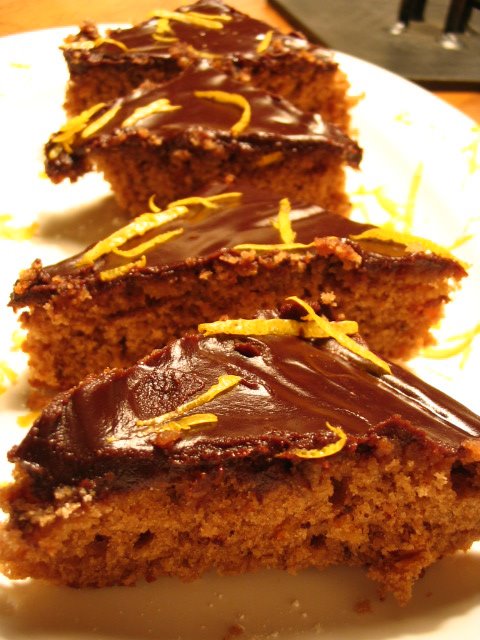
Here’s an easy cookie recipe that you can make and bring in to your office staff and the IT team when you decide to go electronic. It will make things go more smoothly, I promise.
—————————————————————————————————-

CHOCOLATE ORANGE TRIANGLES FOR AN EMR CONVERSION

2 oz.unsweetened chocolate, in pieces
2/3 cup all-purpose flour
1 stick unsalted butter, melted
2 large eggs
½ cup sugar
½ cup orange marmalade
1 tsp vanilla extract
¼ tsp salt
½ tsp baking powder
1 oz. Semisweet chocolate, in pieces

Grated orange zest for garnish
Chocolate glaze (recipe follows)

Preheat oven to 350 degrees. Pulse the unsweetened chocolate with the metal blade of a food processor 4 times, then process until finely chopped, about 1 minute. With the motor running pour the hot butter through the feed tube in a slow, steady stream and process until the chocolate is melted, about 30 seconds. Scrape down the work bowl.

Add the eggs, sugar, marmalade, and vanilla and process until combined, about 5 seconds. Add the flour, baking powder, salt and semisweet chocolate and pulse until combined, about 5 times.

Pour into a greased 8-inch square baking pan and bake in the preheated oven until a cake tester comes out clean, about 30 minutes. (watch carefully). Cool on rack.

Spread with the chocolate glaze and refrigerate until set, about 30 minutes. Sprinkle with the orange zest, cut into 2-inch squares, and halve the squares diagonally. Makes 32 cookies.

Chocolate Glaze
2 oz semisweet chocolate, in piece
2 tbsps. Unsalted butter
2 tbsps. Milk
1/4 cup confectioner’s sugar
1 tsp. Vanilla extract
Pulse the chocolate with the metal blade 4 times, then process until chopped finely, about 1 minute.

Combine the butter, milk, and sugar in a small saucepan and bring to a simmer, about 4 minutes. Stir in the vanilla. With the motor running pour through the feed tube in a slow, steady stream and process until the chocolate is melted, about 30 seconds.

(Recipe from Irene, who may have gotten it originally from Cook’s Illustrated, I’m not sure..)

Category: Second Opinions Food

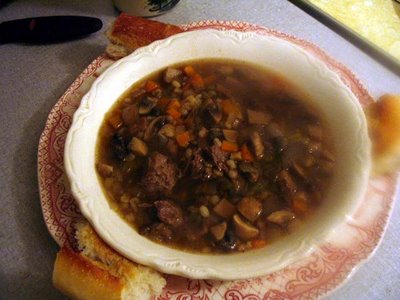
Mushroom Barley Soup Memories

It’s unusually cold, even for December, that first winter in New York City. I’m living in the East Village and studying for grad school finals with my lab partner Robbie, who I think befriended me mostly so that I could tutor him in biochemistry, which he happens to be failing. In return, Robbie is getting me all tied up in knots by refusing to become involved with me because he is, as he puts it, no good for me.

Think Billy Crystal in the first part of Harry met Sally. Now make him cuter, even more cynical and a real sleep-around, then kick him out of his previous school for dealing pot and you’ve got Robbie, the not-so-nice Jewish boy from Brooklyn. An irresistible draw for a 21-year old Catholic girl still fresh from the Philadelphia suburbs.

It’s been dark for over 2 hours, and we’ve been sitting at the kitchen table in my 3rd Floor walk-up on St Mark’s Place since just past noon, reviewing the pathways for carbohydrate metabolism. “I’m starving”, says Robbie. “Let’s go for some Deli.”

“What’s that?” I ask.

He looks at me like I am the most pitiful bumpkin on the face of the earth. In fact, that is the word he actually uses. “Pitiful” he says, pulling me out of my seat. “C’mon. My treat.”

It was to be his only generous gesture in our entire relationship, aside from his initial refusal to get involved with me.

There is a line at the door of the 2nd Ave Deli, something I had never before seen at a restaurant. Especially on such a cold night. The maitre-d’ (could it have been Abe the owner himself?) takes pity on us, and passes out little plastic containers of warm applesauce and plastic spoons to the waiting diners huddled in the blustery entryway.

“We should have ordered in”, mutters Robbie, as he stomps his feet to keep warm. He is wearing only a hooded sweatshirt with a jean jacket on top.

I lick my spoon from the warmth of my big brown fur coat (10 bucks at Trash and Vaudeville). Robbie hated that coat. “That wouldn’t help,” I correct him, still in tutoring mode. “We’d still have to be out here. Plus, I don’t see a take-out window, do you?”

After staring at me for a full 30 seconds with a look of incredulity and mild disdain, Robbie explains the fine art of New York City Restaurant Delivery.

I give him a look of incredulity but not-so-mild distain. “I cannot believe that so many people have the nerve to call another human being and ask them to bring them their food in bad weather when they can go out and get it themselves!”

“Give yourself some time,”replies Robbie.

He was right, of course. But it would be almost a full year before I could gather the Chutzpah to order in for myself, one rainy night in the following November. The delivery boy turned out to be an old man. I felt so guilty I think I gave him the entire contents of my wallet as a tip, and then didn’t order in again for a year. Don’t worry – I’m over it now.

The line outside the Deli moves surprisingly quickly. Soon, they let us inside, past the long deli counter to a small table in the middle of the noisy, bustling room, where we struggle to fit our notebooks on a tabletop already crammed with water glasses and bowls of fresh pickles and cole slaw.

And it is there, while sitting at that table grilling Robbie over and over again on the biochemical reactions of the Kreb Cycle, that I have my first bowl of mushroom barley soup.

Eleusinian Initiation Rites

Now, you may not know this, but barley has religious significance dating back to ancient Greece. There, it was used to make kykeon, a nectar used in the Eleusinian Mysteries, which were the initiation ceremonies for the cult of Demeter and Persophone. It is said that the barley drink, now thought to have been contaminated with ergot, a neuroactive mold, led to psychedelic experiences that convinced the initiates that they had witnessed unspeakable, divine mysteries that satisfied the deepest longings of the human heart.

Is it so surprising, then, that I was to be initiated into the mysteries of the New York Delicatessen by ingesting that same magical grain? Believe me, that bowl of mushroom barley soup was the closest thing to a religious experience that I have ever had. I had drunk the holy water, been baptized in the broth and seen the light. And I would never be the same again.

I remember calling my father that night. “I’ve been raised in the wrong religion. Forget the church – I’m converting to Deli!” I hoped he understood. This was, after all, a man who ate Kielbasa like it was the holy host itself.

Soon thereafter, I would experience my first hot pastrami sandwich, my first cheese blintz and my first bowl of matzah ball soup. I would learn not to order my corned beef sandwich with cheese after a waiter gave me “the look”. I would know the difference between plain and marble rye and what a Dr Brown’s Cel-Ray was. I would, in short, became a New Yorker.

Epilogue

Dismantling the 2nd Ave Deli (more photos at Eater.com)

Not surprisingly, Robbie and I parted ways shortly after he passed biochemistry and, unable to find me to share the good news (I was home in Philly for Christmas), slept with my best friend Shari to celebrate. Shari was a fellow native New Yorker, and equally experienced, so I guess it was a good match, at least for one night.

Sadly, too, the story of the 2nd Avenue Deli was also to end, though not for some years (and for me, many meals) thereafter, when that fabled restaurant closed its doors forever in January, 2006.

So, I hear you asking, why tell this tale now?

Contrary to what you may think, it is not because I have found the recipe for mushroom barley soup in the 2nd Avenue Deli Cookbook (although it is, indeed, in that book, and on Epicurious).

No, it is because I want to tell you that last weekend I made a mushroom barley soup that is even better than the one I first tasted at the 2nd Avenue Deli once upon a time. You read me right. Even better. It is based almost entirely upon a recipe from, who else, my mother-in-law Irene.

As post-impressionism was both an extension of Impressionism and a rejection of that style’s inherent limitations, so this soup, made in the style I like to call post-Deli, both reflects and improves upon its predecessor, the great mushroom barley soup at the 2nd Avenue Deli.

And so I share it with you now, Dear Reader, in the hopes that when you make and enjoy it, you will think of that fabled dish once eaten in that now lost New York City landmark. As for me, my memories will be of a more personal nature, of a cold December night in the East Village when my New York gastronomical conversion began.

POST-SECOND AVE DELI MUSHROOM BARLEY SOUP

This is a very interesting recipe – you basically make soup twice – first a double broth, then removing these veggies, and making the soup itself with fresh veggies, cooking the meat even longer until it is succulent. It’s even better the second day.

1 tbsp olive oil
1-1/2 lbs. top rib, (flanken, with bone)
2-3 cans beef, veggie and/or mushroom broth (I used both beef and veggie)
Water to cover
1 onion, studded with two cloves
2 carrots, cut in thirds
1 large rib of celery, cut in thirds
2-3 sprigs fresh thyme
1 bay leaf

1 large onion, chopped
1 carrot, diced
1 rib celery, diced
½ cup barley, rinsed
1-1/2 lbs. fresh mushrooms, chopped coarsely. (I used a combination of white and baby belles)
A few dried porcini or shitake mushrooms soaked in hot water for 20 minutes
Salt and pepper

Heat olive oil in a large soup pot. Lightly salt and pepper the top rib and brown it in the oil. Add broth and enough water to cover meat. Add cut onion, carrots, celery, thyme and bay leaf. Bring to a gentle boil and simmer until meat is almost tender (about an hour).

Remove the cooked vegetables and discard or use separately. Add diced carrot, celery, onion, barley, and salt and pepper. Simmer ½ hour. Add all mushrooms and the liquid in which the dried mushrooms were soaking (strain it first). Continue cooking about another ½ hour or until the meat is tender. If you have time, refrigerate overnight and remove the fat. (I just skimmed it ater rmoving the veggies the first go round, and ate it that nght. It was not too fatty.) Reheat and enjoy!

If soup is too thick, add water to correct consistency. For an extra special flavor add two marrow bones when you add the chopped vegetables.

Category: Food

The Katrina Blog Project

One of my favorite medical bloggers, Dr Hébert, is posting a day-by-day diary of his life during Katrina on his blog Dr Hébert’s Medical Gumbo. He’s dubbed his account The Katrina Blog Project.

“This is the story of what a disaster looks like through ordinary eyes. It is like Exodus written not from Moses’ viewpoint but in the words of the last Israelite pushing his cart across the muddy bottom of the Sea of Reeds.”

Dr Hébert lived in St Bernard’s Parish, which was in the path of the eye of Katrina and was completely devastated by the hurricane and the massive storm surge that followed.

The blog starts Friday, August 26, and is currently on day 5. It’s a riveting, personal account that I encourage you all to read.

Me and Mr Bikram

This past Saturday, my friend L. talked me into signing up for a week of yoga classes at Bikram Yoga NYC. Of course, like any reasonable person who knows little to nothing about Yoga, I thought Bikram just happened to be the name of the yoga studio.

Boy, was I wever wrong.

MEET MR. BIKRAM

Bikram Yoga is not just the name of the yoga studio. It is the name for a school of Yoga developed by a guy named Bikram Choudhury. (That’s him up there, showing off. )

Mr. Bikram’s yoga is a copyrighted series of 26 standard asana Yoga poses performed over a 90 minute period, and”designed to scientifically warm and stretch muscles, ligaments and tendons in the order in which they should be stretched.”

Bikram claims to have cured his knee problems as a young man with this Yoga method. He then came to the US at the urging of the likes of Shirley MacLaine and Richard Nixon in the 1970’s, and opened franchises across America to spread his gospel. Truth be told, he is a bit of a controversial figure whose American business ways have led some to nickname him “McYoga“.

The Bikram Yoga Poses (from BikramYoga Madrid website)

THE CLASS

Looks like fun”, I said to L. as we stared at the poster of the 26 poses in the school lobby. “I’m pretty sure I can touch my toes if I bend my knees a little.”

Just before class, the nice guy standing next to the sign-up desk advised that I might want to purchase some vitamin C and minerals to take for my first class. I turned him down, figuring that I’d already sprung for the class, a rented mat and towels, and a big bottle of water.

“This place makes it’s money like the movie theater does on popcorn”, I muttered to L.

Wrong, again.

Because there was one little teensy-weensy detail about Bikram Yoga that I didn’t know at that time. It so happens that Mr. Bikrams’ classes are held in a room that is heated to (are you ready?) 104 degrees Fahrenheit. You read me right – 104 degrees. (For my readers outside of the US, that’s 40.5 degrees Celsius.) According to Bikram, the heat is necessary to keep the muscles warm and prevent injury.

Thanks, L.

As we entered the room, the heaters were blowing despite the 80 plus sunshine outside. Suffice it to say that we were sweating before we even laid our mats down. Good thing I rented those towels…

Our teacher (who, I should mention, was wonderful) took us through Mr. Bikram’s copyrighted series of 26 poses at a pace that I know was relatively easy, demonstrating for us while we rested between moves, urging us not to push ourselves, even giving me her towel to use to extend my stretch when it became evident that I could not reach my heels.

And in terms of the poses, I did much better than I would have expected. As I had discovered in other yoga classes, I found I have lots of flexibility in my lower spine, none in my upper, and that being overweight gets in the way of a good pose. But I held my own, I thought.

Till the class was over.

At that point, standing up after taking a little rest in “corpse pose”, I practically fell flat on my face from dizziness. And, as I went to put on my sandals, which had slipped off so easily when I began class, I found my feet were so swollen that I had to loosen the straps just to get them on.

L. wanted to walk all the way down to the river for a little al fresco lunch.

“Air conditioning”, I simply said, and that was that. We went for a nice healthy lunch, and I spent the rest of the day feeling like a damp dishrag.

THE AFTERMATH

The next day, Sunday, I felt even worse – nausea, headache, feverish and fatigued down to my bones. To compensate, I drank tons of water. Wrong move – my feet swelled even more, a situation aggrevated by sitting at the computer till all hours cleaning up the trojans that had crashed it via my husband’s email inbox. (E-email me if you want advice on this, I am now an expert…) At 1:30 am, I hit the sack feeling like I would never get out of bed again.

And then, the oddest thing happened.

I awoke at 6 am Monday feeling refreshed, alert, headache-free and more relaxed than I have felt in months, maybe years. We’re talking a sense of relaxation and calm that was peppered with energy. Still with swollen ankles, but happy as a clam. I literally floated through the day.

It lasted about 24 hours.

By Tuesday, I was back to my usual stressed-out, neck tightened, migraine-any-minute-now state. And my legs? +2 pitting edema up to mid-shin. I hadn’t seen ankles like those since my 39th week of pregnancy. They stayed that way till today (Thursday).

THE ANALYSIS

So, what happened to me?

According to the National Weather Service, Mr Bikram’s room had a heat index of 119 – in the “danger” range where “sunstroke, heat cramps or heat exhaustion are likely and heatstoke is possible with prolonged exposure and/or physical activity.” (Hmm…like 26 poses?)

So I’m sure that on Saturday and Sunday, my symptoms were the result of a mild case of heat exhaustion. Given that I tried to drink plenty of water during and after class, I expect that I inadvertently became both sodium depleted and over-hydrated (hypervolemic hyonatremia in med-speak). Which made me feel worse. And, in this particular situation, the osmotic forces generated by the imbalance between the hypo-osmolic serum and the relatively hyper-osmolic tissues leads to edema (swelling).

As this recent article in the NY times tells us, I did exactly what they are now advising marathon runners not to do. Because hyponatremia, at its extremes, can cause cerebral edema and even death. Experts now advise drinking limited amounts of electrolyte-laden fluids instead of tons of water.

THE UNEXPLAINED

Okay, so I’ve explained why I felt so bad Saturday and Sunday. What I cannot explain is why I felt so good on Monday. I’ve gone through everything I did, ate or drank for the prior 72 hours and the only thing different for me was that darned yoga class.

Now, the Bikram-Yoga folks believe that all that sweating releases toxins from the body. YEah, right. I never bought that sort of talk. Whenever anyone starts to talk about “toxic cleansing” I give them a lecture on the glories of the liver, colon and kidney, the mop-up crew of the human body.

But then again, I’ve lost track of the number of times my basketball and tennis-playing husband has commented on “how good it feels to sweat” whenever I complain about his damp gym shorts and sopping t shirts hanging on the shower rod. This guy lives on sweating, I swear.

Come to think of it, Mr TBTAM is probably the most relaxed, calm and happy person I know (except when he gets to thinking about the current state of American government…) It’s one of the reasons I married him.

Could it be that sweating really is the secret to happiness? Or was I just feeling so good in comparison to how bad I had felt in the acute throws of hyponatremic heat exhaustion?

I’ll never know. Because, although I have 2 more days left in my one week Bikram Yoga trial, I have too much to do in those 2 days to risk feeling that bad again.

But maybe some day soon, when I have the time to spare, I’ll try again. But next time, I’m bringing my own mat and towel, and drinking Gatorade instead of water. _______________________________________________________________

– See a 60 Minutes interview with Bikram Chadbury here.
– Read a New England Journal article about marathon-induced hyponatemia.
– For patients: Heat Exhaustion and Heatstroke: What You Should Know
– For Physicians: Heat Related Illnesses

Caegory: Second Opinions, Considerations.

My Faustian Dilemma

Faust in His Study: Rembrandt von Rijn (1606-1690)
A new birth control method is about to hit the US markets – It is a single-rod implant that contains progesterone, and it is called Implanon. Think of it as a new, improved and smaller version of Norplant. A single rod that releases low doses of a progesterone-type hormone called etonogestrel and is effective for 3 years. I promise I will do an informative post all about this new contraceptive sometime soon. But here’s why I’m writing about it today…

Implanon’s manufacturer has asked me to serve as a trainer, a doctor who teaches other doctors how to insert and remove the implant. They are offering to put me up at a hotel and pay me to attend a 1 1/2 day training session being held at a nearby city.

Why me? Well, I am a family planning advocate and sometime clinical researcher who writes chapters and review articles on contraception, sits on the medical advisory board of a local family planning organization and am the “go-to” person in my department for all things contraceptive. Plus I was an insertion and removal trainer for Norplant. So, I’m a natural for the job. (Not to mention the fact that I really do believe this method is a good thing.)

The fee being offered is certainly a reasonable one for my time as a physician – any less would be an insult, any more might look coercive, and the company is really handling this thing responsibly and reliably. The hotel is in a small northeast city that no one would ever visit unless their mother lived there. There is also a training in Orlando – a fact that I consider a disincentive if anything. (I listed it on the training registration form as my third and last choice of venue.)

And yet I am conflicted. Why? Well, the backlash against big pharma has gotten so huge, and I admit that I have gotten so caught up in the groundswell that any pretense of taking money from a pharmaceutical manufacturer feels a bit like selling my soul to the devil. Having recently said goodbye to drug samples, pharma reps and their lunches, the last thing I want to do now is to serve as a paid consultant to said Big Pharma.

Yet I really do want to learn about this method, and offer it to my patients, and I like the idea of training other physicians and residents about birth control. Also, the FDA requires that insertion training be done – the problems that ultimately led to Norlant’s downfall were the result of untrained clincians inserting the method improperly or botching the removals. Someday I will post about my and my patient’s experiences with Norplant –it is a tragedy and a travesty what the media and legal institution did to this method. Suffice it to say that, as a result of that experience, I believe I have an ethical obligation as an experienced Norplant provider to train my fellow physicians in this new method called Implanon. Because if we can keep the method safe, the docs informed and the lawyers away, we may just have a future with more contraceptive options for American women.

So here’s my dilemma – should I –

A. Go to the training and keep the money?
B. Stay home and learn it from someone else?
C. Turn down the money but still do the training?
D. Force myself to do the training in Orlando as penance for taking the money?
E. Do the training but ask the drug company to send the check to Planned Parenthood?

Any and all thoughts on this matter will be greatly appreciated. I need to make a decision by the end of next week, or I could end up in Orlando.

Ubi desinit Philosophus ibi incipit Medicus
(Where the phiosopher leaves off, there the physician begins)
Be a physician, Faustus, heap up gold,
And be eternis’d for some wondrous cure.
(Christopher Marlowe. Dr Faustus)

Category: Second Opinions

Endless Mountain Life: A Trip to Berry Fields Farm

The trip to Berry Fields Farm from our cottage in the Endless Mountains of Pennsylvania took about 45 minutes – a lovely ride through the pine forests of World’s End State Park, past the covered bridge at Forksville and the rapids and swimming holes of the Loyalsock River, along a winding mountain road lined with cornfields, scattered trailers and wooden farmhouses, and finally, up a dirt lane marked with a sign that read “No Winter Maintenance”.

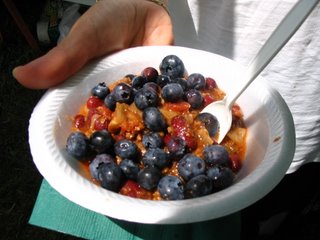
It is the Annual Blueberry Festival which has brought us to Berry Fields Farm on this day. Held in the first weekend of August each year, the festival is a chance for visitors to sample blueberry laden pies, cakes and ice cream, hear a little bluegrass and of course, pick some blueberries. But before I tell you about all that, let me tell you about the farm…

Berry Fields Farm is a tough little scrapper of a farm perched atop Cahill mountain just west of New Albany, Pa. The land, originally purchased by its owner Charles Gerlach as a hunting retreat, is not what anyone would call ideal farm land. It is remote, hilly, and rocky. Yet over the years, Charles and his wife Barbara have turned this isolated little patch of hilltop heaven into a small but vibrant piece of a dream called “sustainable agriculture”.

“What’s that?”, you ask? Well, according to the National Sustainable Agricultue Information Service:

Sustainable agriculture produces abundant food without depleting the earth’s resources or polluting its environment. It is agriculture that follows the principles of nature to develop systems for raising crops and livestock that are, like nature, self-sustaining. Sustainable agriculture is also the agriculture of social values, one whose success is indistinguishable from vibrant rural communities, rich lives for families on the farms, and wholesome food for everyone.

By nature, sustainable agriculture is a local phenomenon. But, like Johnny Appleseed’s trees, small organic farms like Berry Fields are cropping up all over America, the family farm re-invented for a new generation.

The idea of sustainable agriculture is not quite a pipe dream, but it’s close. According to Barbara, this kind of farming makes little to no profit. This fact, more often than not, forces the young couples who start such farms to abandon them when it becomes clear that they cannot generate the income needed to raise a family.

Because the Gerlachs are retired and their children grown, the financial challenges for them are a bit less onerous than for younger families. Still, they work the land alone, with no help save their guests at their B&B, visitors from as far away as Japan who pay for the privilege of working an organic farm. This, along with the income from their little farm store and restaurant, allows Berry Fields’ owners to sustain their dream. They are building additional housing for the student interns they hope will join them next year, bringing yet another “added value” to the farm.

“Added value” – that’s the sustainable agriculture movement’s buzz-word for human labor. Human labor that can ransform a $1 pint of blueberries into a $10 blueberry pie, $2 bars of soap or a $5 jar of jelly. The difference between a failing farm and a sustainable family business.

Barbara and Charles do more than grow berries. They raise goats, chickens, pigs and cows, and they do so naturally. The cows are raised on pasture only, making their meat leaner and healthier. The eggs laid by their chickens are rich in omega-3 fatty acids.

Raising organic animals is no easy undertaking, and the Gerlachs have had to make some tough choices in the process. When their goats acquired a parasitic infection, they removed them from food-producing because the treatment involved chemical antibiotic use. Did I say that Barbara and Charles are committed?

But back to the Festival, which is the real reason we came this day…

About 15 cars lined the road, and although there were never more than 30 or so folks at the festival at any given time, Barbara was worried that her guests would be put off by the crowds. “Crowds?” proclaimed my fellow-New Yorker friend L. “Why, more people than this live on your floor!” Of course, she was right. It was really more like a little gathering than a festival. Yet somehow, this tiny event kept us occupied for a whole afternoon on this beautiful summer day.

We picked blueberries, or were they really huckleberries? They were certainly smaller than the hybrids I am used to eating, but fresh and packed with flavor. While we picked, the musicians who call themselves Oak and Ivy wandered among the berry bushes serenading us with bluegrass and folk songs.

There were clothespins hidden in the berry bushes, and when my younger daughter found one, she was rewarded with a candy bar made with blueberries and chocolate. We ran into our neighbors there among the bushes, and even got a little lost at one point in the blueberry maze.

And of course, there was the food. There were pies and cakes baked by the members of the Sullivan County Art League.

My friend L had chili topped with blueberries, which she pronounced delicious.

I myself headed to the booth run by a local goat farmer, and it was there that I found my own personal Nirvana – what else do you call a place where one can combine the words “organic goat cheese” and perogie” in one delicious mouthful?

What I like best about Berry Fields is that it is so real. This is no Martha Stewart farmette, and while its owners may speak the langauge of the gentleman (and woman) farmer, they are anything but. No pretty clapboard county house, no picturesque red barn here. It’s about the food, the animals and the land, not visual appeal.

But I ask you – With views like this, who needs Martha Stewart?

Category: Considerations