Dense Breasts on Mammogram – No Need to Be Afraid

Mammogram Fatty and Dense

Only in America can we find a way to scare the bejesus out of a woman with normal breasts and a normal mammogram. But that’s exactly what happened when NY Times reporter Roni Caryn Rabin read her normal mammogram results letter –

A sentence in the fourth paragraph grabbed me by the throat. “Your breast tissue is dense.”

I can’t really blame Rabin for being afraid. The information about breast density in her mammo letter was mandatory verbiage crafted by legislators as part of a law that all women be told if they have dense breasts on mammogram.

“Your mammogram shows that your breast tissue is dense. Dense breast tissue is very common and is not abnormal. However, dense breast tissue can make it harder to find cancer on a mammogram and may also be associated with an increased risk of breast cancer. This information about the result of your mammogram is given to you to raise your awareness. Use this information to talk to your doctor about your own risks for breast cancer. At that time, ask your doctor if more screening tests might be useful, based on your risk. A report of your results was sent to your physician.”

Raise awareness? More like raise the alarm. The information mandated by the law is just enough to scare any women who happens to have dense breasts, but not enough to help her understand what this really means.

If you’ve gotten a letter telling you your breasts are dense, don’t be afraid. Having dense breasts is entirely normal, especially if you are under age 60.  Here’s what you need to know –

What is Breast Density? 

Breast density is a radiologic assessment of how well x-rays pass through the breast tissue. It is a surrogate for how much of the breast is composed of glandular tissue and how much is fat. The radiologist reading the mammogram classifies the breast composition as one of the following –

  • Almost entirely fat (<25% glandular)
  • Scattered fibroglandular densities (25-50%)
  • Heterogeneously dense breast tissue (51-75% glandular)
  • Extremely dense (> 75% glandular)

Breast density is subjective.

Different radiologists may give the same mammogram different ratings. Use of computerized density measurement could alleviate inter-observer variability, but there is not yet a standardized computer rating system. For the purposes of the law, dense breasts are defined as those that are heterogeneously dense or extremely dense.

Breast density can vary across a woman’s menstrual cycle and over her lifetime.  

The same women being scanned at a different time of month or at a later year can land into a higher or lower breast density category, and may or may not get that extra statement in her mammogram letter. Recent research suggests that a single breast density reading may not be the best way to predict breast cancer risk, and that the risk may be confined to those women whose breast density does not decrease with age.

Dense breasts are extremely common, especially in younger women. 

According to a recent report of mammograms here in New York City, 74% of women in their 40s, 57% of women in their 50′s, 44% of women in their 60′s and 36% of women in their 70′s have dense breasts.

Increased breast density may be a risk factor for getting breast cancer. 

The mechanism is unknown, but it may be that breast density is just the end result of other factors that increase breast cell proliferation and activity – factors like genetics and postmenopausal hormone use.

How much of a risk? Well, it depends on what study you read and who you compare to whom. If you compare the two extremes of breast density in older women, those with extremely dense breasts have a three to five-fold higher cancer risk than those with mostly fatty breast. The risk is lower than that in those in the middle category of breast density and in younger women, though not well-defined.

The truth is, we really have no way to translate individual breast density into individual risk. Researchers are trying to see if breast density can be incorporated into current risks assessments such as the Gail Model, but at this point, breast density has not been shown to add much more than we already know about a woman’s risk from using these models.

The problem with breast density as a risk factor is that most women at some point in their lives have dense breasts. Should we really consider 75% of women in their 40’s to be at increased risk for breast cancer?

I don’t think so.

Dense breasts can obscure a cancer on mammogram.

This makes mammogram less reliable in women with dense breasts. Digital mammograms may be better at finding breast cancers in women with dense breasts who are also perimenopausal or < age 50, but it is not known if this translates into better outcomes. Additional testing with ultrasound and MRI can find cancers that mammograms miss in women with dense breasts. Unfortunately, breast ultrasound and MRI screening tests are less specific than mammograms – three times as many biopsies will be done, most of which will not be cancer.

Breast cancer patients with dense breasts are not at increased risk of death.

In a study of over 9,000 women with breast cancer, no association between increased density and death from cancer was found. In fact, it was obese women with lower breast density who had the higher risk of death, possibly because their fatty breasts may be a more favorable environment for tumor growth.

We do not know if additional breast cancer screening beyond mammograms saves lives.

Sonogram and/or MRI for breast cancer screening is currently not recommended based on breast density alone. Additional screening beyond mammography is only used in women at highest risk for breast cancer – those with cancer in a first degree relative with a high risk gene mutation, a family history suggesting one of these mutations, a Gail model or other combined lifetime breast cancer risk assessment >25% or a history of chest irradiation. Even in this group, declines in morality with the additional screening have not yet been shown, and the false positive rate of this additional testing is extremely high – only 20% of abnormals are cancer when biopsied.

There are no recommendations to use sonogram and MRI in otherwise low risk women, and none that have shown that using it based on breast density alone saves lives.

Additional screening beyond mammograms adds significant costs to breast cancer screening.

For some women, this additional cost may not be covered by insurance. While Connecticut has passed a law mandating that insurers cover additional sonograms, New York State has not.

What should you do if you’ve been told your breasts are dense on mammography? 

If you are at increased risk for breast cancer due to personal or family history, you may want to consider adding ultrasound or MRI screening.

Otherwise, at the point there is no recommendation that you do anything other than continue screening at whatever interval you and your doctor have decided is right for you. If you decide you want a sonogram, understand that you will need to accept the additional false positives and biopsies that may result and that the additional screening has not been shown to decrease deaths from breast cancer in women at average risk.

_________________________________________________

More info on mammograms and breast density

Lemon-Fennel Chicken with Mushrooms & Scallions

Fennel lemon chicken and spinach

For years, my friend Susan (of the famed Chicken Salad Susan) has been making her Italian grandmother’s sautéed chicken breasts with breadcrumbs, parmesan and fennel.  Not too long ago, she was also on a diet program that included an amazing recipe for pan fried lemon chicken. I decided to combine both her recipes, and now have a killer entree that I’ve made almost weekly since she first shared it with me.

LEMON FENNEL CHICKEN WITH MUSHROOMS & SCALLIONS

You can just make the chicken breasts, and you’ll have an amazing entree. Or just cut up the chicken breasts, skipping the breading, and have another amazing entree. But together? OMG.

Ingredients

  • 1 pound boneless, skinless chicken breasts,  pounded thin
  • 1 egg, lightly beaten
  • 1/4 cup flour
  • 1/4 cup homemade breadcrumbs
  • 1/4 cup Parmesan cheese
  • 3  tbsp fennel seeds
  • 1 tsp lemon zest
  • Juice of 1 lemon
  • 1/2 cup reduced-sodium chicken broth
  • 3 tablespoons reduced-sodium soy sauce
  • 2 tablespoon canola oil
  • 10 ounces mushrooms, quartered
  • 1 bunch scallions, cut into 1-inch pieces, white and green parts divided
  • 1 tablespoon chopped garlic

Preparation

Whisk 3 tablespoons lemon juice with chicken broth and soy sauce in a small bowl and set aside.

Rinse chicken breasts and pat dry. Place flour on a dinner plate. Lay a 12 inch long piece of wax paper down on the counter. Mix the bread crumbs and Parmesan and spread out onto the wax paper. Sprinkle some fennel seeds atop the crumb/cheese mixture in such a density that every bite of the breast you are about to coat will have a fennel seed on it. Lightly coat a breast by dipping in the flour and shaking off, then dip into the egg, then into with the breadcrumb, cheese and fennel mixture, coating the second side in a different spot on the wax paper so that it too gets the fennels seeds on it in the right distribution. Set aside on a plate. Scatter some more fennel seeds if you need to and continue dipping and coating and scattering more fennel seeds as needed to be sure that each breast has enough fennel seeds on each side. Toss any unused breadcrumbs and flour. (Of course, you could just mix the fennel seeds in with the breadcrumbs, but this is how Susan does it, and I assume how her grandmother did it, so that’s how I do it.  There is power in tradition, and I respect it when I can.)

Heat oil in a large skillet over medium-high heat. Add chicken and sauté 2-3 minutes each side, until just cooked through. Transfer to a plate with tongs and cover with tented foil.

Add mushrooms to the pan and cook for about 5 minutes – enough to cook but not to dry them out. You want them plump and juicy.  Add scallion whites, garlic and lemon zest. Cook, stirring, until fragrant, about 30 seconds. Add the broth mixture to the pan; cook, stirring, until thickened, 2 to 3 minutes. Add scallion greens and the chicken and any accumulated juices; cook, stirring, until heated through, 1 to 2 minutes. Serve.

Baba Ganoush, Lebanese Style

Babaganoush, Lebanese Style

My friend Paula and I threw a Middle Eastern dinner party on my rooftop last Saturday evening.

It was really all Paula’s idea. You see,  her dad once ran a Lebanese market in Worcester, Mass. Paula inherited not only her father’s butcher block kitchen table and meat grinder, but a real love for the foods of her ancestors. I can tell you that enthusiasm is highly infectious, having caught it from her last year while sitting at the table at our cottage rolling grape leaves under her tutelage. So when Paula proposed a joint party – she’d provide the food and I, the venue and sous chef duty – I jumped at the idea.

The menu was perfect for the warm summer evening – Appetizers of fresh feta, olives, baba ganoush and pita served with red Lebanese wine, followed by a dinner of grilled lamb kabobs, rice pilaf, stuffed grapes leaves and green salad.

The lamb for the grape leaves? Paula ground it herself that morning.The mint? Dried on her dining room table just a few weeks ago.  And the recipes? Handed down from her father’s generation to her – via the parish cookbook of the St George’s in Worcester. With a few gems culled from May Bsisu’s wonderful cookbook The Arab Table.

We culled the guest list from the ranks of our friends we knew would appreciate the lemony pepper bite of the baba, the saltiness of the feta and the earthy flavors of the lamb, but would also be open to sampling my first attempt at homemade pita bread (a valiant but mistimed effort), and most importantly, open to getting to know one another. We also asked the guests to bring a reading to share that would be appropriate for the gathering.

And so it was that we dozen found ourselves at a picnic table drinking wine under the waxing moon and twinkling lights on one of the most beautiful nights of the year, eating a most delicious meal and afterwards, listening to the words of Kahil Gebran, EB White and Maya Angelou, along with readings about Lebanese and Irish immigrants to America,  capped off with the words of a modern young Jew and the intimate details of the days before the music died.

Our only regret was that the late hour at that point limited our chance to discuss the readings we had shared – a  lesson we will keep in mind as we plan our next Mediterranean salon.

Oh yes, there will be another. Because we’ve barely sampled the mezze or ventured into the kibbe.

And I’ve got pita to perfect.

BABAGANOUSH

Baba Ganoush (Eggplant bi Tahini), Lebanese Style

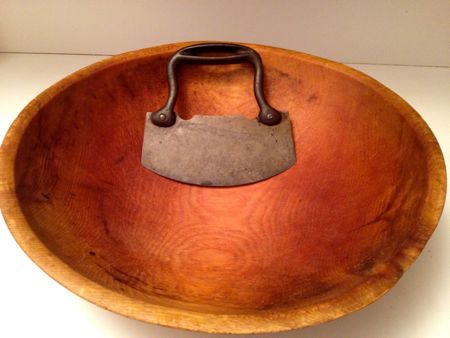
This recipe is originally from the famed El Morocco Restaurant in Worcester, where Paula’s aunt once worked in the kitchen.  This is a much more lemony baba ganoush than you may have tasted before, and is the first baba I’ve ever really loved. The trick is getting the texture just right – too much smoothness and its just a other puree. Not enough and the odd texture of the eggplant dominates the flavors. When Paula told me she makes hers by cutting it over and over again between two knives, I took that as my cue to bring out the wooden bowl and chopper, and the result was a perfectly textured baba.  You can use less lemon if you like – start with one and only add more if you think you’d like it that lemony. (I have a feeling lemons may have been smaller when this recipe was first written.)  Don’t skimp on the pepper and use a coarsely ground sea salt or large grind kosher salt for flavor. Serve with homemade pita chips.

Ingredients

  • 1 large eggplant, skin on, cut in half lengthwise
  • 3 tbsp sesame tahini
  • Juice of 2 lemons
  • 2 cloves garlic, finely minced
  • 2 tbsp water
  • Salt and pepper to taste

Instructions

Brush the eggplant with a little olive oil and broil, turning it frequently, until the meat softens, about 15 minutes total.  (f you want to grill it, that would be even better…)

Scoop out the softened eggplant meat into a large wooden bowl, discarding the skins. Add the tahini, lemon, garlic and chop until the eggplant is blended, but still recognizable as eggplant. (Alternatively you can use a pastry blender or two knives. If you must use a blender or food processor, be very careful not to pulverize it into an unrecognizable puree.) Avoid long stringy pieces – its a relatively fine chop.  Add water and salt and pepper to taste. Garnish with parsley, lemon or a scallion.  If you want to drizzle a bit of extra virgin olive oil on top, go ahead. No one will complain.

My Wooden bowl and chopper


Seven Things You Can Do to Help Reduce Prescription Errors

Pill BottleI just got off the phone with a very upset patient who discovered that her pharmacy has been giving her the wrong medication for the past 5 months, substituting a similarly spelled antibiotic for her rheumatoid arthritis med. She was tipped off when she realized how bad she had been feeling of late and decided to check the expiration date of her med, only to find it was the wrong drug. I won’t get into the unethical behavior of the pharmacist when she pointed out the error, something I’ll be reporting on her behalf to both the head of the pharmacy chain and the state Pharmacy board.

But that’s not the point of this post. The point is that, despite all our fancy technology and advances in healthcare, medication errors can and will occur.

So what can you do, as a patient, to be sure that your prescriptions are correct?

1. Keep a list of your current meds with you at all times. Include brand or generic name, dose and frequency. Paper, online, or on your phone – wherever its easiest and most accessible. But a paper list in your wallet will cover you in emergencies, so consider that even if you use your phone routinely.

2. Cross check and update your med list with your provider at every visit. In quality parlance we call it medication reconciliation, and it’s one of the most important things we docs do at a patient visit.  You’d be shocked how many patient come to a visit without knowing the names of the drugs they are taking. Now, if I go to prescribe a new medication, how can I be sure it doesn’t interact badly with something you are already taking? Or even if you may already be taking the very med I am prescribing? If I’m lucky, your pharmacist will pick it up, but only if you’ve filled a prescription in his system before. Don’t leave it to chance. Take charge.

3. Ask for an updated list of your medications and prescriptions before leaving your doctor’s office. Most EMR’s can create a current med list, so ask your doc or his/her staff for a copy. If you use it as your med list to carry with you, we’ll all be on the same page.  Alternatively, if your practice gives out an AVS (after visit summary) at check out, that usually will have your med list on it.

4. If you’re tech savvy, use the practice portal. Your providers practice portal has a med list. Take it upon yourself to check the portal between visits to be sure your med list is up to date and correct. You can usually print your med list yourself from the patient portal.

5. Cross check every med after you pick it up against the prescription your provider wrote. This includes refills. Use your printed med list, the portal or your AVS to check what your provider wants you to be taking. If you don’t have that, you can ask the pharmacist for a copy of your prescription. Don’t wait till side effects occur, as my patient did, to double check. Your health is too important for that.

6. Don’t hesitate to speak up if you think a prescription is wrong. You take it once a week, and now it says twice a week? Say something. And it’s not just the pharmacist who can make a mistake. Your doc isn’t perfect either. In fact, we’re less perfect in some ways since we started using the EMR to write prescriptions. More than once, I’ve caught myself typing in a prescription in the wrong patient’s chart – with up to 4 charts open on the computer screen at a time, it happens, trust me. Recently, my EMR made every part of a prescription a discrete field or check off box from a drop down, so that writing a single prescription is more like completing an online tax return than ordering a med. I hate it. It used to be so much faster (and safer) for me to just write or type out the frequency and dose. So please, stop me if you think I got it wrong. 

7. Finally, don’t forget that so called “natural” supplements are meds too. Don’t  get me started on the over use of these unregulated products. (And yes, overuse of prescription drugs as well, but at least we know whose making them and what’s in them.) But do know that many, many interactions can occur between so called “natural” products and prescription meds. So if you’re taking any kind of supplement, vitamin, herb or natural product, be sure to add it to your med list.

Any more suggestions or ideas? Tell us in the comments section.

Understanding Women’s Choice for Mastectomy

It’s a bit of a conundrum.

Despite advances in breast cancer treatment, and ongoing proof that survival is just as good after breast conserving surgery as it is with mastectomy, more and more women are opting for mastectomy for earlier and earlier stage cancers, especially DCIS.

In a well written, insightful post, Dr Deanna Attai, president-elect of the American Society of Breast Surgeons, outlines both the arguments against mastectomy and why women might make a reasonable choice to have a mastectomy anyway.

What we see in our offices is a rational fear: Many women understand that the type of surgery does not determine their survival.  While of utmost importance, survival is not the only thing that is important to women being treated for breast cancer. Women worry about having to repeat the whole process in another year or so if something new shows up on a mammogram or if a lump is felt. Women question the value of annual mammography for surveillance when their initial tumor was not picked up by a mammogram. Women have seen their family members and friends develop complications from radiation therapy and from attempts to perform additional surgery after radiation therapy. While women understand that a mastectomy is no guarantee that they will remain cancer-free, to many it is such a significant decrease in the rate of recurrence or new primary cancer that they feel it is an acceptable trade off for the complication rates that have been reported in patients who undergo a CPM with reconstruction.

I encourage you to read Dr Attai’s post – it goes a long way to informing both patients and their physicians about this agonizingly difficult decision that so many women face.

____________________________________

Mastectomy image from Wikipedia

Vinod Khosla – Still Stirring Things Up

Vinod Khosla (Image from Wikipedia)
Vinod Khosla (Wikipedia)

Vinod Khosla’s still at it. This time its the Stanford Big Data in Biomedicine Conference. 

I don’t really blame him – he’s got quite a thing going on the speaker circuit.  As long as he keeps getting invited to give keynote addresses at healthcare summits, he’ll keep cranking through his slide set and stirring up the hornet’s nest by saying that 80% of docs will be replaced by digital devices. Which coincidentally, his venture capital firm finances. Except now he’s calling it big data, since that’s what the most recent summit he spoke at was about. (Like any paid speaker with a slide set, he’s good at mixing it up for his audience.)

Here’s the response I wrote when Khosla started his act a few years ago. Since he’s still saying the same old thing, I didn’t see much need to rewrite it. (Although like any writer given the chance, I did edit it a tad.)

Will Doctors Be Needed in the Future?

There’s a big discussion going on in the health tech community about a controversial keynote speech given by Vinod Khosla at the Health Innovation Summit (HIS), in which he stated that 80% of what doctors do could be replaced by machines.

If you’re a doc like me who has no idea who the heck Vinod Khosisa is (he’s a venture capitalist and co-founder of Sun Microsystems), why he’d be a keynote speaker at a healthcare event, well, that’s the point of this post.

You see, there are a whole lot of folks like Khosia out there – investors, entrepreneurs, tech types – who are attempting to redefine healthcare according to their own personal vision.  Where we see a healthcare system in crisis, they see opportunity – just another problem with a technological solution.  Computer-driven algorithms are the answer to mis-diagnosis and medical error, IPhone apps can replace physician visits, video connectivity can increase access.

Where we see illness and distress, they see a market.

And what business folks like to call disruption in the marketplace. Think about what happened to downtown small town USA after the first shopping mall opened. Or what happened to movie houses when Netflix started offering DVD rentals online. Or where all the independent bookstores went when the first Borders opened up, and what happened to Borders when the Kindle hit the market.

If  Khosla is right, the we docs in our offices and hospitals are the old downtown department stores, the bookstores and the bricks and mortar businesses in an online revolution.

We’re replaceable. At least most of us.

Is Khosla right?

Maybe.

The therapeutic relationship between a doctor and a patient can never be replicated by an IPhone app. Not when so many of my patients leave my office on a daily basis telling me how much better they feel just having spoken to me. It’s a powerful and sacred relationship that is irreplaceable.

These days, however, almost all of my patients have googled their symptoms, and many have done a over the counter diagnostic test or treatment  before coming in to see me. I’ll never see the ones who got their questions answered online or their symptoms cured by that over the counter med – I see what’s left after self-diagnosis and self-treatment has failed, or google told them to see me.

That’s disruption, isn’t it?

One day very soon, women will be able to screen themselves for cervical cancer and std’s using a self-administered vaginal swab. No need to see me unless the test is abnormal, or there are symptoms.

Disruption.

Of course, computer driven diagnostic algorithms, apps and programs can create a whole new set of problems in over-diagnosis, since “there’s nothing seriously wrong with you” is rarely an output.  In my office, that’s a very frequent clinical assessment. Functional ovarian pain.  The occasional errant menstrual cycle or missed period. Anxiety. Stress. Depression. Lack of sleep. Over-eating, over-drinking, over-medicating.  What computer is going to pick that up?

Not to mention trauma care, surgery, childbirth, respiratory distress and any one of thousands of health emergencies that you can’t treat with an IPad.  I don’t see any of that work going away for docs anytime soon, do you? Some of it, of course, is being shared with trained non-physicians, and even robots. But docs are still an indispensable part of the healthcare mix.

So while the mix is changing, we docs are still in it. And I don’t see that changing. At least for here and for now. But the future?

I don’t know.

Docs need to be part of the digital revolution

I do know that if this is the new revolution in healthcare, we docs better get in on it.

Take the EMR as an example of what happens when docs let non-docs innovate in healthcare without significant physician input. We become typists, not physicians. Clerical work that used to be done by lower paid staff – entering lab and radiology orders – becomes ours to do. We spend the majority of a patient visit looking at a computer screen and not the patient. Retrieving relevant clinical information is like searching for a needle in the haystack of required fields of entry, most of which are not necessary to provide care.

Indeed, we have not yet shown definitively that EMR’s improve outcomes.

And yet we’re all using them, aren’t we?

If we are not part of the digital revolution and leave it to the venture capitalists and entrepreneurs, they will develop products that may sell, but if they don’t improve outcomes, all that will have been accomplished is a disruption in a marketplace.

Wouldn’t it be so much better if we could disrupt disease?

The real opportunity in healthcare innovation

There are millions upon millions of folks – some in American, but most in the undeveloped world – who have never had, and will never have the opportunity for a patient-physician therapeutic relationship such as that I’ve described above. They have no one to call when Google tells them to “talk to your doctor”.

But the overwhelming majority of the do have cell phones. Amazing, really. We can’t get indoor plumbing, modern contraception or malaria tents to all those in need, but 80% of folks in the developing word have cellphones. If that’s not an opportunity and a potential market for healthcare innovation, then nothing is. If we can get any healthcare into the hands of these folks, even if it’s healthcare delivered by a mobile app, we have the potential to improve their lives.

Now, imagine that we docs were able to free ourselves from the 80% of our work that can be replaced by technology, and then redistributed ourselves (virtually and personally) across the globe where we were truly needed, so that we could provide needed healthcare to the entire planet?

Now that’s disprution.

When it’s Your Wife…

In a painfully honest and moving essay entitled “The Day I started Lying to Ruth“, physician Peter Bach chronicles his gradual evolution from the oncologist who couldn’t understand why his patients would continue to seek treatment for a disease that was inevitably fatal

Each successive change [of treatment] brings more side effects with less chance of benefit… the cancer gets smarter, the treatments get dumber. Somewhere in this progression the trade-off no longer makes sense … I’ve often thought that cancer doctors go well past that point.

to the husband who, along with his wife, grasped at any options made available to them, whether or not they provided a chance for cure.

None of that mattered to me, the medical professional to whom all these nuances and trade-offs should. All I could think about was the blood test telling us the tumor marker was too high. With that, any dreamy conceit—that patients should be given enough knowledge that they can weigh the risks and benefits for themselves, then come to the choice that best suits them—flew out the window. Our choice wasn’t a choice. Take the chemo…. I will never again be mystified, as I had been with many patients, by why someone who is at the precipice of death seeks out yet another shot at treatment, even with something harmful that has a near-zero chance of helping. “Why not?” was suddenly a winning argument.

Bach’s story will be all too familiar to those of us who have had a loved one succumb to cancer. For me, it was my sister Fran – a nurse who, like Bach and his wife, was forced to negotiate the frightening choice between the rock and the hard place, always holding out hope for another round of chemo that her doctors said would “treat but not cure” her cancer. We all lied to ourselves, me especially, by not saying the truth. Until it was too late, and then it was over.  (God, I miss her …)

What makes Bach’s essay even more powerful for me is knowing that he is one of our county’s foremost experts in health care effectiveness and yes, cost.  What his essay is telling me is that he understands what cancer patients and their families have known all along – that reining in health care costs will mean more than just raising copays and lowering drug costs and funding more effective interventions. It will also mean quashing hope. And learning to tell ourselves the truth.

Curtailing the growing cost of end of life care is probably one of the most difficult challenges lying ahead of us. How we face that challenge will define us, both as a profession and as a nation.

Knowing Bach is at the table, I have a feeling we’re going to do it right.

Polenta & Eggs

Polenta & Eggs

We made a big batch of butternut squash polenta with sausages and onion, adding an extra cup of grated squash to the polenta as it cooked. While this made for a delicious flavored polenta, there was quite a bit left over.

The great thing about polenta is that it hardens as it cools, so we spread it into a class refrigerator dish and put it in the fridge. Next morning, I cut it into rectangles and sauteed it up beside my egg as it cooked in olive oil. A sprinkling of freshly ground pepper topped off a delicious breakfast!

What do you do with your leftover polenta?

Spaghetti w/ Garlicky Breadcrumbs & Anchovies

Spaghetti w/ garlicky breadcrumbs & Anchovies

You know the apple hasn’t fallen far from the tree when your daughter texts and asks what you’re doing tonight, and you text back that you are making this for dinner, and she texts back “OMG!! I just watched that video this morning!” followed by a little icon that she describes as “Me running home for dinner!”

Yep, it doesn’t take much to excite us in the TBTAM household, and this recipe, along with the utterly charming video of Melissa Clark making it, was the highlight of our day yesterday.

We made the dish exactly as written, but but did add a little grated Parmesan when serving.

Try to have just one helping, okay?

Ortho Diaphragm Discontinued

diaphragmUPDATE 7/3/15: THE CAYA DIAPHRAGM IS NOW AVAILABLE IN THE UNITED STATES. HERE”S WHAT YOU NEED TO KNOW to prescribe to obtain it.

It appears as if Janssen Pharmaceuticals has discontinued production of the Ortho All Flex Diaphragm.  That’s not great news for women wanting the full range of contraceptive options.

The good news is that diaphragms are still available in the United States through Cooper Surgical. It’s a wide seal diaphragm, which may not be suitable for all women, but will probably fit most. Your doctor will have to get a fitting set for this particular diaphragm, and once your size is determined, order it for you rather than you taking a prescription to the pharmacy.

If you happen to be in Europe, you can get a Caya Diaphragm without a prescription.

I suspect the market for diaphragms was just too small for Jaansen to keep it going. I’ve only fitted one woman for a diaphragm in the past 6 months.

That’s a real shame, because the diaphragm is an important contraceptive option for motivated women who can’t or don’t want to use hormones or IUD’s.  When used properly by motivated couples, efficacy can be quite high.  I know – I was a long time diaphragm user, and despite being quite fertile, never had an unplanned pregnancy.

Here’s hoping that the Caya manufacturer will step into the US breach and get the diaphragm back into the hands of women who want to use it.

_________________________________________________________________

More about the diaphragm from

Pollen!

Yew Pollen
Yew Pollen

So I was sitting on my bed on Sunday afternoon (oh all right, I was taking a nap…) and happened to glance out the open door into the garden, where I saw that our Japanese Yew bushes seemed to be smoking.

Really. Several times a minute, at random intervals and from different locations, little puffs of smoke were emanating from between the branches.

I was sure there was a fire, but a closer inspection revealed that this was no smoke. This was pollen, fine as smoke, bursting out of the small flower buds that had cropped up all over the bush this season.

Yew Pollen
Yew Pollen

As the seed pods open, they let out a fine spray of dust-like particles that now coated the tree and, like dust from an old carpet, fell in abundance when the wind blew or when one shook a branch.


It really was an amazing spectacle, watching these yews propagating themselves right in front of our eyes. 

And unfortunately for hay fever sufferers, our noses.

A Graphic Medical Tale

tumblr_n3ktusIZU21rr3k1co1_1280

An otherwise healthy young man develops hugely swollen lymph nodes in his neck and is admitted to Cleveland Clinic for evaluation and treatment. Being also a talented graphic artist and writer, he pens a graphic tale of his experiences in being a patient and a bit of a medical oddity.

On hospitalization, the fortune of living near world-class medical care, and raging against the risky unknowns. Drawn shortly after I left the hospital in January of 2014.

Add my friend Davey Connor to the emerging chorus of patients who aren’t afraid to let us know what it’s like to be on the other side of our stethoscopes.

A great read for docs and patients alike.

Broiled Salmon with Mushrooms and Farro – Inspired by Lyfe Chef Art Smith

Broiled salmon with mushrooms and Farro TBTAM

One of the highlights of my visit to the Medicine X Conference in Palo Alto in September, in addition to my poster presentation and meeting all the amazing e-patients, docs and tech gurus there, was dinner at Lyfe Kitchen.

Founded by former McDonalds CEO Mike Roberts, Lyfe (which stands for Love Your Food Everyday) is the first of a growing chain of healthy, pretty fast food franchises that “put sustainability, our planet and our employees first”.

As soon as I entered Lyfe, I was hooked.

There was a gorgeous live herb garden forming the centerpiece of the place and lending a deliciously fresh scent to the room.

Lyfe herb garden

The food itself was healthy and varied, with plenty of veggie, vegan, low fat and gluten free options on the menu created by Chef Art Smith, who you may know as Oprahs personal chef.  Smith, who himself lost over 100 pounds after being diagnosed with diabetes, has kept dishes under 600 cals, low in saturated fat and sodium, and high in fiber and protein.

Service was faster than a traditional sit down restaurant – diners line up at the counter and place their orders, then sit down with a pager that alerts the servers where they are and when their food is ready. Prices were moderate,  but not cheap, which is to be expected if local food sources are being used and employees treated like human beings.

On to the food – The edamame hummus was delicious. (I have the recipe and will post it soon)

Lyfe edamame dip

as were the flatbread

Lfye pizza

the grilled fish

Lyfe salmon

the veggie burger and the sweet potato fries.

Lyfe burger

Smith’s cookbook Healthy Comfort was on sale at Lyfe, so I picked up a copy for inspiration and dinner ideas.

I’m excited to see healthy food making it closer to the masses and look forward to the day when Lyfe makes it to NYC. If they do, they’ll find some real competition here in the Belgian chain Le Pain Quotidian, an even faster growing chain that serves delicious, organic and healthy food.

(Recipe after the jump) Continue Reading

Almond Cake

Almondcake4

One of life’s better days.

Started with having both girls home for dinner. Add in daylight savings time and the first bike ride of the season in Central Park and life is pretty damned good.  Then give me a sunny afternoon in the kitchen baking and I’m over the top.

This cake will put you over the top, too. From my fave old magazine “Pleasures of Cooking”, it’s dense and sweet but not too sweet due to a touch of lemon tartness and has a wonderfully chewy outer crust.

I made the cake substituting olive for vegetable oil, resulting in a slightly richer and denser cake than the original recipe. Here’s the original cake made with veggie oil by my mother in law Irene-

VEGGIE OIL ALMOND CAKE

and mine made with olive oil. Mine is a little lower because I took some batter off to make cupcakes, which I”ll show you in another post, so concentrate on the crumb texture. See how it’s denser? It actually fell a tad when I took it out of the oven, but was well cooked from what I could tell. It could be my cake pans or the olive oil that made the difference there, I’m not sure.

OLIvE OIL ALMOND CAKE

Both were delicious. When we taste-tested frozen and thawed versions of both cakes with my husband’s family today, they were evenly split on which they preferred. So I’ll leave it to you to decide which you’ll make. I”m sticking with the olive oil because it seems healthier and more authentic and I loved how it tasted.

almondcake2

(See recipe after the jump) Continue Reading

Meditation

From the Massenet opera Thais, performed by Yo Yo Ma.

If love came with background music, this would be it.