Dinner (Maze) & the Theater (Other Desert Cities). A Quintessential NYC Evening.

It’s one of my favorite things to do in New York. Dinner and a play.  It’s also among the most challenging combination of activities in the Big Apple to pull off well.

So much can go wrong – not having a reservation and spending a half hour wandering Restaurant Row with the tourists looking for a table (I’ve done that more times than I can count); finding out your dinner reservation has put you into a pre-theater mill where you’re herded like cattle at the slaughter (ditto); or rushing anxiously through an otherwise delicious dinner and then running like crazy to make curtain time (I call it doing the Times Square Bob and Weave).

Then there’s choosing a bad play (not often but it happens); choosing a great play that one of your company hates and everyone else loves (that play with the goat); finding out the lead is replaced by the understudy  (that Laura Linney play that wasn’t); and let’s not get into the lines at the ladies room, shall we?

Well, last night we pulled it off. Dinner at Maze and tix to Other Desert Cities. Perfect combo. (Not to mention great friends…)

MAZE

The only table available at Maze was at 5:30, and while I felt a bit like I was heading out for an early bird special, the timing was just right. So right that it’s going to be my new dinner start time for pre-theater. We had a wonderfully leisurely meal and great conversation unencumbered by worries about making curtain time. And had time for an absolutely perfect Margarita at the bar before sitting down to a fabulous meal.

The bread – best I’ve ever had at a restaurant, hands down. A lightly salted cross between a focaccia and a baguette is the best way to describe it. It felt very light on the tummy and we went through two little buckets – mostly because we needed it to sop up all the great sauces we had.

Two of us ordered the scallops appetizer – perfectly cooked with little bits of cauliflower and capers. (Sautéed sea scallops golden raisin purée, cauliflower beignets, crispy capers $18)

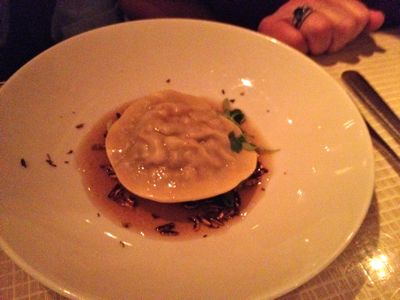
The single short rib ravioli appetizer had a surprisingly generous and delicious meat filling.
The sweetbreads appetizer was a bit of a disappointment. When I eat sweetbreads, I’m looking for that soft inner texture. These pieces were more like crackling sweetbreads. Delicious, just not what one would hope for.  A better description in the menu would have been helpful. (Oven baked beetroots caramelized sweet breads, celeriac mousseline, mache salad $18)

The Bronzino was truly amazing. Trust me, we sopped up every bit of that beurre rouge. (Filet of branzino spinach and artichoke fricassée, beurre rouge, crispy phyllo $26)

But the star of the evening? The little pot of fingerling potatoes in a shallot cream sauce that were served with the Trout Market special. (Whole roasted Idaho brook trout Sheldon Farm fingerling potatoes, orange and fennel salad $29) There were more than needed for one person, which meant we all got to share them. OMG. The potatoes were perfectly cooked and the sauce – well, we were all practically licking the pot to get every bit. I asked how they were made and got this much – shallots, garlic, chicken broth and I assume butter and cream and parsley. If anyone reading this has the Maze cookbook, let me know if the recipe is in there. (I tweeted Ramsay to see if he would share it – I’ll let you know if he responds.)

We all shared dessert – delicious. (Chocolate pudding stout ice cream, pretzel, peanut butter powder $9.00)

No one overate or over-drank, both of which can be disasterous before a play. Susan and I shared the Bronzino, MR TBTAM only had appetizers, Boyd shared his potatoes (OMG again…) and we all tasted one another’s dishes and shared the dessert.  It was a completely satisfying meal. The bill for 4 of us, including 2 beers and 1 glass of wine, but not the drinks at the bar, was $200.

Maze also has a pre-fixe theater menu during the week for $35. I consider that a real bargain.

Our early reservations meant we had time to enjoy a leisurely walk to the  Booth Theater on 45th St to see Other Desert Cities.

OTHER DESERT CITIES

What a cast.

I’ve loved Rachel Griffiths since Muriel’s Wedding, and she was fabulous as Brooke, a 30-something writer who arrives at her parent’s Palm Springs home to announce she’s publishing a memoir that revisits their shared tragedy and threatens to upend her parent’s carefully reconstructed life.  Stockard Channing it a tour de force as a Jewish-Texan Right-wing Mama Grizzly modeled on Nancy Reagan, and Stacy Keatch her completely sympathetic Papa bear counterpart. Judith Light is transformed as a recovering alcoholic aunt. (Why have I not seen her in a play before? I’ve been missing some amazing stage acting!) And I was thrilled to find Justin Kirk playing Brooke’s younger brother Trip – while there was much of Andy Botwin in Trip, it’s a character I happen to love, and Kirk plays the part beautifully. (His final outburst actually drew applause during the play.)

We found ourselves a bit confused as to the chronology of the play – which war were they talking about – Iraq or Vietnam? What year was it? How old is everyone supposed to be?  But that just gave us fodder for a spirited conversation at intermission, which was the first one in as long as I can remember that did not include a visit to the ladies room.

Hanging around talking afterwards, a nearby burst of applause made us realize we were near the stage door, from which the cast was emerging.

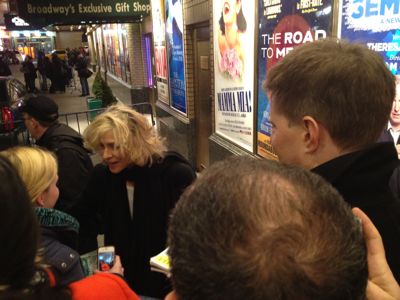
I got a few pics and had a brief conversation with Judith Light, who, after signing autographs and taking pics strolled off with her companion and merged into the crowd on 45th street.

It’s what I so love about New York. The Gods walk among us.

Pfizer Recalls Lo-Ovral & Its Generic Birth Control Pill. What Should You Do?

You’ve heard by now that Pfizer has recalled about a million birth control pills due to concerns the the hormone dosing and pill order in the packs could be wrong. This could affect the pills efficacy, exposing women to unplanned pregnancy.  There are no concerns beyond this about safety.

The pill they’ve recalled is called Lo-Ovral or its generic Norgestrel 0.3 mg/Ethinyl Estradiol 0.03mg. I’ve posted a list of the affected lots below. The first thing you need to do is check your pill pack against the list to see if you are taking a recalled pill.

If you’re not taking a recalled pack, take a deep breath and relax. Then share this post on Facebook or wherever you share, so that your friends who may be taking a recalled pill learn about it as soon as possible.

What should you do if you are taking a recalled pack?

Talk to your doctor about what you should do if you are taking a recalled pack. Here’s what I’ll be telling my affected patients.  (Disclaimer – What follows is advice I will be giving my patients.  What your doctor may want you to do could differ. )

  • First of all, don’t panic.  If you’re not spotting or bleeding out of schedule,  you’re probably still protected against pregnancy. But make no assumptions – Presume you are unprotected and follow the steps below.
  • Head immediately to the pharmacy for a new pack of pills.
  • If you’ve been sexually active since your last period, do a pregnancy test. If it’s negative (and it most likely will be negative), start your new pack immediately and use condoms for the next two weeks. Your next period should come at the end of your new pack of pills. If it does not, do another pregnancy test. If you don’t want to wait till then to be sure you’re not pregnant, you can do a second pregnancy test two to three weeks after the first.
  • If you’ve had sex in the past 5 days, discuss with your doc if you should consider taking emergency contraception.
  • If you haven’t been sexually active, no harm has been done. Get a new pack and start it right away. Use condoms if you have sex in the next two weeks.
  • If you’re pregnant, contact your doctor. What you decide is up to you, but know that accidental exposure to normal doses of birth control pills in early pregnancy should not impact the pregnancy outcome.

Greenwich Village Culinary Walking Tour

Sometimes it’s fun to act like a tourist and see your home through fresh eyes. That’s what we did yesterday, when we joined a Manhattan Walking Tour of the West Village that had tempted us with a great low-price offer on Gilt City.  Blessed with unseasonably warm weather, the company of good friends and a fabulous tour guide, we spent a leisurely 2 hours or so wandering through charming streets, learning a bit of history, architecture, fun facts and neighborhood gossip while sampling the unique culinary offerings of one of my favorite neighborhoods in New York.

Here’s a tiny bit of what we saw, learned and ate –

A Little History

Here are just two of the fun facts we learned-

Did you know that the reason the streets of the Village are so circuitous is because they followed the paths of stereams? And that those streams still can be heard running uner the streets? Minetta Lane is one such street.  (Here’s a fabulous blog post I found about a building with a tube that dips down into the Minetta stream and fills with water whenever the stream rises. Read the comments section of the post for more underground Manhattan steam stories).

Hudson Street is named appropriately, since it used to run alongside the river. After decades of landfill along the west and south sides of Manhattan, however, Hudson St now runs three blocks inland.

A little Architecture

We wandered off the main drag through winding streets past carriage houses and old horse throughs, saw the a teeny building covered in keys, the oldest house in NYC, the narrowest house in NYC, a former toy shop and the largest children’s play house ever built, and of course the building where Friends supposedly lived. And learned about landmark designation, and how some retailers are shamelessly getting around the rules. And what it means to be “86’ed”. (Hint – It has to do with an address we passed by…)

A lot of Gorgeous Blue Sky

You see more sky in the Village, where there are fewer tall buildings.

A Little Music

A Little Noshing

This was a culinary tour, after all, and in this regard, it did not disappoint. Here’s where we went and what we tasted –

The Chocolate Bar 

We skipped the exquisite chocolates and went straight for a classic NYC Egg Cream made with the requisite Fox’s U-Bet Chocolate Syrup, milk and soda water.  The Chocolate Bar has been credited with reinvigorating the egg cream after a long hiatus from the culinary repertoire of modern New York, though some would argue that the Egg Cream was doing just fine before they came along, thank you.  I’d ague that an egg cream is a lower fat alternative to a milk shake  and that it tastes, well… invigorating.

Il Cantuccio 

The Italian bakery has three branches – the other two are in Italy. The glass-windowed bakery is the heart of the store and was in action when we arrived.  The focaccio were deliciously fresh and reminded me of Rome.

Biscotti, made with prune or figs or chocolate, were practically right out of the oven. They cut them right in front of you. I bought a box home.

Fiaccio’s Pork Store

A NYC institution, with another store in Brooklyn. We bought sweet sausage with fennel to cook for dinner tomorrow night. Then we had rice balls – a first for me. Breaded, not fried and perfection!

The marinated artichoke hearts and mozarella were the best I’ve ever eaten (and I’ve eaten many before, trust me…)

We stopped briefly into Murray’s Cheese Shop, newly expanded and looking disturbingly neauveau (I liked the old place better…) and snuck into Amy’s Bread for a slice of chocolate cake for later.

Mamoun’s Falafel

Best baba ghanoush I’ve ever had. Eaten in Washington Square Park, just the way it should be.

A Little Off Tour Shopping

BookBook

You can’t walk by this wonderful independent book store without stopping in. So we did.

The Abingdon Square Green Market.

Understandably small in winter, but still wonderful.

The Meadow

Also not on the tour (maybe it should be?) . We stopped there on the way home, having heard so much about this store that sells – are you ready? – SALT. I picked up a tin sampler set of finishing salts – salt that’s put on food at the time you eat it, as opposed to salting your food while you cook it – and already have fallen in love with the black diamond salt.

But that’s another blog post for another day…

__________________________________________

Manhattan Walking Tours offers small group guided tours around Manhattan. Thanks to Alex for a fabulous tour. Look for us on the Wall Street history tour one of these days soon!


Sometimes My Patients Bring Me Food

Thanks DV for the wonderful Ardith Mae Goat Feta you brought me today at the Union Square Green Market after you found my blog and realized that I was a fellow foodie.  I had it for lunch and it was the best feta I’ve tasted to date. Not salty like so many I’ve eaten before. Just wonderfully fresh, rich and flavorful. I’ll be using the rest this weekend in a salad for sure. While I can’t get to Union Square on Fridays to get more, I discovered they also sell at the Columbus Ave Green Market on Sundays!

And the homemade Erba Toscana you learned to make in Italy?  The smell was driving me bonkers, so I actually sprinkled a little on the feta – OMG, delish. Can’t wait to use it on fish or chicken. Now I know what I should be doing with the herbs in my garden, instead of letting them die back over the winter.  (And what a great idea for holiday gift giving!) You are an inspiration.

Finding out your patients love food as much as you do. Just a little unexpected bonus of  the blog. (I do love it so.)


Are You Obligated to Tell Your Partner(s) that You Have HPV? This Doc Says No.

One of the most common questions I get from my patients who have had had an abnormal pap due to HPV infection is this –

Are they obligated to notify their past, current, future or potential sexual partners that they have or have had HPV?

I believe the answer is a qualified no. And here are the reasons why –

1. HPV is ubiquitous.

Close to three-quarters of adults have had HPV at some point in their lives. Ninety five percent of the time, that infection will clear within 1-2 years with no long-term consequences to themselves or their partners.

Although we can offer treatment or removal for genital warts and precancerous pap smears, there is no medical treatment to clear the HPV virus itself in an infected individual without these conditions. That’s the job of the immune system, which can be helped along in this regard by using condoms, avoiding tobacco and eating a diet rich in fruits and vegetables.

2. Unlike women, most men with HPV have no way of knowing they are infected.

Unless they have a visible genital wart, or a much, much rarer HPV-related cancer, most men who have HPV have no idea they are infected. That’s because there is no available HPV test for men. 

Women, on the other hand, if they happen to get an abnormal pap smear during the time they are infected, may very well find out that they have HPV. (I’m not going into the management of abnormal paps here, but suffice it to say that the overwhelming majority of abnormal paps due to HPV will resolve without treatment just as the virus itself resolves. Those that don’t, and which carry precancerous changes, can be effectively treated,)

3. Why then, should a woman be obligated to tell her partner that she has HPV? 

Given the ubiquitous nature of HPV infection, unless her partner is a virgin, the odds are pretty darned high that he already has had HPV. He may actually have the infection right now and be the one who gave it to her. On the other hand, he may have had it in the past and already be immune to the strain of HPV she has. Or be infected with another strain she does not have, so that she may actually be the one taking the risk by sleeping with him.

She’ll never know, and he’ll never know. Because he cannot be tested. Or treated.

4. HPV is not like chlamydia.

There is no role for partner notification and  treatment in preventing the spread of HPV. The only thing that partner notification accomplishes is to turn women with abnormal paps into pariahs, while the rest of the HPV infected men and women out there continue to copulate in blissful ignorance.

Which is why I don’t believe that every abnormal pap needs to turn into an STD confessional.

I do believe that all sexually active adults have an obligation to themselves and others to  prevent the spread of HPV and other STD’s by practicing responsible sexual activity.

That means being tested and treated for those STD’s whose spread we can stem through screening and partner notification, being vaccinated against those we can prevent, using condoms and limiting our numbers of sexual partners.

It’s not a moral message, unless morality means acting responsibly and maturely, and respecting one’s own health and that of others. By limiting one’s partners, I mean confining intimate physical relationships to those who we really care about. (Dare I use the word love?…)

In this context, some women may take HPV infection as a sign that it’s time to stem the one night stands.  A few may choose to hold off on relations altogether until their infection clears. The majority, who are already limiting their sexual activity to caring relationships, will make no changes in their behavior except perhaps to use condoms until the infection clears. And if they are already in a caring relationship, they usually end up discussing it with their partner. Because that’s what couples do – they talk about their lives, their health and their fears.

Which is very, very different from mandatory STD partner notification and treatment.

The Good News

The good news for HPV-infected women is that almost all HPV infections will clear. Once HPV is gone, your increased risk for cervical cancer goes with it. As does your risk for transmitting the virus to others. Which takes care of the issue of future partners.

The other good news is that getting regular pap smears will prevent the uncommon but important consequence of HPV infection – cervical cancer.

Genital warts are worth discussing with your partner.

I do think it’s worth discussing with your current partner if you discover that you have genital warts.More often that you’d think, the male partner may have  small, previously undetected genital warts that are amenable to treatment. He can visit his doc for a careful exam and get treated if warts are present. That in turn may help you clear the infection faster yourself, since your immune system won’t be under constant barrage with high viral loads from your partner.

Condoms are also worth discussing.

If you have an abnormal pap due to HPV, and you are not using condoms, it’s worth discussing the matter with your partner and asking him to use protection when you have sex. Women with HPV whose partners use condoms will clear the virus and return to normal paps faster than those who have unprotected sex.

There is a role for HPV vaccination.

I also support the use of HPV vaccination. Despite my objections to how it has been priced, marketed and legislated, the vaccine is safe and effective. Getting vaccinated after you’re infected won’t help you clear the infection faster, but can prevent new infections with the 4 strains that the vaccine targets.
_______________________________________________

Sausage, Kale & Potato Soup with Fig Compote

If this is what you see out your bedroom window when you wake up –

This is what you have for lunch.


Sausage, Kale and Potato Soup with Fig Compote

I don’t know if I’m gilding the lily with the compote or not, but whenever I see sausages I think of figs, and I liked the richness a dollop of it added to the soup. Mr TBTAM thought the soup was perfect without it, but then he spread the compote on warm bread and ate it along with the soup. You can make and eat it either way. Or not at all. Because the soup really is delicious all on its own.

There are lots of recipes for this soup out there out there – this one is modified from Epicurious, found via Smitten Kitchen. We used Italian sausage, but I’d love to try it with Kielbasa or the more traditional Portuguese Linguica sausage. Smoked sausage will slice up easier than Italian, and would add a wonderful flavor. If you use linguica, you may not need the herbs since the sausage is spiced nicely. You can use white potatoes, sweet potatoes or both – I used what I happened to have around. Not sure why I added the carrot, it was probably not necessary.

2 tbsp olive oil
1 lb ( 2 medium) sweet potatoes, peeled, quartered lengthwise and cut into 1 inch slices
1 lb (2 medium) Yukon gold potatoes, peeled, quartered lengthwise and cut into 1 inch slices
1 large onion, peeled and chopped
2 large carrots – peeled and chopped
4 garlic cloves,  peeled and diced
1 coil sweet italian sausage, sliced 1/4 inch thick
1 tbsp fresh thyme leaves or 1/2 tsp dried
1 tbsp fresh oregano leaves, or 1/2 tsp dried
1 large bunch kale, washed, middle spine cut out and leaves torn or chopped into bite-sized pieces
6 cups chicken stock
Salt, pepper and a pinch of hot red pepper flakes for seasoning.

Heat olive oil in large pot over medium high heat. Add sausage and saute till browned on all sides.

Remove sausage and set aside. Try not to eat any. (You can drain them on paper towels and remove some of the fat from the pot if you want at this point.)

Add onions and carrots to the pot and saute till onions are transluscent, about 8 minutes.

Add potatoes and saute, stirring often, about 10 minutes or until they start to soften.

Add garlic and cook for one minute. Add broth, thyme, oregano and bring to a boil, deglazing pan as it heats. Turn down heat and simmer covered, till potatoes are soft, about 20 minutes.

Mash the potatoes in the pot with a potato masher, just enough to thicken the sauce a bit, but leaving plenty of potato chunks (this step is optional, and I may not do it in the future.)

Add the kale and the sausage

and heat till kale is wilted.

Season and serve hot, with fig compote on the side. You can stir a spoonful of the compote into your soup, or spread it on warm bread and eat alongside the soup. Or not.

Fig Compote

10 dried mission figs, stems removed and diced
1/2 cup white wine
1/2 cup chicken broth
¼ tsp salt
¼ tsp fresh ground pepper

Combine ingredients and simmer in a small pot over low heat, mashing the figs with a fork as they soften, until thick and rich. Serve either as a dollop in your soup or spead onto warm baguette slices.

Adapting Office Workflows to the EMR – or How I Restored Patient Face Time & Got Back the Joy in Medicine

The Problem : Lost Face Time = Lost Joy

One day, about 5 years into using the electronic medical record in my practice, I came to the realization that I wasn’t having fun anymore. I was sitting throughout most of every office encounter facing a computer screen, my back to the patient on the exam table across the room. The joy of face to face interaction with people, the real reason I went into medicine in the first place, had been replaced with the more pressing urgency of data entry.

My revisit routine went something like this – I’d enter the room, briefly greet the patient (undressed and sitting on the exam table) and then, apologetically saying “Let me just open your chart”, I’d log on and begin interacting with the more immediately demanding presence in the room – the EMR. I’d turn around as often as I could to look at my patient, but mostly I listened but kept my back to her and I typed. After which I’d rush over to her side, do the exam, then head back over to the computer to make sure I got all her orders, refills and charges in as required.  A brief goodbye, and I was on to my next patient.

As more and more mandatory clicks were demanded from the EMR to prove I was a good doctor – smoking history reviewed (click), medication reconciliation  (click, click, click,click), problem list review (erase duplicates from ENT , remove resolved problems, add today’s, then click that I had reviewed what I just did) – the actual moments of face time with my patients had become smaller and smaller, till they were almost an annoying distraction from the real task at hand – finishing my charts.

I found myself spending office hours longing for them to be over, and even more sadly, wondering just how many more years I needed to do this before I could retire.

Something had to change. Since the EMR wasn’t going anywhere, it was going to be up to me to make it work.

Renovating the Exam Room was not the anwser

My internist has a patient chair next to the desk in the exam room – I talk with her there, then she leaves the room while I change, then she comes back and does the exam, finally wrapping things up at the desk while I wait in my gown. Then I dress after she leaves.

I thought about pushing for our exams rooms to be renovated, but realized that I probably wouldn’t adopt my internist’s workflow. It just ties up an exam room for too long.

Advance chart prep was not the answer

I tried doing what some of my colleagues do – reviewing the charts of my patients the night before, creating a presumptive note based on her history and the scheduled reason for her visit (when I knew it) , even entering charges and orders for mammograms and birth control pill refills, all of which I could quickly edit and sign tomorrow when I saw the patient, freeing up the encounter itself for more personal interaction.

That idea lasted about a day. While it may work for surgical sub-specialists who hold office hours twice a week to prep charts the night before, it’s impossible for a doc like myself who sees between 15-24 patients a day, 4 days a week.  I had to find a way to get today’s work done today (and not at 4:30 am today, which is when another colleague does his chart prep).

Changing office workflow was the answer

I realized that my private office, which sits between my two exam rooms, is arranged so that I can type and look at my patient at the same time. So I decided to reserve all my electronic charting to my office, and leave the exam room to do what it does best – exams.

My patients now come to see me in my office before and sometimes after they’ve been examined – a workflow previously reserved for new patients. It’s a little more complicated for the office staff, but it’s working really well for me and for my patients. We’re both more relaxed and can both look one another in the eye while we talk and I type.

Its not just the office staff who’ve had to get used to the new workflow. Long-time patients can get thrown, despite my staff explaining that this is the new routine. One patient told me she felt like she was being called to the principal’s office. Another was convinced I had bad news for her. Once I explain my rationale, however, my patients are more than pleased with the new arrangement. Some have remarked on how much they like my office, and how its decor and wall art has allowed them to get a better sense of who I am.

Other pluses –  I’m no longer wasting precious time logging in and out of the EMR, since my office computer isn’t used by anyone but me. I’m physically more comfortable, and so is my patient. Our wrap up after the exam is that much more personal because I am able to enter her mammogram and refills and even her charges while she changes instead of in the exam room. I remember more of the visit later because I’m more fully present with the patient in the exam room. Finally, there’s less down time for me, since I’ve effectively added a third room to office hours and can see a patient in my office while the other two patients are either dressing or undressing in the exam rooms.

But the biggest upside to my new workflow? I’m having fun!  It’s like falling in love with medicine (and my wonderful patients) all over again.

The down side

The down side to my new workflow is that I’ve got to hold everything in memory between the time my patient leaves my office and when she is ready in the exam room, during which I may have seen another patient or two.  It can take me a second or two to ascertain who’s behind door number two, and sometimes I get it wrong. Which has led to an embarrassing moment or two when I opened the door with a comment related to a prior conversation in my office and realize the person behind it is not who I was expecting to see. I’ve since learned to keep my mouth shut until I’m entirely in the exam room.

The good old days 

In the good old days, I could pick up a chart from the rack outside the door, and in what seems life a few seconds, familiarize myself with my patient’s history (because I kept a great paper chart if I do say so myself…) before opening the door to greet her. During the visit, I could sit with the chart in my lap, jotting down notes as we spoke, my focus on my patient and my thoughts rather than a user interface. Once the visit was over, a few brief jotted notes and some well-placed check marks on the encounter form summarized the visit, a few scribbles on a prescription pad or radiology order form clipped to the chart finished the orders (the rest taken verbally by my tech), a check off or two on the superbill and I was done. The entire work of a patient’s encounter took place in one room (or just outside its door), and in one allotted space of time, during which I was hers and hers alone. My chart was there, sure, but it was not the dominant presence in the encounter the way the EMR is now.

Is the IPad the answer?

I find myself thinking a lot about the Ipad these days. While initially skeptical about its place in healthcare, I’m beginning to think that it may ultimately provide the best workflow solution for me. However, I’m worried about my ability to type into it – something that’s not easy to do standing up.  And its compelling interface could be even more of a distraction than the desktop. But its portability could allow me to review a patient’s chart outside the room just like the old days, and things like favorite lists and drop downs in the EMR could minimize typing.

Our EMR vendor at this point only offers a limited version for the Ipad, something that may be useful on call but not robust enough for office hours. So nothing new anytime soon.

That’s okay. I’m happy again. I can wait.
_______________________________________________________________

Pauline Chen,MD wrote about this issue last year in the NY Times. She points out that some docs seem to handle the distraction of the EMR better than others, integrating it more seamlessly into their practice. If you use the EMR and have a workflow that works well for you, tell us about it in the comments. 

Annual Sonogram Screening Prolongs Ovarian Cancer Survival, but Does it Save Lives?

Results from the Kentucky Ovarian Cancer Screening Study at first glance look incredibly promising.  Among the over 37 thousand women who underwent annual pelvic sonograms, the 5-year survival rate for all women with ovarian cancer in the screened group was 75% compared with 54% for unscreened women with ovarian cancer from the same institution treated exactly the same otherwise. The investigators attribute this increased survival to earlier detection – 70% of the screened group were diagnosed at stage I or II, compared with only 27% in the un-screened group. Stage III cancers tended to be earlier (IIIa and IIIB instead of IIIC), and there were no stage IV cancers among women who were screened.

The investigators markedly improved on the positive predictive value of screening by boldly refusing to go where others have always gone before – to the operating room. They stood firm and watched cysts grow to as large as 10 cm before intervening, provided those cysts did not bear the defining characteristics of malignancy – namely solid areas and papillary internal growths. They also were not afraid to tweek their triage algorithm as experience with sonography improved. This is perhaps the biggest contribution from the study – permission to watch and wait.

Following a mean of 5.5 screens in 37,293 women, the authors achieved a specificity of 98.5% and a PPV of 8.9% with 11.1 operations per case of primary invasive epithelial ovarian cancer. This compares with a specificity of 98.4% and 19.5 operations per case of primary invasive epithelial ovarian cancer in the Prostate, Lung, Colorectal and Ovarian Cancer Screening trial, in which both ultrasonography and CA 125 were used as first-line tests.

But a closer look reveals important questions that must be answered before we can begin to recommend screening in the general population.

1. Could the results be explained by the healthy volunteer effect? This was not a randomized trial, just a comparison between women in the screening program and the rest of the population who got ovarian cancer in the same time frame outside the program.  We all know that folks who volunteer for studies such as this tend to be healthier in general than the overall population, thus skewing survival statistics in their favor. In this study, however, survival was equivalent between control and screened groups diagnosed in early stages, suggesting that it was indeed the stage shift that led to higher survival in screened groups and not just a healthy volunteer effect.

2.  How about lead time effect? This happens when cancer is identified a little earlier, giving the false impression that folks are living longer when it is really that they have just learned a little earlier about the diagnosis that ultimately will lead to their demise. All screening studies have this potential bias. This is why overall mortality and not just survival time must be the relevant statistic to compare between screened and unscreened groups.

3. Not all cancers were caught by sono. Twelve women developed cancer in the year after a normal screening test, with 7 deaths due to cancer in this group. Such aggressive tumors may never lend themselves to early detection, no matter what modality is used.

4. Major surgery remains the only way to ultimately diagnose ovarian cancer. In the Kentucky trial, 523 women, or about 1.4% of participants  screened ended up in the OR, and 86% of these women did not have cancer.  Until we have a less invasive was to get reliable pathology on ovarian cysts, we are going to be exposing healthy women to unnecessary surgery while chasing the elusive early diagnosis.  While this may be marginally acceptable in high risk women, expanding screening to the general population will lead to millions of avoidable operations, with their consequent risks, costs and mortality.

___________________________________________________________________________

Long-term survival of women with epithelial ovarian cancer detected by ultrasonographic screening. van Nagell JR, Miller RW, DeSimone CP, Ueland FR, Podzielinski I, Goodrich ST, Elder JW, Huang B, Kryscio RJ, Pavlik EJ Obstet Gynecol. 2011 Dec; 118(6):1212-21

Jacobs,I; Menon,U. Can Ovarian Cancer Screening Save Lives? The Question Remains Unanswered. Obstet & Gynecol. 118(6):1209-1211, December 2011.

Night Float Schedule vs Traditional OB Call = Improved Obstetric Outcomes?

As a result of mandatory work hour restrictions, residency programs have moved from the traditional call schedule, where they worked up to 36 hours at a time, to a night float system with distinct day and nightime shifts similar to the ones nurses have worked for years.

While no work restrictions exist for attending physicians, some obstetric attending practices are moving towards a night float system similar to that of the young doctors they supervise, with some not-so-surprising changes in labor management and patient outcomes.

When a 6 person academic OB generalist practice at Northwestern University’s Feinberg College of Medicine changed from a traditional call schedule to a night float system, there were  –

  • Less inductions;
  • More labor augmentation with pitocin;
  • Less manual extractions of placentas;
  • Less episiotomies;
  • Less 3rd and 4th degress lacerations;and
  • Improved neontal unbilical artery pH (A sign of fetal well-being)

Of course, this is just one small study in a single practice, and the results may not be generalizable to other practices in other settings. But it makes sense. If you’re not worried about getting some shut eye, you’re less likely to feel the need to use induction to move deliveries to daytime, more likely to move along a night time stalled labor with a little pitocin, and more likely to wait for the perineum to stretch fully and the placenta to take it’s sweet time to deliver.

__________________________________________________

Type of Attending Obstetrician Call Schedule and Changes in Labor Management and Outcome. Barber, Emma L. MD; Eisenberg, David L. MD; Grobman, William A. MD, MBA. Obstetrics & Gynecology: December 2011 – Volume 118 – Issue 6 – p 1371–1376

Image – Van Gogh’s Starry Night from Wikimedia Commons

Basa Filets with Pine Nut, Parmesan and Basil Pesto Crust

It hasn’t been easy.

I’ve been married for almost a quarter century to a man who eats whatever he wants and is still the same weight he was in high school. That means having to sit next to him at Sunday morning breakfast watching him sop up the yolks of his two sunny-side up eggs with a buttered bagel, while I nibble at an egg white omelet.  On the other hand, it also means feeling like a pig when he refuses to even taste the delicious appetizer I’m eating, because he doesn’t want to “ruin” his dinner.   After said dinner, however, I’ll open the freezer to find that once again, he’s brought home, not one but two half gallons of ice cream (he likes to mix the flavors).  I swear I want to just take those damned ice cream cartons and toss them in the trash. But who am I to tell a guy who rides his bike to work every day and plays tennis at least once a week that he can’t have ice cream?

Not that he purposefully sabotages me or anything.

Because he doesn’t. After all, the poor guy never knows which wife he’s getting when he calls me from work to plan the evening’s meal – the wife who loves Shephard’s Pie as much as he does or the one who’s starting South Beach – again. If I counter with a suggestion for fish for dinner, he may just argue back that he really is in the mood for meat. How could he know that this is not a “what are you in the mood for?” discussion but yet another of many, many make-or-break moments for my diet?  (Unless of course,  I’ve  already broken my diet at lunch and given up for the day, in which case it is a “what are you in the mood for?” discussion…)

Now I’m sure at some point early on, when love was young (and I was much thinner), he must have been a little more clued in to my dietary routine. But now, after so many years of countless diets,  it seems he’s learned to just keep to his own food desires and leave me to handle the weight issues on my own.  It pisses me off sometimes, but mostly I understand.

Why am I telling you this?

I’m telling you all this now so that you can appreciate what it is I am going to tell you next, which is this – His doctor just told him he has 3 months to lower his cholesterol or he has to take a statin.

I won’t say that I’ve been waiting for this moment for 25 years...

But you know, it kind of feels that way. For the first time in our marriage, my husband and I are actually on a shared road diet-wise.

It’s really quite amazing when I think about it. We actually had the same breakfast last weekend – steel cut oatmeal. He called tonight from work to suggest we have tofu for dinner! (Which we did.)   And last night, when I suggested this wonderful fish entree from Kalyn’s Kitchen for dinner, he jumped at the chance to have one of the three fish meals he’s decided to eat a week.  I’ve already lost 5 pounds since his doc gave him the ultimatum – all without feeling at all like I’m dieting.

I finally have a live-in diet buddy. Not a lose weight and starve yourself diet buddy, but a let’s eat healthy and keep eating great food buddy.  Add in the fact that he’s always been my ” Do you wanna’ join me on a bike ride?” buddy, and I have a feeling we’re off on a wonderful journey together.

Oh, and the ice cream in the freezer?

It’s GONE.

Basa Filets with Pine Nut, Parmesan and Basil Pesto Crust

Makes 3-4 servings. Adapted from Kalyn, who adapted it from Cooking New American. I encourage you to check out her recipe, which also has great prep pics. Kalyn chops her pine nuts, giving a more even crust. I think I will do that next time; I was just feeling lazy tonight. I wanted to be sure I had enough topping for three filets, so I increased the pesto and decreased the mayo a tad from the original recipe. I also added more garlic.

3 basa or other white fish fillets, about 6 oz. each (You could use flounder, tilapia or cod to name a few)
3 tbsp pine nuts
2 tbsp grated Parmesan Cheese
1/2 tsp finely minced garlic
3 tbsp basil pesto (Made without cheese – see recipe below)
1 tbsp mayonnaise

Preheat oven to 400 F.  Brush casserole dish with olive oil (We used a Le Creuset lasagna pan).  Remove the fish fillets from the refrigerator and let them come to room temperature while the oven heats.

Mix together the pine nuts, Parmesan cheese, garlic, pesto and mayo. Use a rubber scraper to spread the crust mixture evenly over the surface of each fish fillet. Pile it on so all the crust mixture is used.

Bake fish 10-15 minutes, until fish is firm to the touch and crust mixture is starting to lightly brown. If necessary, pop the filets under the broiler for a few minutes to get the crust brown (as we did).

Serve hot. (We served with string beans sauteed in oil and roasted cauliflower, sweet potato and figs.)

Basil Pesto
I decided to make this batch of pesto  without cheese or pine nuts, since I was adding these to the topping later. Turns out it tastes great – my daughter had it on pasta, which she heavily tops with grated parmesan anyway.
  • 2 cups packed fresh basil leaves
  • 2 large garlic cloves, peeled
  • pinch of salt
  • 1/2 cup olive oil
  • (1/4 cup grated Parmesan cheese -optional)

Combine the basil, garlic, and salt in the bowl of food processor and grind till the mixture forms a paste.  While running the food processor, slowly drizzle in the olive oil.  Stores well in the fridge or freezer. Before serving beat in 1/4 cup grated Parmesan or pass the Parmesan at the table.

Grand Rounds Vol 8:No 15 – The Twitter Edition

ONCE UPON  TIME…

Before Facebook and Twitter and Google+, and long before the word “social media” became religion, something called the Medical Blogging made its appearance on the world-wide web.

In those days, there was a small, close-knit community of medical bloggers, who read and commented on one another’s blogs, held long discussions in the comments sections and embedded links to one another’s posts in order to send a message – “I’m reading you and this is what I think about what you wrote”.  In this group, there was no one with a product or a book to sell, no one with ads on their pages, and no one aggregating other blogger’s content (although Kevin was very busy linking away – he was always way ahead of the rest of us at this game).

GRAND ROUNDS IS BORN

At the forefront of this little group of bloggers was Nick Genes, who one day said “Let’s do a medical blog carnival!” For those of you too internet-young to know what a blog carnival is, it is a compilation of posts on a given topic submitted by bloggers and curated by a rotating series of volunteers who post that week’s compilation on their own site. Nick cleverly called his carnival “Grand Rounds” and the rest, as they say, is history.

When Grand Rounds started in September 2004, it was the highlight of the week for all of us. We hung out on our computers on Tuesday mornings with a cup of coffee, checking out the best of what the medical blogsphere had produced that week, linking to it on our own blogs and leaving lots of comments for the host. Hosting and having your blog post cited in Grand Rounds evolved to be a great honor and was the best way to introduce yourself to your fellow medical bloggers and to jumpstart your presence in the online medical community. It was our little home on the internet, and we loved it.

BUT THAT WAS SEVEN YEARS AGO…

Which in internet time is like an entire generation. Since then, the number of doctors engaged in social media has skyrocketed as has the volume and quality of the conversation about healthcare on the internet. Mainstream media healthcare journalists, some of whom are doctors, are creating fabulous content that truthfully is outshining what many of us docs with a busy day job (including myself) can produce on a regular basis. Aggregator sites like Kevin MD, Better Health and even Huff Post are republishing the best of what many bloggers are writing.  More importantly, the concept of the individual blog has been augmented and in some cases, overshadowed by Twitter and to a lesser extent, Facebook, whose continual unending stream demands our constant attention, lest we miss something important that someone said (or re-said, as is mostly the case).

In truth, Grand Rounds has dropped a bit off all of our radars. Many, if not most of us have abandoned the old RSS feed to hang out on Twitter, where our online community has grown from a few dozen bloggers to feeds and followers in the hundreds and even thousands. Which begs the question –

WHAT IS THE FUTURE OF GRAND ROUNDS ?

It’s a topic that has garnered much discussion in the past few weeks, as Nick and current Grand Rounds curator Val Jones surveyed the medical blogging community about what they thought Grand Rounds should be.  

I expect Dr Vartebedian, our rapid-rising social media guru, will have something interesting to say and do on the topic next week when he hosts Grand Rounds. And so, I will leave my edition of Grand Rounds more as prelude to his than the definitive word on what the New Grand Rounds format will be.

THIS WEEK’S GRAND ROUNDS EXPERIMENT

Think of this edition more as a little experiment to see if Grand Rounds can make it in the era of the short communiqué (which already this post has far, far exceeded, making me an official blogging dinosaur).

I’ve culled 12 posts well worth your read from submitted links and my wanderings around the internet. Every post is summarized and commented on in 140 characters or less. I’m posting at 7 am and tweeting both the entire set and each post individually throughout the morning, and ask that you re-tweet if you feel about a post the same way I do. If you submitted a post and it wasn’t listed, please don’t be offended – and do submit again next week! 

I actually found the curating a shorter list of posts made hosting a much less laborious and more enjoyable process than previously, and while composing tweets is ever challenging, it’s always fun. 

Perhaps the echo chamber will not only revive but rejuvenate this old dinosaur, so that it will reverberate throughout and beyond our not so little anymore blogging community. Whether or not that happens, dear reader, is up to you.

So Tweet! Tweet! Tweet!

GRAND ROUNDS – THE TWITTER EDITION

Dan Muro at Forbes.com

  • Healthcare Stats for 2012.  Some will astound, some frighten, some anger you (esp no. 11). http://onforb.es/vRqRDs @GrandRounds

Shara Yurkowitz at Plosblogs –

  • This may hurt a bit” Why some docs fail to live up to their title in a patient’s eyes (and ears). http://bit.ly/vM168E @GrandRounds

Dr Michael Korlwchak at Wired Medical Practice

  • Deep Thoughts from the Meaningful Use Mountaintop. The harsh realities of EMR in practice. http://bit.ly/sKUt5n @GrandRounds

Dr.Bertalan Meskó at Science Roll

  • 12 predictions for HIT, Tech & Innovation in 2012. (He got most of 2011 right.) http://bit.ly/rLB0uh @GrandRounds

Beth L Gainer at Calling the Shots.

  • “Five years ago today, I had to get something off my chest. It was my breasts.” Brutally honest. http://bit.ly/up8V2s @GrandRounds

RL Bates, MD at Suture for a Living

  • @RLBates – Top Eleven of 2011. The years’s best from one of medicine’s best bloggers. http://bit.ly/udij9t @GrandRounds

Jamie Rauscherat Health Jam

Michele R Berman, MD at Celebrity Diagnosis

  • Celebrity Health – 2011. Shamelessly taking advantage of Rich & Famous to teach rest of us about health. @CelebrityDx. http://bit.ly/sLRM93

Dr Elaine Schattnerat Medical Lessons

  • @MedicalLessons – IOM report on environment & breast cancer – great summary of an important report. http://bit.ly/uFjQDP @GrandRounds

Dr Mike Sevilla at Family Medicine Rocks

  • @drmikesevilla – Open Letter to Congress – I Will Stop Taking Medicare. (Cuts delayed – Go Mike!) http://bit.ly/sgo6bm @GrandRounds

Richard Winters, MD at Beyond the Clinical

  • @drwinters. How I lost credibility in 5 mins – Investigating MD Incident Reports.Docs & admins must-read  http://bit.ly/uBwcY3 @GrandRounds

William Dale, MD at WilliamDaleMd

  • A Personal Journey Down the Rabbit Hole – Doc tries to get son’s med record. Powerful. @WilliamDale_md  http://bit.ly/vWVcQIl @GrandRounds

TBTAM 2011 – The Year in Health Blogging (Plus Two Songs)

Asking a blogger to pick her top posts of the year is like asking a mom which of her children she loves best. Because I love them all. Finding out which posts you love most is not possible – my stat counter only reports details on the last few days. So I picked the posts I think reflect what this blog is about (other than the recipes, of course…) and of which I am particularly proud.

Looking back on 2011, I’m frustrated to realize that so much of my energy was spent countering Big Pharma marketing, inaccuracies in health reporting and those who would limit reproductive rights for women. I like to think I’m having an impact, limited though it may be, among my small but treasured cadre of readers. A sincere thanks to each and every one of you for your visits, comments, tweets, likes and most importantly, your friendship and encouragement.

I don’t know what the future holds for the individual medical blogger, as the short-form communique grows in dominance and the online medical community becomes larger and more diffuse. As more and more docs enter social media, I hope we continue to be individual voices and not just an echo chamber for the mainstream media and medical marketing machines.

  • How To’s – A Twofer.
  • Mammograms – The controversy led to 4 posts this year (and an exciting research project that I’ll be telling you about soon)
  • Emergency Contraception – Important enough for two posts as the battle for OTC availability for teens wages on.
  • Big Pharma – My favorite whipping boy.
  • Birth Control and Blood Clots – The Patch & Yaz dominated the contraceptive conversation this year.
    • FDA Patch Ruling – The FDA allowed the Patch to stay, but with modified labeling. I put in my two sense and describe the population of women for whom the Patch remains an important contraceptive option.
    • Birth Control & Blood Clots : Visualizing the Risks – Driven by me need to put the risks into perspective for my patients, I pull out my time-honored dot charts and some common sense.
  • Another Death from Cancer – My post about my sister’s death from cancer, while intensely personal, is one that untold millions of us who have had a loved one die of this devastating disease could have written.

And for your musical pleasure –

  • The Healthcare Social Media Anthem – with apologies to the Grateful Dead. Sing along now –  “Set out marketing myself online, A friend on Facebook is a friend of mine…”
  • The Meaningful Use Song – With apologies to Gilbert & Sullivan, the only songwriters with music appropriate to handle the ridiculous complexity of the EMR. 880 views on You Tube!

Art vs. Medicine


I came across this compelling little dyad in a pop-up gallery on 57th St on New Year’s Eve.  Artist Kristian Glynn compares his own financial status –  “Empty”  to that of his surgeon girlfriend – “Loaded”.

I’d love to have bought them both, but I can’t afford it…

Best of luck to Glynn and especially to young gallery owner EA Glitner, whose travels have led him on a world journey to collect art. It’s a lifestyle I envy and which takes a very different kind of courage than it takes to accept the responsibility for another’s life under anesthesia. Both are courageous, though clearly the latter provides a more secure income.