
 Il giardino di Epicuro
Il Giardino Di Epicuro is a family-owned restaurant in Massa de Maritea that serves food made from ingredients that, for the most part, the owners grow themselves. They also cure their own meats.
Fernando calls the restaurant “the Philosopher”. If so, the philosophy seems to be that of Horatius, whose famous quotation adorns the walls. (Translation – “Eat, drink…there is nothing else beyond that.)
 The night we eat at the Philosopher is a quiet one, so the owner himself takes our orders, or rather tells us what to order, in a gruff but lovable way that adds to the ambiance of this find of a restaurant.
Best part of the meal? Hands down, the Chickpea noodles. I have to learn to make this…
 Other highlights? Gnocci with truffles
 the homemade grappa
 and standing outside onto the vine covered patio looking at the moon while the kids play in the garden.
Ristorante Vincenzo a Mare Located in Port Maratea, Ristorante Vincenzo a Mare has a lovely, vine-covered porch overlooking the port. Fernando tells us he chose it, “so we can look at Fabrizio’s boat”. He and Fabrizio have reason to be proud of that boat. They brought her back to life with a new motor in a two-day long adventure that at one point had them stranded on the sea a windless hot afternoon with no sunscreen.
 The menu at Vincenzo a Mare is handwritten, a charming touch that only added to the ambiance of a wonderful meal. The food is fresh and delicious, especially the snapper up there, which though bony, is exceedingly flavorful and well-spiced.
But the best part of the meal? The lesson Fernando gives us in Italian table manners. Here, I’ll let him show you, as he explains how to do Scarpetta or “The little shoe”.
Double click on arrow to view video.
Beach Party Maratea
For our last night in Maratea, Fernando has the perfect dinner suggestion, this time a beach party. Fabrizio, Emily and I take the boat into the Porta for pizza as the setting sun shines through gathering evening clouds.
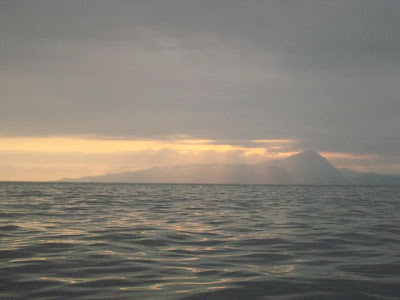 Fernando supplies the beer, and Diego brings his ipod and speakers. By the time we arrive with the pizza, it is growing dark, and the fire is blazing.
 Party may not be the best word for what we are doing, for we don’t really drink much, and the families talk softly as we listen to the music and watch the Sea. I take a brief dip at the water’s edge, and come back to find everyone starting to fall asleep. Time to put out the fire and head back to our hotel.
There is no more perfect a way to end a perfect vacation.


 Then there is the main town, or Centro Storico, nestled on the mountainside 1,000 ft above the Porta.
 It has a square,
 a mermaid fountain,
 charming little alleys
 filled with restaurants,
 shops
shops and galleries,
 and a bakery called Iannini that sells the most amazing cookies I have ever eaten.
 The old town is Maratea Superiore, which sits atop Mt San Biago above cliffs so steep that the road extends out from the rock walls to allow cars to make the climb.
  Overlooking the town is the
  and the rustic but lovely
  Here, we could choose to sit in the shade on the upper beach just outside our room
 along with the salamanders,
 or walk down a short path to the lower beach for a swim.
 We could also join Fabrizio on his sailboat,
 or take the shuttle bus to the larger public beach, which has two cafes, changing areas and kayaks to rent.
 One afternoon, we took the kayaks out along the coast, and the bravest among us swam into a hidden grotto. This, my friends, was everything a vacation should be.
 “But what”, I hear you asking, “do the Italians eat at the beach?”
 Friselle with Tomatoes, Olive oil and Capers


 To be correct, here’s what that thong should look like…
 Remember that the currently marketed vaccines only target 2 of the 12 known strains of HPV that cause cervical cancer. Pap smears are still critical in screening for cervical cancer and detecting precancerous lesions before they become life-threatening.
 the Forum,
 and the Colliseum (Fabulous tour by Steve of
  But by far, the best part of visiting ancient Rome was having a picnic under the olive trees on the Palatine Hill.
 Wanja packed “turtle rolls”
 onto which we piled fresh mozarella, tomatoes and basil, henceforth known as a “Palatine Sandwich”.
 On Sunday, we rented bikes at the train station and rode out along the Appian Way, (which is closed to traffice on Sundays) to the Catacombs. Highly recommended, and a new bike path within the city made it even easier. Then to the Spanish steps and the Trevi Fountain. Sorry, no photos, but here’s a little clip of the Trevi Fountain scene from La Dolce Vita…
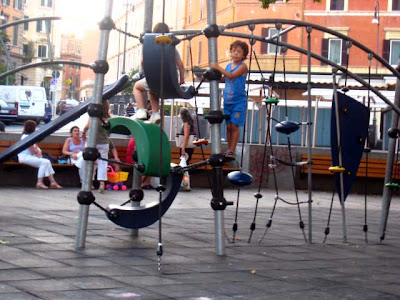
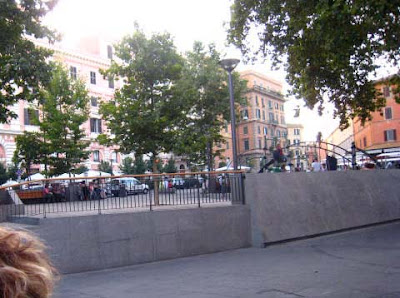 The Piazza has long been home to a local vegetable market, but until recently was also Trastevere’s unoffical parking lot and home to drug dealers. That all changed when the Piazza was
  Now if we had had this at our neighborhood playgound in NYC, my kids would have been there every evening. Heck, I’d be swinging on those swings myself..
 The market in Piazza San Cosamo is a bit quiet these hot summer days, but that doesn’t mean the fruits and vegatables are not just as gorgeous as in the high season.

 If, like us, you are in Rome in late July, you will be just in time for


 Unfortunately, we will miss the rest of the Festival, because we are heading to the beach, with a stop in Villetri along the way.
  Vinci
Vinci The museum is dedicated not to Leonardo’s art, but to his machines – construction machines, optic instruments, fabric looms. They’ve built quite a number of Leonardo’s machines to his exact specifications, including his bicycle and flying machine. This is just a great little museum!
 The kids are actually interested, and we learn how a rack and pinion works, how simple machines can be used to lift large stones with little effort, and how ball bearings reduce friction. This is the physics of everyday life, the stuff I love to explain to the kids. And to see daVinci’s actual notebooks and drawings is magical.
 A quick sandwich in town and we hit the road again. Next stop, Lucca.
 We decide to rent bikes and join in the fun.
 After about an hour of riding, the views of the town from the ramparts begin to tempt Mr TBTAM and I, who want to head down into the town to explore.
 But the kids are enjoying the ramparts too much to come down, and we give in to them and take a break from touring. Emily starts a watercolor of this scene…
 but before she is finished, a nearby church chimes the hour, and she must put away her paints so we can get the bikes back by 8 pm.
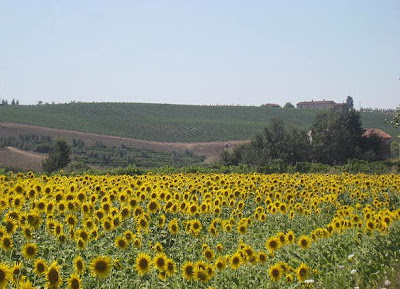 Our Italian hosts head back to Rome, leaving us on our own for a few days. Although we will miss them, we are excited about tackling this country ourselves. We decide to drive to Siena for the day.
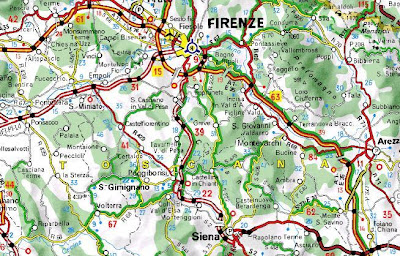 We decide to take rte 22, that green road up there that looks like a straight shot between Florence and Siena. We figure that the 40 kilometer or so drive will take at most 2 hours.
 Panzano in Chianti
 We sit on a large terrace shaded by Wisteria and other vines, overlooking the valley. The ravioli ricotta e spinaci al burro e salvia (ravioli in sage butter) is the best I have ever had in my life – how do they make it so light?
 As we make the turn, an old lady glares out at us from between her curtains. I can almost hear her muttering, “Touristsi…”
 Siena is a medieval city built on a mountaintop in the heart of Tuscany. The heart of the city is restricted to pedestrians, giving it almost a Disneyworld kind of feel. But this is a real town populated year-round and having a vibrant shopping district, a strong arts culture, and a twice-yearly horse race around the Piazza del Campo.
 Mr TBTAM and Emily climb the Tower of the Pallazzo Publico while Nats and I tour the rooms inside. The frescoes there are amazing, and we are quite taken with Ambrogio Lorenzetti’s enormous fresco “Allegory of Good and Bad Government”, which encompasses an entire room.
 We lean in close to look at the detail on the strangely prophetic Bad Government frescoe….
 There is a jazz school in Siena, and they are recruiting students at the Pallazzo. I check out the brochure, but there is no course in scat singing. Too bad, I might have stayed on for that. But students of jazz are everywhere in this town.
 I love everything about it – the zebra striped columns,
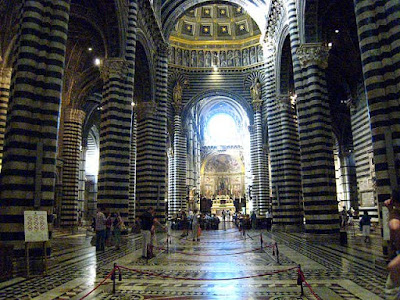 the floors
 and the ceilings.
 But the Duomo is closing, and the sun is setting. We need to get back on the road to make it to Florence before it is too dark to read the poorly lit road signs on the autostrade. So we head back down to the car, strolling a little more slowly than we should, vowing to return someday soon for a longer visit to this lovely town.


 After gorging oursleves on prosciutto and ham and scomorza, we headed out to visit Tempio Maggiore, the only Synagogue in Florence. Definitely worth the trip, and far from the tourist crowds. Moorish design, gorgeous. Security was tight, and they gave the girls shawls to cover their shoulders for the tour. Sorry they forbade cameras inside, but
  Beautiful Oleander growing on a wall across from the Synagogue, and everywhere we went throughout this country. Given how oleander grows here in this hot sunny climate, I am wondering if it would do well on my rooftop, and consider sneaking some cuttings through customs, but reconsider and plan to check it out when I get home…
 and close the rooftop cafe with drinks.
 Dinner is a pizza with anchovies.
 More strolling. gelato for the kids, then home to Boga Pinte.


 Tomorrow – On our own in Sienna and Vinci